


37 Nutrient Parameters: What U.S. Dog Owners Must Check on AAFCO Labels
Learn how AAFCO and FDA rules show up on U.S. dog food labels, how to read the nutritional adequacy statement, and which wording signals feeding trials or...

AAFCO does not approve, test, or certify dog food. A product can legally claim to be “complete and balanced” in the U.S. only if it meets AAFCO’s nutrient profiles or passes an AAFCO feeding trial, and manufacturers must print a nutritional adequacy statement plus a life-stage claim on the label. That statement, not the marketing copy on the front of the bag, is where the real answer lives.
TL;DR:
- Products claiming to be “complete and balanced” must meet AAFCO nutrient profiles or pass a feeding trial, with the claim on the label indicating the method used.
- Compliance relies on industry self-certification, enforced through label laws and inspections by the FDA and state officials, not on direct approval by AAFCO.
- Feeding puppies or dogs with formulas intended for different life stages can lead to nutrient deficiencies or imbalances over time.
- Manufacturers use either laboratory analysis or feeding trials to prove a product meets AAFCO standards, with trials indicating a higher level of real-world validation.
- Careful reading of the nutritional adequacy statement, guaranteed analysis, and ingredient list helps ensure the food aligns with your dog’s specific needs and life stage.
Table of Contents
- What Do AAFCO Dog Food Standards Actually Regulate?
- What Does “Complete and Balanced” Mean Under AAFCO Rules?
- How Do Companies Prove a Food Meets AAFCO Standards?
- How Do You Read the Nutritional Adequacy Statement on a Label?
- How Do You Choose the Right AAFCO-Compliant Food for Your Dog?
- Why Walnut Creek Pet Pays Close Attention to Labeling
- Find Clearly Labeled, U.S.-Made Treats and Supplies
- Where to Verify AAFCO and FDA Rules Yourself
- Sources
What Do AAFCO Dog Food Standards Actually Regulate?
AAFCO, the Association of American Feed Control Officials, writes the model rulebook. It publishes nutrient profiles and definitions that states can adopt into law, but it has no lab, no inspectors, and no approval stamp of its own. That job falls to two other players.
The FDA enforces federal food safety and labeling law for pet food, including misbranding and adulteration cases. State feed control officials, often working out of a state department of agriculture, register products and inspect for compliance at the retail level. In practice, this three-way split works like this:
- AAFCO drafts the standards and definitions used industry-wide
- FDA handles federal enforcement, recalls, and interstate commerce issues
- State officials license products, check labels, and pull samples locally
- Recalls typically start with a manufacturer report or a state finding, then escalate to FDA if there’s a broader safety issue
No single agency “approves” a bag before it hits the shelf. Compliance is largely self-certified by the manufacturer, backed by label law that all three layers enforce.
What Does “Complete and Balanced” Mean Under AAFCO Rules?
“Complete and balanced” means a food supplies every nutrient a dog needs, in the right ratios, without requiring anything else added to the bowl. AAFCO backs that claim with two nutrient profiles for dogs: Adult Maintenance and Growth & Reproduction. A food that satisfies both minimums can be labeled “all life stages,” which covers puppies, adults, and pregnant or nursing dogs at once.
AAFCO nutrient profiles include many distinct nutrient parameters, mostly minimums but some maximums, that a dog food formula must satisfy across both profiles, covering everything from crude protein to zinc and calcium-to-phosphorus ratios.
A few mechanics matter here:
- Values are expressed on a dry-matter basis, meaning moisture is stripped out mathematically so a kibble and a canned food can be compared fairly
- Growth & Reproduction requires higher minimums for things like calcium, phosphorus, and protein than Adult Maintenance
- Feeding an adult-only formula to a growing puppy, or vice versa, can create real nutrient mismatches over months of feeding, not just a minor inefficiency
That last point trips up more owners than you’d expect. A large-breed puppy fed an adult formula misses growth-stage calcium and phosphorus targets that matter for skeletal development.
How Do Companies Prove a Food Meets AAFCO Standards?
Manufacturers have exactly two paths to substantiate a complete and balanced claim, and the label wording tells you which one they used.
Lab-based nutrient analysis checks the finished formula’s chemical composition against the AAFCO profiles and confirms every one of the 37 parameters is met on paper. You’ll see this phrased on the bag as “formulated to meet the nutritional levels established by the AAFCO Dog Food Nutrient Profiles.”
AAFCO feeding trials go further: real dogs eat the food for a defined period under a set protocol, and their health markers are tracked. Look for language like “Animal feeding tests using AAFCO procedures substantiate that [product] provides complete and balanced nutrition.”
- Lab analysis confirms what’s in the food
- Feeding trials confirm the food actually works in a living dog over time
- A feeding-trial product can pass even when its lab-measured nutrient levels differ slightly from profile numbers, because the trial demonstrates real-world adequacy directly
Pro Tip: Neither method is inherently better for every dog, but a feeding-trial claim generally signals more testing investment by the manufacturer. If your dog has a sensitive stomach or a chronic condition, that extra layer of validation can be worth seeking out.
How Do You Read the Nutritional Adequacy Statement on a Label?
The nutritional adequacy statement usually sits near the ingredient list or feeding directions, often in smaller print than the marketing claims up front. Here’s how to work through the whole label in order:
- Find the adequacy statement first. It names the life stage (growth, maintenance, all life stages) and how the claim was substantiated.
- Check the guaranteed analysis. It lists minimum crude protein and fat, maximum fiber and moisture, as if fed. To compare a wet and dry food fairly, convert both to dry-matter basis by dividing each value by the percentage of dry matter (100% minus moisture).
- Scan the ingredient list. Ingredients are ordered by pre-cooking weight, and a claim like “with chicken” only requires 3% chicken by AAFCO’s naming rules, far less than “chicken dinner” or “chicken formula” require.
- Read the feeding directions. They should break amounts down by weight and life stage, not offer one generic scoop size for every dog.
How Do You Choose the Right AAFCO-Compliant Food for Your Dog?
Start with life stage, not brand reputation. A senior dog and a growing Labrador puppy have different nutrient needs even from the same company’s product line, and matching the label’s life-stage claim to your dog’s actual stage is the single biggest lever you control.
Watch for these warning signs on any bag:
- “Complete” or “balanced” language with no adequacy statement anywhere on the package
- Vague ingredient terms like “meat by-products” with no species named
- Feeding directions that skip life stage or give a single flat amount regardless of weight
Pro Tip: If your dog has kidney disease, a food allergy, or another condition requiring a home-prepared or heavily modified diet, research context on formulation and health outcomes supports working with your veterinarian or a board-certified veterinary nutritionist rather than improvising off a label.
Why Walnut Creek Pet Pays Close Attention to Labeling
Walnutcreekpet built its catalog around single-ingredient and minimally processed options because that transparency matters when you’re trying to verify a label yourself. We favor products where the ingredient list is short enough to actually read, and we call out on product pages when something is a treat or supplement rather than a complete diet, so you’re not guessing whether it belongs alongside a full meal or on top of one, like the turkey topper in our lineup.
— Timothy
Find Clearly Labeled, U.S.-Made Treats and Supplies
Once you know what to look for on a dog food label, the same scrutiny pays off with treats and small-animal supplies too. Walnutcreekpet stocks USA-made, single-ingredient items where the label tells you exactly what’s inside, no guessing required.
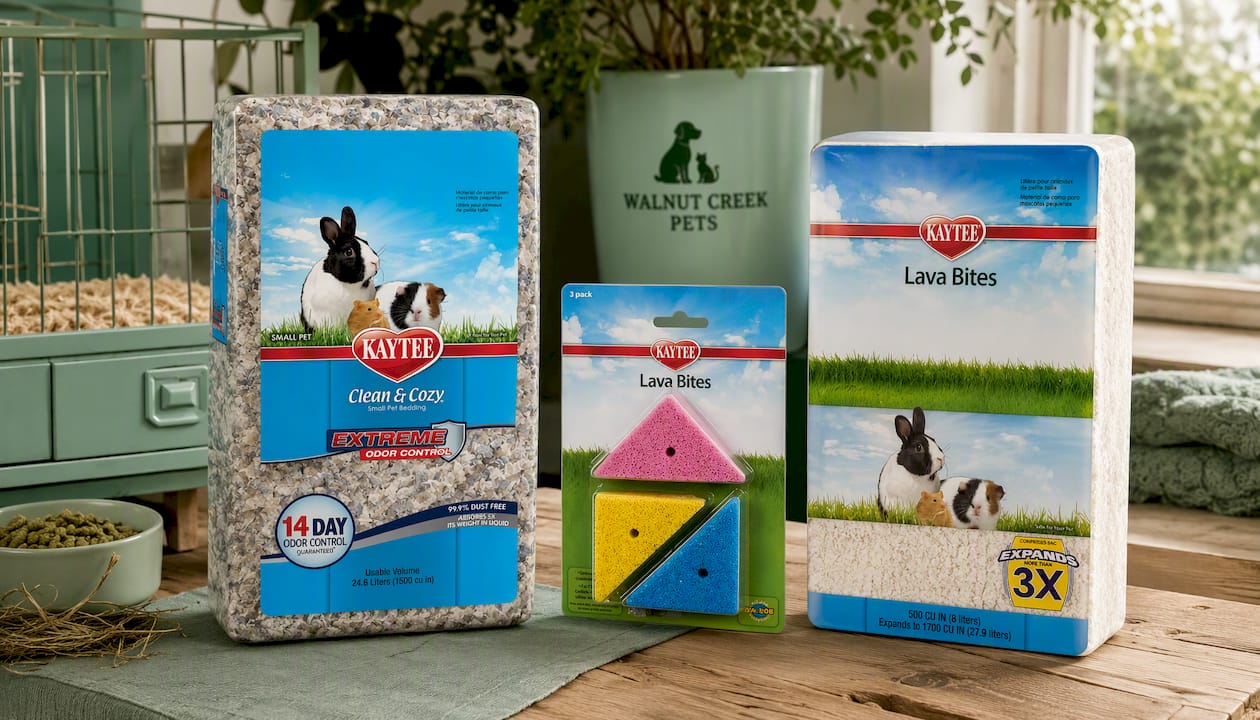
Small-animal owners get the same clarity. The Kaytee Clean and Cozy Small Animal Bedding Extreme Odor 24.6L is built for odor control in cages that see daily use, while the Kaytee Clean & Cozy Small Animal Bedding White 24.6L offers a simpler, unscented option for sensitive pets. For a quick chew that fits between meals, the Kaytee Lava Bites Small Animal Chews 3pk gives small pets something to gnaw on without replacing a full diet. Browse the full catalog at Walnut Creek Pet and check the label details listed right on each product page before you buy.
Where to Verify AAFCO and FDA Rules Yourself
- FDA: Complete and Balanced Pet Food
- AAFCO: Understanding Pet Food
- AAFCO: Frequently Asked Questions
- K-State SRIS Database
Sources
- Complete and balanced pet food | FDA
- Understanding Pet Food | AAFCO
- Frequently Asked Questions | AAFCO


