


78°F, Zero Ammonia: Betta Fish Water Parameters for New Owners
Set 78°F, keep pH near 7, and maintain zero ammonia and nitrite. A numbers-first maintenance plan with weekly tests, safe water changes, and gear picks.

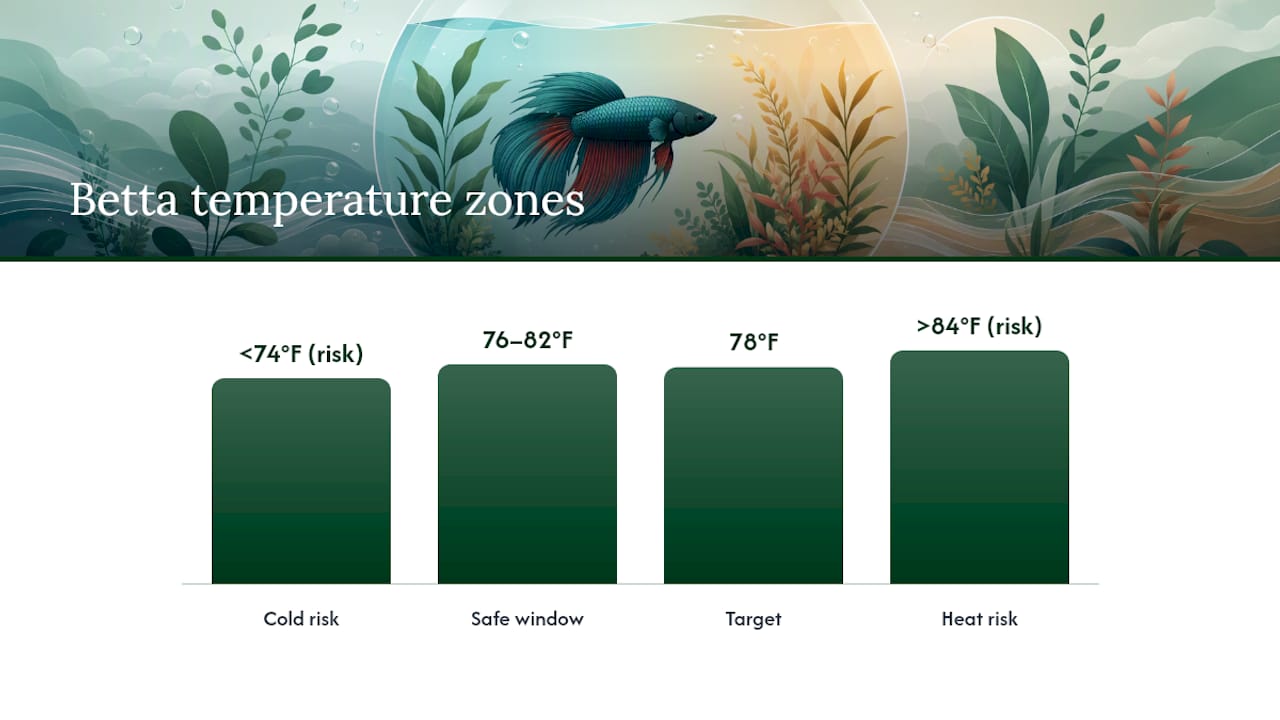
Aim for 78°F, a pH near 7 (6.5 to 7.5 is fine), zero ammonia, zero nitrite, and low nitrate. Water should move gently, never blast from the filter, and you should test weekly once things settle down. Test right now: if ammonia or nitrite reads above 0, do an immediate partial water change and stop feeding until both numbers hit zero.
TL;DR:
- Maintaining stable water parameters is more important than chasing exact numbers, with temperature kept at 78°F and pH near 7 for optimal health.
- Regular testing of ammonia and nitrite levels, ensuring they stay at zero, is crucial to prevent toxic spikes that quickly harm bettas.
- Proper water treatment involves dechlorinating tap water with conditioners rated for chloramine and matching water temperature before each change.
- Weekly water changes of 10 to 30 percent help keep nitrate levels under control and prevent water quality issues.
- Using liquid test kits instead of strips provides more accurate readings, especially for ammonia, nitrite, nitrate, and pH, to catch problems early.
Table of Contents
- Betta Fish Water Parameters: What Each Number Actually Means
- The Nitrogen Cycle: Your Real Water Quality Number to Watch
- How Often to Test Betta Fish Water Quality (And What to Buy)
- Preparing Water: Dechlorinating, Matching Temperature, and Safe Changes
- Weekly Maintenance and Reading Your Betta’s Symptoms
- About This Guide and Walnut Creek Pet’s Approach to Fish Care
- What Actually Matters in Betta Care (An Editorial Take)
- Get Your Betta Fish Water Parameters Right From Day One
- Sources
- FAQ
Betta Fish Water Parameters: What Each Number Actually Means
Getting the numbers right matters less than getting them stable. That’s the part most care sheets bury under a wall of ranges, and it’s the single biggest thing PetMD and other reputable sources agree on: a betta that lives in 76°F water every day does better than one that swings between 74°F and 82°F, even though both numbers fall inside the “acceptable” range.
Temperature: 76 to 82°F, with 78°F as your target
Bettas are tropical fish. In the wild, researchers have recorded habitat temperatures averaging near 86°F, but that’s a survival environment, not a health target, and it comes paired with oxygen levels far too low for a captive tank (FA212, University of Florida IFAS). In your tank, 76 to 82°F is the safe working window, and 78°F is the number to build around. Below 74°F, a betta’s metabolism slows down enough to suppress its immune system, which is why “cold” bettas often develop fin rot or velvet weeks after a heater fails. Above 84°F, oxygen solubility drops and the fish’s metabolism speeds up faster than its gills can keep pace with, leading to stress and shortened lifespan.
A cheap glass thermometer stuck to the tank wall is often off by two or three degrees. A digital probe thermometer, or a heater paired with an external controller, gives you a number you can actually trust. If you’re running a heater on a tank prone to temperature swings, a thermostat controller bracket like the INKBIRD unit keeps the heater from short cycling and holds that 78°F line far more reliably than an uncontrolled heater alone.
pH: aim near 7, tolerate 6.5 to 7.5
PetMD’s guidance suggests bettas tolerate a pH range starting slightly acidic to slightly alkaline, with a target near neutral. Wild bettas actually live in water closer to pH 5.5, according to field data collected in their native range, but that acidity comes bundled with tannin-stained, oxygen-poor water that would stress a captive fish kept in a clean, filtered tank (FA212). Don’t chase the wild number. Chase stability at whatever pH your tap water naturally sits at, as long as it’s inside 6.5 to 7.5.
The trap most new keepers fall into is buying pH-adjusting drops, dosing the tank, and watching the number crash the next day. Unbuffered pH swings are far more dangerous than a “slightly off” pH that holds steady. If your tap water tests at 7.8 and your betta is thriving there, leave it alone.
GH and KH: the numbers nobody explains well
General hardness (GH) measures dissolved calcium and magnesium, the minerals that make water “hard” or “soft.” Carbonate hardness (KH) measures the water’s buffering capacity, which is its ability to resist pH swings. Low KH means your pH can crash overnight after a water change or a bio-load spike; higher KH keeps pH locked in place even as the tank produces acids from fish waste and decomposing food.
Most betta keepers do fine with:
- GH in the 4 to 8 dGH range (moderately soft to moderately hard)
- KH of at least 3 dKH, which gives you a buffer against sudden pH drops
- Testing GH/KH monthly rather than weekly, since these shift more slowly than ammonia or pH
If your tap water tests near zero KH, your pH is essentially unprotected and small waste buildups can crash it fast. A KH test kit is worth the ten dollars it costs, especially if you’ve ever seen an otherwise healthy tank’s pH drop half a point in a week for no obvious reason.
Dissolved oxygen and flow
Bettas breathe air through a labyrinth organ, which lets them survive in stagnant rice paddies and roadside ditches back home. That adaptation is a survival trait, not evidence that your tank should run low on oxygen. IFAS notes that bettas do better in calm water and that heavy filtration can actually stress them, but “calm” doesn’t mean “still” (FA212). Surface agitation still matters for gas exchange and for keeping a biofilm from forming on the water’s surface. A sponge filter or a filter with an adjustable output, like a well-fitted filter basket setup, gives you the biological filtration a betta needs without the current that shreds long fins.
The Nitrogen Cycle: Your Real Water Quality Number to Watch
Ammonia and nitrite are the two numbers that actually kill bettas. Nitrate is the one you manage over time. Understanding why takes about thirty seconds.
Fish waste and uneaten food break down into ammonia, which is toxic even at low concentrations. Beneficial bacteria (mainly Nitrosomonas) convert that ammonia into nitrite, which is also toxic and interferes with a fish’s ability to carry oxygen in its blood. A second group of bacteria (Nitrobacter) then converts nitrite into nitrate, which is far less toxic and gets removed through routine water changes. This is the nitrogen cycle, and it’s the entire reason “new tank syndrome” kills so many bettas in their first two weeks in a home aquarium.
Your working targets, drawn from practical hobbyist guidance (KeepersNook Betta Tank Setup Guide):
- Ammonia: 0 ppm. Any reading above zero calls for an immediate partial water change.
- Nitrite: 0 ppm. Same rule. Nitrite poisoning shows up fast and it shows up ugly.
- Nitrate: under 20 to 40 ppm. This is a management number, not an emergency number. Regular water changes keep nitrate in check.
- Establish the cycle before adding a fish, either through fishless cycling (dosing pure ammonia and waiting for bacteria to establish, typically four to six weeks) or by seeding a new filter with mature media from an established, healthy tank.
- If you skip cycling, stock light, test daily, and expect to do more frequent water changes for the first month while bacteria populations catch up.
If ammonia or nitrite spikes hard in an established tank, something has changed: a dead snail, overfeeding, a filter that got cleaned too aggressively and lost its bacterial colony.
How Often to Test Betta Fish Water Quality (And What to Buy)
Liquid test kits beat test strips for accuracy, full stop. Strips are convenient and fine for a quick sanity check, but they’re notoriously hard to read against their color chart, and small color differences translate into big differences in actual ammonia or nitrite concentration. A liquid kit that tests ammonia, nitrite, nitrate, and pH costs more upfront and lasts for dozens of tests, which makes it cheaper per test than strips within a few months.
What you need to test regularly:
- Ammonia
- Nitrite
- Nitrate
- pH
- Temperature
- GH and KH (monthly is usually enough)
- Chlorine or chloramine in your tap water, at least once, before you set up your conditioning routine
Testing frequency that actually matches your situation:
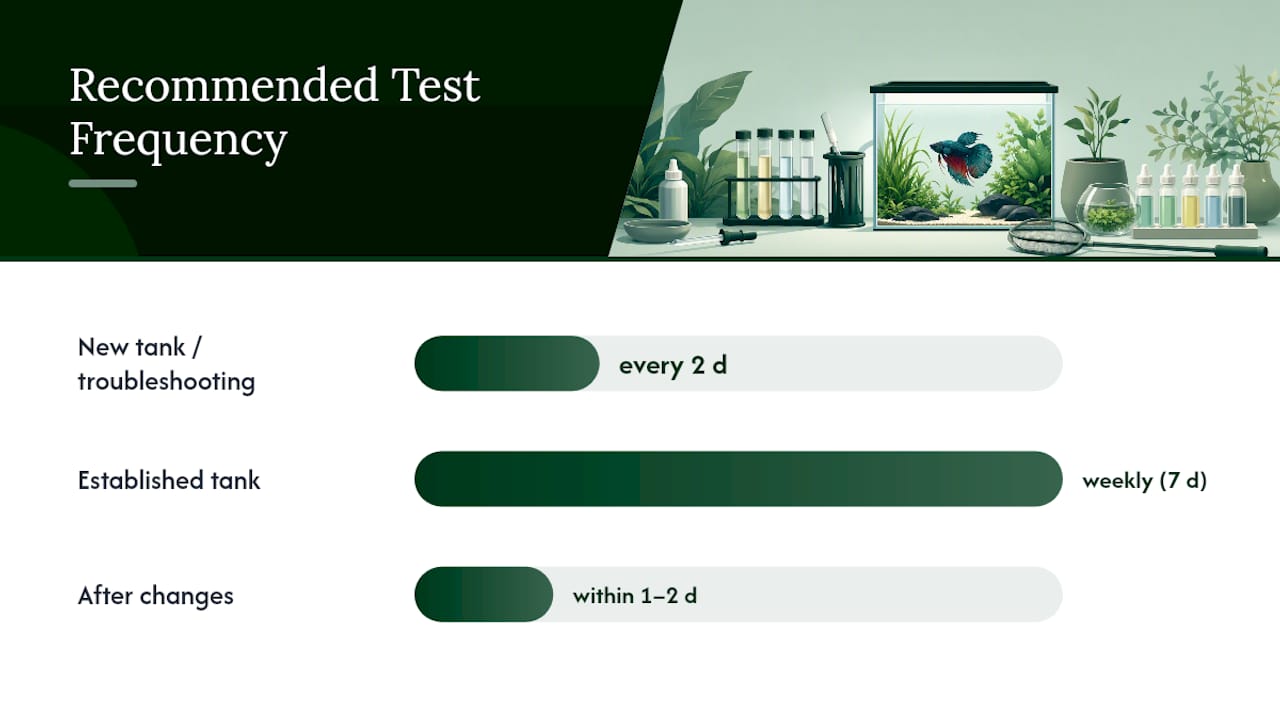
- While cycling a new tank, or troubleshooting a problem: every other day for the first month (KeepersNook).
- Once the tank is established and stable: weekly, matching the schedule PetMD recommends alongside routine partial water changes.
- After any change: new filter media, a new fish, a dosed medication, or a heater swap, test again within 24 to 48 hours.
When a reading comes back out of range, work through it in order: confirm the reading with a second test (kits can give a false high right after dosing conditioner), check your heater and filter are both running, then act. High nitrate means it’s time for your regular water change, just a bit early. A pH that’s drifted more than half a point from its usual reading means check your KH before you touch anything else.
Pro Tip: Keep a simple log, even a sticky note on the tank stand, with the date and your four core numbers. A slow creep in nitrate over three weeks, or a pH that’s drifted down half a point, is nearly invisible test to test but obvious once you see five weeks of numbers stacked in a row. That’s usually how you catch a dying filter or a failing heater before it becomes an emergency.
Preparing Water: Dechlorinating, Matching Temperature, and Safe Changes
Tap water is not betta-ready straight out of the faucet. Municipal water treatment plants add chlorine or chloramine to kill pathogens, and both are toxic to fish and to the beneficial bacteria running your nitrogen cycle.
- Treat every batch of tap water with a conditioner rated for chloramine, not just chlorine. Chlorine dissipates somewhat on its own if water sits out for 24 hours, but chloramine does not break down that way and needs a conditioner that neutralizes both the chlorine and the ammonia it releases.
- Match temperature before you pour. Water that’s more than a couple of degrees off from tank temperature stresses a betta and can trigger temperature shock in worse cases. Run the tap warm or cold until a thermometer reads within a degree or two of your tank.
- Check pH only if you’re topping off from a very different source, like well water or an RO unit. Straight tap-to-tap changes rarely need pH matching if your source water is consistent.
- Change 10 to 20% weekly for a single betta in a filtered, cycled tank, and closer to 25 to 30% weekly for smaller tanks or heavier stocking, a range consistent with common manufacturer guidance for planted and lightly stocked setups (Fluval Betta Care Guide).
- During an ammonia emergency, change water in stages rather than all at once. A full 100% swap strips out the beneficial bacteria clinging to your substrate and decor along with the toxins, which can restart the whole cycle. Two 40% changes spaced a few hours apart do the job without collapsing your biofilter.
Some keepers add Indian almond leaf or similar tannin-releasing botanicals to soften water slightly and nudge pH down, a practice some equipment manufacturers mention as supportive for coloration and mild antimicrobial effect (Fluval Betta Care Guide). It’s optional, cosmetic more than corrective, and not a substitute for actual water changes.
Weekly Maintenance and Reading Your Betta’s Symptoms
A stable betta tank runs on a short, boring checklist, and boring is exactly what you want.
- Test ammonia, nitrite, nitrate, and pH weekly (more often for new tanks).
- Change 10 to 30% of the water weekly, depending on tank size and stocking.
- Rinse mechanical filter media in old tank water, never tap water, to protect the bacteria living on it.
- Replace filter cartridges per the manufacturer’s schedule, staggering old and new media if possible so you don’t wipe out your bacterial colony in one swap.
- Perform routine maintenance such as checking the heater’s accuracy and cleaning filter components regularly.
- Top off evaporated water between changes; in small, evaporation-prone tanks, an automatic top-off unit like the Tunze Osmolator prevents the mineral concentration spikes that come from letting a tank evaporate down and refilling it all at once.
Roughly 3 to 5 watts of heater power per gallon is the standard rule of thumb for keeping a small betta tank at a stable temperature, according to widely used manufacturer guidance (Fluval Betta Care Guide). Undersized heaters struggle to hold 78°F in a drafty room; oversized heaters without a controller can overshoot and cook a small volume of water fast.
Symptoms tell you where to look before a test kit confirms it:
Rapid or labored breathing at the surface usually points to ammonia, nitrite, or genuinely low oxygen, especially in a tank with poor surface movement. Test ammonia and nitrite first.
Clamped fins held tight against the body signal general water quality stress, disease, or a recent harsh change. Cross-check temperature and pH against your log before assuming illness.
Lethargy, sitting on the bottom, faded color often trace back to temperature swings or a pH that’s drifted outside 6.5 to 7.5. Confirm with your thermometer and pH kit before reaching for medication.
If water parameters test clean across the board and symptoms persist for more than a couple of days, that’s the point to involve a vet experienced with fish or a knowledgeable aquatic specialist rather than guessing further. Most betta health problems, though, trace back to one of the numbers above.
About This Guide and Walnut Creek Pet’s Approach to Fish Care
This guide draws on published husbandry research from the University of Florida IFAS Extension and clinical care recommendations from PetMD, cross-checked against practical hobbyist and manufacturer guidance.
Walnut Creek Pet’s catalog runs well beyond aquatics, and a few items illustrate the range hobbyists shop across when they keep multiple pets:
- Marshall Pet Ferret Octo-Play Toy Octopus and the Marshall Pet Ferret Face Toy for ferret enrichment
- Oxbow Enriched Life Timothy Lollipop Apple Chew for small animal dental health
- Stella & Chewy’s Freeze Dried Meal Mixers Surf & Turf for dogs
- Kaytee Clean & Cozy Colors Bedding in Sunset and Plum shades for small animal habitats
- Oasis Vita-Drops for Ferrets and Pretty Pets Sugar Glider Food for exotic small pet diets
None of these are betta care items specifically, but they show the same philosophy applied everywhere Walnut Creek Pet sells: simple, single-ingredient, purpose-built products over generic filler.
What Actually Matters in Betta Care (An Editorial Take)
Most betta care content spends too much time on exact numbers and not enough on the discipline of checking them. A pH of 7.2 versus 7.4 has never killed a betta. A filter that lost its bacterial colony three weeks ago because nobody tested ammonia, that kills bettas constantly, and it’s completely preventable with a five-dollar test kit and a weekly habit.
The conventional advice oversells precision and undersells consistency. Chasing a “perfect” pH with chemical adjusters causes more emergency room visits, so to speak, than water that sits at a stable 7.6 forever. If I had to rank priorities for a new betta keeper, it’s this: cycle the tank first, buy a real liquid test kit before you buy any decor, and treat every water change like it’s the thing keeping the fish alive, because it is. The betta’s flashy fins get all the attention in the store. The nitrogen cycle running invisibly underneath is what actually keeps it alive at home.
— Timothy
Get Your Betta Fish Water Parameters Right From Day One
Getting these numbers right takes the right gear on hand before problems start, not a scramble after ammonia spikes. Heaters, thermostat controllers, gentle filtration, water conditioners, and liquid test kits are available for this kind of setup, alongside discounts for new pet adopters getting a first tank running.
If you’re stocking a starter betta setup, the Kaytee Natural Snack line and other single-ingredient picks in the catalog reflect the same organic, no-filler standard Walnut Creek Pet applies across every species it supports, not just aquatics. Browse the full product catalog to find conditioners, heaters, and test kits sized for your tank, and check the new-adopter discount if you’ve recently brought home any pet, finned or otherwise.
Sources
- FA212: Evolution, Culture, and Care for Betta splendens
- Betta Fish Care Sheet | PetMD
- Betta Tank Setup Guide | KeepersNook
- Betta (Fluval) care guide
FAQ
Can betta fish survive in tap water?
Not straight from the faucet. Tap water usually contains chlorine or chloramine that’s toxic to fish and to the bacteria running your nitrogen cycle, so it needs a conditioner rated for both before it goes in the tank.
What are the do’s and don’ts of betta fish care?
Don’t chase a “perfect” pH with chemicals, skip cycling a new tank, or run a filter with strong current against a betta’s long fins.
How do you prepare water for a betta fish?
Treat tap water with a chlorine and chloramine conditioner, let it match your tank’s temperature within a degree or two, and only worry about pH matching if your source water differs significantly from what’s already in the tank.
Do bettas like shallow tanks?
Bettas survive in shallow water in the wild, but shallow does not mean small or unfiltered. A properly heated, cycled tank of at least a few gallons with stable betta fish water parameters supports far better health than a shallow, unheated bowl.


