




Leaving already?
Can we tempt you with 5$ off your first order?
Min Order of $50


Care Guide & Supplies
Rabbits thrive on high-fiber hay, fresh greens, and quality pellets. Browse our rabbit-specific products below.
Habitat, diet, lighting, troubleshooting and a first-48-hours quick start. Free, no email required — from our family in Lancaster County to yours.

Kaytee Forti-Diet Pro Health Honey Flavor Rabbit Treat Stick 8oz/2pk

Marshall Pet Rabbit Chew Toy with Apple Wood

Oxbow Garden Select Adult Rabbit Food 4lb

A & E Cages Smakers Rabbit & Rodent Triple Pack Treat Stick Veggie/Carob/Fruit, 1ea/3 pk

Kaytee Fiesta Rabbit Food 3.5lbs

Kaytee Fiesta Rabbit Food 6.5lb

Kaytee Fiesta Rabbit Food Flavor Medley 1ea/25 lb

Kaytee Food from the Wild Rabbit 1ea/4 lb

Kaytee Forti Diet Rabbit Food 1ea/5 lb

Kaytee Forti-Diet Pro Health Nourish+Protech Juvenile Rabbit Food 3lb

Why Rabbits Need Room to Stretch and Sprint

Why Rabbits Need Hiding Spots to Feel Secure

Why Chewing Is Essential for Rabbit Health

The Complete Guide to Pet Rabbits: Bonding, Bunny-Proofing, and Building a Routine That Works
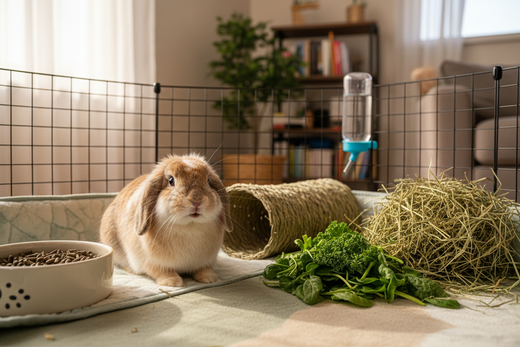
Rabbit Care 101: A Practical Guide to a Healthy, Happy House Rabbit

Hay, Pellets, Greens, and Water: The Rabbit Diet Basics (Plus Leakless Water Bottle Tips)

Rabbit Housing 101: Playpens, Indoor Setups, and Outdoor Rabbit Houses (Safe, Roomy, and Easy to Clean)

Rabbit Nursing & Baby Bunny Basics: What’s Normal, What’s Not, and How to Support Mom Safely
The whole guide, free to read right here — habitat, diet, lighting, troubleshooting and a first-48-hours quick start. No email required.
Welcome to the family! Somewhere between the ears, the nose-nudges, and that first full-body flop onto your living room rug, a rabbit stops being a pet and becomes a member of the household. We wrote this guide because rabbits are one of the most misunderstood animals in America — sold as easy starter pets, then handed husbandry advice that hasn't been updated since 1978. What follows is the real thing: current rabbit welfare and exotics-vet consensus, written plainly, from our family in Christiana, Lancaster County to yours. No mystery ingredients, no mystery advice.
The first two days set the tone for the next decade. Your job right now is not bonding, training, or showing off your new rabbit to the neighbors — it is making the world quiet, safe, and predictable so a prey animal can decide you aren't a threat.
Here's what actually belongs in your cart, described by category so you can shop confidently — look for these features whatever brand you land on.
Ready to set up? Browse the essentials in our collections: Critter Enclosures and Critter Bedding and Accessories.
Enrichment, one click away. Shop Critter Toys and Accessories.
A rabbit is not a small dog, a quiet cat, or a hamster with longer ears. It is a highly social, highly intelligent prey animal with a digestive system that runs on a knife's edge — and once you understand those three facts, almost every care recommendation in this guide starts to make sense.
Lifespan: 8–12 years. A well-housed, spayed or neutered indoor rabbit on a hay-first diet commonly lives into its early teens. That is a dog-length commitment. Plan for it the way you'd plan for a dog: vet budget, vacation coverage, and a decade of daily hay.
Size varies enormously by breed. Netherland Dwarfs and Polish rabbits sit around 2–3 lbs. Mini Rex, Holland Lops, and Dutch rabbits run roughly 3–5 lbs. Standard breeds like the New Zealand, Californian, and English Lop land around 8–11 lbs. Flemish Giants and other giant breeds routinely exceed 14 lbs and can reach 20. Size affects everything downstream — enclosure footprint, pellet portions, nail trim frequency, and how much heat they can tolerate (bigger, heavier-coated rabbits suffer more in summer).
They are crepuscular. Rabbits are built for dawn and dusk. Expect your rabbit to be busiest in the early morning and the evening, and to spend a good chunk of midday dozing with their eyes half-open. This is wonderful news for people who work normal hours and terrible news for anyone expecting an animal that plays on demand at 2pm. Don't mistake a napping rabbit for a sick one — or a sick one for a napping one. Learn your rabbit's normal rhythm so you notice the difference.
Prey-animal body language. Rabbits are near the bottom of the food chain and their bodies never forget it. Reading them correctly is the single best skill you can develop:
Why a rabbit is not a low-maintenance starter pet. We say this with love, because the belief that rabbits are easy has put an enormous number of animals in lonely hutches. A rabbit needs hay refilled and droppings checked daily, a litter area cleaned daily, several hours of out-of-enclosure exercise daily, a companion of its own species in most cases, a rabbit-savvy vet (pricier than a dog-and-cat practice), spay or neuter surgery, and an owner who can spot a gut emergency within hours. They also chew, dig, and redecorate. A rabbit is more demanding than a cat — and wonderful. Just not a beginner's afterthought.
What surprises new owners. How much hay one rabbit goes through. How loud a thump is at 3am. How much personality fits in a four-pound animal — they sulk, hold grudges, and come running for a favorite treat. How litter-trainable they are. How fast an unspayed female's temperament turns at four months. How quickly a quiet rabbit becomes an emergency. And how social they are: a bonded rabbit will spend half its life pressed against another warm body, grooming ears.
Forget everything the pet-store aisle told you about rabbit housing. The pictures on the boxes are not sized for the animals inside them.
Rabbit housing has two parts: the home base (sleeping, eating, litter box) and the exercise space (where they actually run). You need both.
More space is never wasted on a rabbit. A rabbit that cannot run, stretch out flat, stand up, or take three consecutive hops is being kept in a box, however nice the box is.
A standard "rabbit hutch" or pet-store cage runs 24 to 36 inches long — a medium rabbit stretched out is most of that, and three hops puts them at the wall. The consequences are documented: muscle wastage and weak bones, obesity, an inability to reach the hind end to groom (which leads straight to a soiled rear and flystrike risk), stress behaviors like bar-chewing and repetitive circling, and depression that reads as "a calm, quiet rabbit." If your rabbit can't take a running start in it, it's a carrier, not a home.
Solid floors only. Never wire. Wire-bottom caging causes sore hocks (ulcerative pododermatitis — pressure sores and ulcers on the underside of the hind feet), which are painful, slow to heal, and prone to deep infection. Rabbits have no protective pads on their feet, just fur over bone. Good options: sealed plywood or vinyl flooring topped with washable rugs or fleece, interlocking foam tiles covered with fabric, or low-pile carpet remnants you don't mind replacing. Slick surfaces are their own hazard — hardwood and tile give a rabbit nothing to grip, and a panicked scramble on a slippery floor can cause a spinal or leg injury. Cover the main thoroughfares.
Rabbits are tidy animals if you let them be. The standard arrangement, which you can treat as a blueprint:
We strongly recommend indoors. Indoor rabbits live longer, are observed more closely (which matters enormously for catching illness early), and are safe from the three big outdoor killers: predators, parasites, and weather.
Outdoors the risks are specific. Predators — hawks, foxes, raccoons, neighborhood dogs — can kill a rabbit through wire, or kill one from fright alone without touching it. Biting flies cause flystrike; mosquitoes and rabbit fleas carry disease. And a Pennsylvania spring can swing thirty-five degrees in a day. A part-time outdoor rabbit needs a predator-proof structure with a solid roof and a secure latch (raccoons open simple hooks), full-day shade, deep dry winter bedding, a wind break, daily rear-end checks, and the same exercise space and companionship as an indoor rabbit. Never leave one in an outdoor run unsupervised and uncovered.
Rabbits handle cold far better than heat. A dry, draft-free rabbit with deep bedding copes near freezing; the same rabbit can die in an afternoon at 85°F. They don't sweat and don't pant efficiently — they shed heat mostly through their ears. Keep them below about 80°F (27°C), with 60–70°F as the happy zone. Above 80°F, act: towel-wrapped frozen bottles to lean against, ceramic tiles, a fan moving air across (not onto) the enclosure, misted ears, closed blinds, AC if you have it. Long-coated and giant breeds, overweight rabbits, and seniors are at highest risk. Heat stroke is frequently fatal and almost always preventable.
Two rabbits need roughly double the space of one — not the same space shared. Bonded rabbits spend most of the day touching, but they also need the option to walk away, which means two hides, two litter pans, two water bowls, and two feeding spots so neither can guard the resources. A pair kept too tightly will fight, and rabbit fights cause serious injuries and can break a bond permanently.
Two different jobs here: litter goes in the pan to absorb urine and odor, and bedding is the soft, warm material a rabbit rests and burrows in. Some materials do both. The wrong material causes respiratory disease or a fatal blockage, so this is worth getting right the first time.
| Material | Absorbency | Odor control | Best used as | Notes and cautions |
|---|---|---|---|---|
| Paper-based pellets | Excellent | Very good | Litter | Our default recommendation. Dust-free, highly absorbent, safe if nibbled, composts well. Slightly firmer underfoot — pair with a soft mat elsewhere. |
| Shredded or compressed paper bedding | Good | Moderate | Bedding, litter | Soft, warm, excellent for digging boxes and nesting. Needs changing more often than pellets. Avoid glossy or heavily inked printed paper. |
| Aspen shavings | Good | Moderate | Bedding, litter base | The only wood shaving we recommend — a hardwood with no aromatic phenols. Choose kiln-dried, low-dust, and sift out fines. |
| Straw | Poor | Poor | Bedding and insulation only | Hollow stems trap air, which makes it the best cold-weather insulator. Barely absorbs urine, so never use it alone in a litter pan. Not the same as hay and not a food. |
| Hemp bedding | Very good | Good | Bedding, litter | Low dust, very absorbent, soft, naturally resistant to odor, breaks down nicely in compost. Costs more per bag but lasts. |
What to avoid outright:
Depth and cleaning. An inch or two of litter is plenty — rabbits don't bury waste the way cats do. Scoop or change the pan daily (two minutes, and it's the difference between a pleasant house and a pungent one), spot-clean floor and bedding daily, strip and wash everything weekly. White vinegar dissolves the calcium residue rabbit urine leaves behind better than any specialty cleaner.
If you read only one section of this guide, read this one. The overwhelming majority of rabbit illness we hear about — dental disease, gut shutdowns, obesity, soft stool, bladder sludge — traces back to what's in the bowl. Rabbit food is not complicated, but it is counterintuitive, because the cheapest and most boring thing in your cart is also the most important.
Unlimited grass hay, available every hour of every day, making up roughly 80–90% of everything your rabbit eats. Not a side dish. Not a bedding material. The foundation.
Two reasons, both non-negotiable. Fiber keeps the gut moving — a rabbit's digestive tract is a conveyor belt that only works with long-strand fiber traveling through it. Take the fiber away and motility slows, gas builds, and you get GI stasis, the most common way pet rabbits die. And chewing hay wears the teeth down; rabbit teeth grow for life, and the slow side-to-side grinding of coarse hay is the only thing that keeps them at the right length and angle.
A rabbit should eat roughly its own body volume in hay every day. Yes, that's an absurd amount of hay. Buy in bulk.
Good grass hays: timothy, orchard grass, meadow, brome, oat hay, botanical mixes. Rotating two or three keeps a fussy rabbit interested. Look for green color, long intact strands, visible leaf, a sweet smell — and reject anything yellow, dusty, musty, damp, or powdered. Dusty hay irritates the airways; moldy hay can be fatal.
Alfalfa is a special case — a legume, not a grass, much higher in protein and calcium. It suits rabbits under about 6–7 months and pregnant or nursing does, where the extra calories and calcium support growth. For a healthy adult, steady alfalfa contributes to obesity and to calcium-based bladder sludge and stones. Transition to grass hay gradually over a couple of weeks around the 6–7 month mark.
Pellets exist to backfill vitamins and minerals. They're calorie-dense and need almost no chewing, so unlimited pellets make an overweight rabbit with underworked teeth. Measure them.
| Adult body weight | Daily plain pellets (approx.) | Daily fresh leafy greens | Grass hay |
|---|---|---|---|
| 2 lbs (0.9 kg) | 1 tbsp – 1/8 cup | ~1 packed cup | Unlimited |
| 4 lbs (1.8 kg) | ~1/8 – 1/4 cup | ~2 packed cups | Unlimited |
| 6 lbs (2.7 kg) | ~1/4 cup | ~3 packed cups | Unlimited |
| 8 lbs (3.6 kg) | ~1/4 – 1/3 cup | ~4 packed cups | Unlimited |
| 10 lbs (4.5 kg) | ~1/3 – 1/2 cup | ~5 packed cups | Unlimited |
| 12+ lbs (5.4+ kg) | ~1/2 cup | ~6 packed cups | Unlimited |
The rule behind that table: roughly 1/4 cup of pellets per 5–6 lbs of body weight per day and 1 packed cup of leafy greens per 2 lbs of body weight per day, split morning and evening. Rabbits under 6 months get free-fed alfalfa-based pellets alongside unlimited hay, tapering to measured adult portions by 7–12 months. For an overweight rabbit or one refusing hay, cut pellets further under vet guidance — a rabbit full of pellets won't eat enough hay, and the fix is fewer pellets, not more coaxing.
What a good pellet looks like: uniform, plain, green-brown, timothy- or grass-based, crude fiber 18% or higher (22% is better), protein 12–14%, calcium 0.5–1.0%, and no seeds, corn, molasses, dried fruit, nuts, or colored pieces. If you can pick individual ingredients out with your fingers, put it back.
Those colorful mixes — flaked peas, corn, seeds, puffed bits, dried banana — are among the most damaging products sold for rabbits, and veterinary research has been clear on this for years.
The mechanism is selective feeding. Given a mix, a rabbit eats the sweet, starchy pieces first and leaves the fibrous pellet behind — so the actual diet ends up high in sugar and starch and low in fiber. Downstream: less hay eaten (they're already full of calories), so less dental wear and progressive malocclusion (teeth meeting at the wrong angle and growing into points, spurs, or abscesses); disrupted hindgut fermentation, so soft uneaten cecotropes and a messy rear; obesity; and a markedly higher risk of GI stasis. Studies comparing muesli-fed rabbits to hay-and-plain-pellet-fed rabbits found worse dental wear, lower cecotrope consumption, and more gut problems in the muesli group.
If your rabbit is on a mix now, switch gradually over two to four weeks, raising the proportion of plain pellet while keeping hay intake strong. Don't go cold turkey — sudden change is its own risk.
Fresh leafy greens add moisture, variety, and micronutrients. Aim for two to four different types a day, rotated through the week. Introduce anything new one at a time in a small amount and watch the droppings for 48 hours before adding another. Wash everything, and use only fresh, crisp greens — never wilted or slimy.
| Safe for daily rotation | Feed with caution or in moderation | Never feed |
|---|---|---|
| Romaine and other dark leaf lettuces | Kale (high calcium — rotate, don't daily) | Iceberg lettuce (negligible nutrition) |
| Green and red leaf lettuce | Spinach (high in calcium and oxalates) | Rhubarb leaves and stalks |
| Cilantro | Parsley (high calcium) | Avocado (any part) |
| Basil, mint, dill, oregano | Swiss chard (oxalates) | Onion, garlic, leeks, chives |
| Carrot tops and radish tops | Dandelion greens (high calcium, diuretic) | Raw potato, potato peel, and leaves |
| Arugula | Mustard and collard greens (high calcium) | Beans, peas in the pod, corn kernels |
| Endive, escarole, radicchio | Broccoli and broccoli leaves (gas-forming) | Seeds, nuts, and any nut butter |
| Bok choy | Cabbage and cauliflower (gas-forming) | Bread, crackers, cereal, pasta, oats |
| Watercress | Brussels sprouts (gas-forming) | Chocolate and any candy |
| Celery leaves and stalk (cut small) | Bell pepper (fine in moderation) | Yogurt drops and dairy of any kind |
| Fennel fronds | Fresh fruit and carrot (treats only, see below) | Meat, eggs, processed human food |
| Raspberry and blackberry leaves | Beet greens (oxalates) | Lawn clippings from a mower |
Two patterns worth understanding rather than memorizing. High-calcium greens — kale, spinach, parsley, dandelion, mustard greens, collards — are nutritious and fine in rotation, but a diet built on them contributes to bladder sludge and stones, because rabbits absorb and excrete dietary calcium differently than most mammals. Rotate them in; don't make them the base. Gas-forming greens — brassicas, especially broccoli, cabbage, cauliflower, and sprouts — are safe in small amounts for most rabbits but cause painful gas in sensitive ones. Small portions, watch the response.
Grass is excellent — fresh-picked from a pesticide-free area, it's one of the best foods a rabbit can have. But never feed lawn clippings from a mower: they start fermenting immediately and cause severe gut upset.
Rabbits have a serious sweet tooth and no judgment whatsoever. You are the judgment.
Fresh water, changed daily, available always — in a heavy, wide ceramic bowl. Rabbits drink substantially more from an open bowl than from a sipper bottle, where they work at an awkward angle for a trickle, and hydration directly protects against GI stasis and urinary sludge. If you like a bottle for tidiness, provide a bowl too. Check outdoor water for ice twice daily in winter. A rabbit on mostly dry hay drinks a surprising amount, so a sudden change either way belongs in your log and in a call to the vet.
Your rabbit produces two completely different kinds of droppings, and knowing the difference will save you a panicked phone call.
Regular fecal pellets are the ones you see all day: round, dry, firm, uniform, golden to dark brown, essentially odorless, and full of visible fiber. A healthy rabbit makes hundreds a day. These are waste.
Cecotropes are different. Produced in the cecum — a large fermentation chamber where gut bacteria break down fiber — they come out soft, dark, shiny, clustered like a tiny blackberry, and noticeably more pungent. They are food. Cecotropes carry B vitamins, vitamin K, amino acids, and microbial protein a rabbit can't absorb on the first pass, so the rabbit eats them directly from the anus — usually in the early hours or during quiet midday rest — and digests them a second time. This is cecotrophy, and it is essential. Many owners never see one in years of keeping rabbits, because they're eaten the instant they appear.
Cecotropes are not diarrhea. Diarrhea is unformed, watery, uniformly liquid, and a genuine emergency in rabbits — especially in young ones. Cecotropes are distinctly clustered and lobed, with a shiny mucus coating.
When to be concerned: regularly finding uneaten cecotropes squashed on the floor, in the pan, or matted into the fur means something is off. The usual causes are a diet too rich in carbohydrates and too low in fiber (so the rabbit makes more cecotropes than it needs), obesity or arthritis stopping it from reaching its hind end, or dental pain making eating them uncomfortable. The first fix is almost always more hay and fewer pellets and treats. If it lasts beyond a week or two, or the rear is getting soiled, see your vet — a dirty rear end is both a flystrike risk and a sign of something underneath.
Shop the food and supplies: Browse Critter Food Treats & Feed.
Rabbit teeth never stop growing. All 28 of them — incisors at the front, and the premolars and molars in the back that you cannot see without a vet's otoscope — are open-rooted and erupt continuously for the animal's entire life, at a rate commonly cited around 2 mm per week for the incisors. That's roughly an inch of new tooth per rabbit per season.
The only thing that keeps pace is grinding coarse fiber. A rabbit chewing hay makes thousands of side-to-side jaw movements an hour, and that specific motion wears the cheek teeth evenly against each other. This is why hay matters more than any chew toy you can buy. Willow balls, wooden blocks, and apple sticks are genuinely valuable — enrichment, a gnawing outlet, good for the incisors — but they're chewed front-to-back, which does little for the molars at the back of the mouth, exactly where the worst dental disease develops. No amount of chew toys compensates for a low-hay diet.
Malocclusion means the teeth no longer meet correctly, so they grow unopposed and unworn. Incisors overgrow into tusks that curl out of the mouth or up into the nostrils. Cheek teeth grow razor-sharp spurs that lacerate the tongue and cheeks, or their roots push the wrong way into the jaw and eye socket, producing abscesses and weepy eyes. It is extremely painful and it is progressive. Causes: genetics (short-faced dwarf and lop breeds are predisposed), low-fiber diet, and trauma from a fall or from pulling against cage bars.
Signs to watch for — any one of these warrants a vet appointment:
Check the front incisors yourself monthly — lift the lip and see whether the top pair overlaps the bottom pair cleanly. The back teeth need a vet, at every annual checkup and more often for a short-faced breed or any rabbit with a dental history. Caught early, malocclusion is managed with periodic burring under sedation plus an aggressive hay-first diet. Caught late, it becomes abscesses, extractions, and chronic pain.
Rabbits hide illness as a survival instinct. By the time a rabbit looks sick, it has usually been unwell for a while — so your advantage is knowing the early signs cold.
What you see: A rabbit that stops eating or eats much less. Few or no droppings, or droppings suddenly tiny and misshapen. Hunched, belly pressed to the floor, loud tooth grinding, unwilling to move, abdomen gurgling or completely silent. They may refuse even a favorite treat.
Why: Gut motility slows or stops. Low fiber, dehydration, stress, pain from something else (dental disease is a very common trigger), or a sudden diet change stalls the conveyor belt. Gas builds, gut contents dry out, harmful bacteria overgrow, and the pain makes the rabbit eat even less — a spiral that turns fatal.
What to do: Treat it as urgent from the first missed meal. Offer every tempting green and fresh grass you have, encourage water, keep the rabbit warm and quiet. No home remedies without veterinary direction — and never force-feed or massage the abdomen of a rabbit that might have a true blockage, which needs different and immediate treatment.
Call a vet: If a rabbit has not eaten or passed droppings for 12 hours, that is an emergency — today, not tomorrow. Earlier if the rabbit is also hunched, grinding its teeth, or lethargic. Rabbits can deteriorate from "a bit quiet" to critical in under a day.
What you see: Pellets eaten, hay ignored. Dropping food, drooling, a wet chin, weepy eyes, facial lumps, weight loss, eating only soft things.
Why: Continuously growing teeth not being worn down evenly — usually too little hay, sometimes breed conformation or past trauma. Spurs form on the cheek teeth and cut the tongue and cheeks.
What to do: Raise hay intake immediately, cut pellets and treats, and offer several hay types to find one they'll eat. That manages risk but doesn't fix existing overgrowth.
Call a vet: As soon as you notice any of those signs. Overgrown teeth need burring under sedation — you cannot clip or file them at home, and attempting it causes fractures.
What you see: Nails curling sideways or hooking, catching on fabric, clicking on hard floors, splayed toes, a changed gait.
Why: Pet rabbits don't dig and run on abrasive ground the way wild ones do, so nails keep growing. Left long they twist the toes, hurt, and can tear off into the quick.
What to do: Trim every 4–6 weeks. Shine a light behind a pale nail to find the pink quick and cut 2–3 mm beyond it; on dark nails take small slivers. Keep styptic powder handy. If you're nervous, most vet and grooming practices do it quickly and cheaply.
Call a vet: If a nail is torn, bleeding persistently, infected, or so overgrown it has deformed the toe.
What you see: Bald patches on the underside of the hind feet, then redness, scabbing, or open ulcers. Reluctance to hop, shifting weight, sitting oddly.
Why: Pressure and friction on skin that has no protective pad — wire flooring, hard or abrasive surfaces, damp or dirty bedding, obesity, inactivity, or naturally thin foot fur (Rex and large breeds are predisposed).
What to do: Remove all wire flooring permanently. Deep, soft, dry bedding and washable mats over hard floors. Keep it dry, manage weight, encourage exercise.
Call a vet: As soon as skin is broken or inflamed. Sore hocks become deep, bone-involving infections that are very difficult to resolve. Early intervention matters.
What you see: Rapid shallow breathing, panting, wet nose and mouth, hot or very red ears, drooling, lethargy or collapse, stretched out flat and refusing to move.
Why: Rabbits dump heat through their ears and little else. Above roughly 80°F, especially with humidity, body temperature climbs fast.
What to do: Act immediately — move them somewhere cool, mist or wipe the ears with cool (not ice-cold) water, offer water, set a towel-wrapped frozen bottle beside them, move air gently over them. Never submerge a rabbit in cold water; the shock can kill.
Call a vet: Immediately, during first aid, not after. Heat stroke causes organ damage that needs treatment even if the rabbit seems to perk up.
What you see: Damp, soiled, or urine-stained fur around the rear. Tiny yellowish-white eggs like rice grains at the skin, then maggots in the skin. The rabbit may be quiet, hunched, or suddenly collapsed.
Why: Blowflies lay eggs on damp, soiled fur. Larvae hatch within hours and eat into living tissue, releasing toxins — a rabbit can go from fine to critical in under 24 hours. Highest risk: overweight rabbits, arthritic or dental-compromised rabbits who can't groom their rear, rabbits with soft stool, and any rabbit outdoors in warm weather.
What to do: Prevention is everything. Check the rear end and tail base every single day in warm months, twice daily for outdoor rabbits. Keep the enclosure bone dry, fix whatever is causing a soiled rear (diet, weight, dental pain), and clip the rear coat short on long-haired rabbits in summer.
Call a vet: The moment you see eggs or maggots — this is a true emergency requiring immediate veterinary care. Do not try to pick them out and wait.
What you see: Head tilt, loss of balance, rolling, rapid flicking eye movements, hind-limb weakness or partial paralysis, urine scalding from incontinence, cloudy white spots in the eye, or cataracts in a young rabbit.
Why: A microscopic parasite, extremely common in the pet rabbit population and carried silently by many healthy rabbits. It spreads through urine and from doe to kit, usually only causing disease when the immune system is stressed, and it targets the brain, kidneys, and eyes.
What to do: Make the space fall-safe — low sides, padding, food and water within easy reach — and support eating and hydration. Treatment is a course of a specific anti-parasitic plus supportive care, prescribed by a vet.
Call a vet: Same day for any head tilt, balance loss, or hind-limb weakness. Head tilt has several possible causes (inner ear infection being the other common one), they look similar, and the treatments differ.
What you see: Often nothing until late — then bloody or unusual discharge, a swollen abdomen, reduced appetite, lethargy, or a mass you can feel. Unspayed does also commonly show false pregnancies, nest building, and territorial aggression.
Why: Uterine adenocarcinoma is strikingly common in intact does. The figure most cited in rabbit medicine is that a majority of unspayed females — often quoted as up to around 60% or more — develop it by about five years old; newer surveys suggest the true rate may be lower than those classic figures, but every source agrees the risk is substantial and climbs steeply with age. It spreads to the lungs.
What to do: Spay her. An elective spay at about 4–6 months removes the risk almost entirely and is far safer than cancer surgery on a sick senior rabbit. Spaying later in life is usually still possible — discuss it with your vet.
Call a vet: Immediately for any bloody discharge, abdominal swelling, or abdominal mass in an unspayed doe. And proactively, right now, to schedule the spay.
What you see: Sneezing, thick white or yellow discharge from the nose or eyes, crusty matted front paws from wiping the face, noisy or labored breathing, head shaking, reduced appetite.
Why: Usually bacterial — Pasteurella multocida is the classic culprit, with Bordetella and others involved. Poor ventilation, ammonia from a dirty enclosure, dusty hay or bedding, cedar and pine shavings, and stress all predispose, and dental root infections or blocked tear ducts produce the same picture.
What to do: Fix the environment — dust-free bedding, ventilation without drafts, daily litter changes, clean hay. Isolate from other rabbits until a vet has weighed in, since some causes are contagious.
Call a vet: For any colored nasal discharge or labored breathing. Rabbits are obligate nose-breathers, so a blocked nose is more serious for them than for us. "Snuffles" needs culture-guided antibiotics; it rarely resolves on its own and can become chronic.
What you see: A reliably clean rabbit suddenly scattering droppings, spraying urine up walls, or toileting in a new corner.
Why: Usually one of three things. Hormones — intact rabbits mark territory, typically starting at 3–5 months. Territory change — new furniture, a new pet, a rearranged enclosure, a new room opened up. Or a medical problem — urinary tract infection, bladder sludge or stones, arthritis making the pan hard to climb into, or diarrhea.
What to do: Spay or neuter — it resolves most marking. Clean soiled spots with white vinegar to erase the scent marker. Put a pan in whichever corner they chose rather than fighting it, keep hay in or beside the pan, use low sides for seniors, and expand roaming territory gradually. Scatter droppings into the pan to re-mark it, and never punish.
Call a vet: If there is straining, blood in the urine, a thick chalky white urine deposit, dribbling, a wet rear end, or if an altered rabbit with previously perfect habits regresses with no environmental explanation.
What you see: Lunging, grunting, boxing with the front paws, nipping, circling your feet and honking, mounting, sudden territorial defense of the enclosure — often from a rabbit who was sweet last month. Usually starts at 3–5 months.
Why: Sexual maturity. These are normal hormone-driven territorial and mating behaviors, not a character flaw and not something you did. Occasionally the real cause is fear (from being grabbed repeatedly) or pain.
What to do: Spay or neuter and give it time — behavior usually settles over 4–8 weeks as hormones clear. Meanwhile: stop reaching in to grab them, interact at floor level, let them approach you, never chase or corner, and hand-feed greens to rebuild trust. Treat the enclosure as a space you don't invade while they're in it.
Call a vet: If aggression appears suddenly in an already-altered adult rabbit, or comes with hunching, tooth grinding, or appetite change — unexplained aggression in a previously calm rabbit is often pain.
| What you see | Likely cause | What to do | Urgency |
|---|---|---|---|
| Not eating, no droppings 12+ hrs | GI stasis | Tempt with fresh greens, keep warm, go in | Emergency — same day |
| Eats pellets, refuses hay | Dental pain or malocclusion | Vet dental exam; raise hay, cut pellets | Days |
| Soft, uneaten cecotropes | Too much pellet or treat, too little fiber | Cut pellets and fruit, increase hay | Week; vet if persistent |
| Watery diarrhea | Dietary upset, infection, parasites | Vet now; fatal fast in young rabbits | Emergency |
| Hot ears, panting, flat out | Heat stroke | Cool ears, airflow, vet immediately | Emergency |
| Eggs or maggots at the rear | Flystrike | Vet immediately | Emergency |
| Head tilt, rolling, falling | E. cuniculi or inner ear infection | Pad the space, vet same day | Same day |
| Colored nasal or eye discharge | Respiratory infection | Vet; improve ventilation and bedding | Days |
| Bloody discharge, unspayed doe | Uterine disease | Vet immediately | Emergency |
| Bald, red, or ulcerated hind feet | Sore hocks | Remove wire, soft dry bedding, vet | Days |
| Sudden lunging and spraying | Hormones | Spay or neuter; stop handling from above | Weeks |
| Clicking, curling nails | Overgrown nails | Trim every 4–6 weeks | Weeks |
Rabbits shed heavily — a couple of big molts a year plus smaller ones, often coming off in patches that leave a rabbit looking moth-eaten. Because rabbits groom constantly and cannot vomit, every swallowed hair has to pass all the way through the gut. In a rabbit eating plenty of hay, it does. In one on a low-fiber diet, or already slowing down, swallowed fur binds with dry gut contents into a mat — wool block — which is both a cause and a consequence of GI stasis.
Your defenses are brushing and hay. Comb daily during a molt (every few days otherwise) and gently pluck loose tufts with your fingers — on a molting rabbit it comes away easily. Long-coated breeds like Angoras need daily attention year-round plus a summer clip. And keep hay intake high through molt season; fiber is what carries the fur through.
One of the firmest rules in rabbit care. Do not put a rabbit in water. Rabbits panic, and a thrashing rabbit can break its own back or dislocate a hip. Beyond injury, a wet rabbit's dense coat takes hours to dry — hypothermia — and wet skin gets infected fast. Rabbits are meticulous self-groomers and don't need bathing.
For a dirty rear, use a dry clean: cornstarch-based small-animal powder worked in and gently combed out. If moisture is genuinely needed, spot clean only — a damp cloth on one small area, dried immediately — then work out why the rabbit is getting dirty, because a chronically soiled rear end is always a symptom of something else.
Every 4–6 weeks, and easiest with two people: one holding the rabbit supported against their body, one trimming. Many rabbits do best wrapped snugly in a towel with one foot out at a time. Light behind a pale nail shows the pink quick — cut 2–3 mm past it; on dark nails take small slivers. Keep styptic powder ready. Short calm sessions, one or two feet a day if needed, beat a single wrestling match.
Most rabbits hate being picked up, because being lifted off the ground is exactly what a predator does. Interact at floor level and lift only when you must.
When you do: one hand under the chest, the other firmly supporting the hindquarters, and bring the rabbit straight in against your body, feet toward you, head tucked into your elbow. The hind end must always be supported — a rabbit's hind legs are extraordinarily powerful relative to a fine, lightweight skeleton, and an unsupported kick can fracture the spine. Stay low to the ground or sit down first so a struggle means a short drop. If the rabbit panics, crouch and release it gently rather than gripping harder.
Never lift a rabbit by the ears. Ears are delicate cartilage full of blood vessels — it is painful and injurious, full stop. Never lift by the scruff either; rabbits have loose skin that tears, and unlike a kitten, an adult rabbit's weight is not designed to hang from its neck.
Placed on its back, a rabbit often goes completely still and limp. That is tonic immobility — a hardwired prey response to being caught, far closer to playing dead than to calm. Research measuring heart rate, respiration, and stress hormones in "tranced" rabbits shows a fear state, not a relaxed one. Don't use it for entertainment or as routine restraint for grooming and nail trims. If a procedure genuinely needs a rabbit on its back, that's a conversation with your vet.
Health. Spaying removes the risk of uterine adenocarcinoma — common and often fatal in intact does — plus uterine infections and false pregnancies. Neutering eliminates testicular cancer and reduces the fighting that leads to abscesses.
Behavior. It dramatically reduces urine spraying, territorial marking, aggression, lunging, nipping, and relentless mounting. It's the single most effective fix for a rabbit who "turned mean" at four months, and it's what makes reliable litter training and free-roaming possible in a family home.
Companionship. Intact rabbits generally can't be safely housed together. Altered rabbits can — and that unlocks the biggest welfare improvement available to a pet rabbit.
Timing: bucks from around 3.5–4 months, once the testicles have descended; does from around 4–6 months. Choose a vet who routinely does rabbit surgery with rabbit-appropriate anesthetic protocols — ask directly how many rabbit spays they perform. Expect a quiet week or two, watch the incision, and above all confirm they are eating and passing droppings within the first 24 hours, because post-surgical gut slowdown is the main complication.
Rabbits are obligately social. In the wild they live in warrens, spending their lives in physical contact — grooming, lying flank to flank, taking turns on lookout. A single pet rabbit, even with a devoted owner, is alone for the great majority of its day, and the behavioral evidence is strong: depression, lethargy, reduced appetite, destructive and repetitive behavior, over-attachment. Current welfare guidance from RWAF and the House Rabbit Society alike treats compatible pairs or small groups as the default, not the exception.
The best pairing is usually a neutered male with a spayed female. Same-sex pairs can work, especially littermates raised together and altered early, but carry more friction. Never house an intact pair together unless you want kits — a doe can conceive again within days of giving birth.
Bonding is a process, not an introduction, and it takes anywhere from days to a couple of months.
If bonding stalls or turns genuinely violent, get help from a rabbit rescue — many offer bonding services. And adopting an already-bonded pair is the easiest path of all, plus it gives two rabbits a home at once.
| Frequency | Tasks |
|---|---|
| Daily | Top up grass hay so it never runs out; change water; feed measured pellets and fresh greens; scoop or change the litter pan; check appetite and count droppings loosely; check the rear end is clean and dry; provide 4–5+ hours of exercise outside the home base; a quick hands-on look at eyes, nose, and breathing |
| Weekly | Strip and wash the enclosure, bowls, and litter pan (white vinegar for urine scale); wash fabric mats and bedding; weigh the rabbit if you can and log it; rotate chew toys and refresh the digging box; check hay stores for mold or damp; brush (daily during a molt) |
| Monthly | Nail check and trim every 4–6 weeks; lift the lip and check the front incisors; run hands over the whole body feeling for lumps, scabs, mats, or sore spots; check the underside of the hind feet; assess body condition — ribs and spine should be easy to feel but not sharp; deep-clean the enclosure and surrounding floor |
| Seasonally | Summer: set up cooling (tiles, frozen bottles, fans, shade) and check the rear twice daily for flystrike risk; clip the rear coat on long-haired rabbits. Winter: extra deep bedding, draft-proofing, check water for freezing twice daily. Spring and fall: expect a heavy molt — daily brushing and extra hay |
| Annually | Full veterinary wellness exam including a proper dental check of the back teeth; discuss RHDV2 vaccination availability in your state; review diet and weight; twice yearly for rabbits over 5 or with any dental, respiratory, or mobility history |
Some things can wait for a weekday appointment. These cannot. Go today — call the nearest rabbit-savvy or emergency exotics clinic now if you see:
And book a routine appointment within a few days for: gradual weight loss, refusing hay while still eating pellets, drooling or a wet chin, colored nasal or eye discharge, persistently uneaten cecotropes, a soiled rear end, sneezing, scratching or flaky skin, bald patches, lameness, broken skin on the hind feet, or any behavior change you can't explain.
Keep two numbers on your fridge: your regular rabbit vet, and a 24-hour emergency exotics clinic. Most general small-animal practices do not treat rabbits confidently, and sorting that out at 11pm is not when you want to start looking.
As much as it wants, all day, with none of it ever running out — hay should be about 80–90% of everything your rabbit eats. A practical benchmark is a pile roughly the size of your rabbit's own body every day. If your rabbit isn't eating that much hay, the usual reason is that it's filling up on pellets, treats, or greens instead, so cut those back before you worry about the hay itself.
Dark leafy greens are the backbone: romaine and other leaf lettuces, cilantro, basil, mint, dill, arugula, endive, bok choy, watercress, carrot tops, and fresh herbs. Rotate two to four different types daily and introduce anything new one at a time, in a small amount. Go easy on high-calcium greens like kale, spinach, parsley, and dandelion, and on gas-forming brassicas like broccoli and cabbage. Never feed iceberg lettuce, rhubarb, avocado, onion, garlic, raw potato, beans, seeds, or nuts.
They can survive alone, but most do considerably worse for it. Rabbits are deeply social animals that in the wild spend their whole lives in physical contact with others, and solitary pet rabbits commonly show signs of depression, lethargy, and destructive or repetitive behavior. Current welfare guidance treats a compatible bonded pair as the default, not a luxury. If a single rabbit is your only option, it needs substantially more of your time and daily interaction to compensate.
Bigger than almost anything sold as a rabbit cage. Aim for at least about 12 square feet of continuous floor for a single small-to-medium rabbit — 4 ft by 3 ft — tall enough to stand fully upright, plus 24–32 square feet of separate exercise space available for a minimum of 4–5 hours every day. Double that for a bonded pair or a large breed; the UK welfare benchmark is roughly 10 ft by 6 ft by 3 ft of accessible space for a pair, at all times. A rabbit-proofed room with free-roam access is easier and better than any cage.
It depends where you live. In the UK and much of Europe, rabbits are routinely vaccinated against myxomatosis and rabbit hemorrhagic disease. In the United States, a vaccine for RHDV2 — a highly contagious and usually fatal virus now present in parts of the country — has been available under USDA conditional licensing, with availability varying by state and veterinarian. Ask your rabbit vet directly what is available and recommended in your area, especially if your rabbit ever goes outdoors.
Treat this as serious from the very first missed meal. A rabbit that stops eating is usually either in GI stasis, in dental pain, or in pain from something else — and because reduced gut motility is itself dangerous, the not-eating quickly becomes its own emergency regardless of what started it. Check for droppings, offer fresh greens and grass, and if your rabbit hasn't eaten or passed droppings in 12 hours, that is a same-day veterinary emergency.
Yes, and they take to it readily — rabbits naturally choose one or two corners as a toilet. Put a low-sided pan in the corner they've already picked, keep hay in or right beside it (rabbits eat while they go), use paper-based or aspen litter, and scatter a few of their droppings in to mark it. Spaying or neutering makes an enormous difference, since most scattering and spraying is hormonal territory marking. Expand their roaming space gradually and clean accidents with white vinegar to erase the scent cue.
A well-cared-for indoor rabbit typically lives 8–12 years, and spayed or neutered rabbits on a hay-first diet often reach their early teens. Smaller breeds tend toward the longer end, giant breeds the shorter. This is a dog-length commitment, not a short-term pet — plan for a decade of daily hay, annual vet visits, and vacation coverage.
In the great majority of cases, yes. A bonded partner provides the constant grooming, contact, and security that no human schedule can replicate, and bonded rabbits are visibly calmer and more confident. The best combination is usually a neutered male with a spayed female, both altered before you attempt bonding. Adopting an already-bonded pair from a rescue is the simplest route, and many rescues will help you bond a single rabbit to a new partner.
A hard hind-foot thump is an alarm signal — in the wild it warns the warren of danger, and in your living room it usually means your rabbit heard, saw, or smelled something it didn't like. Rabbits also thump out of pure indignation: you moved their box, you took too long with dinner, you had the audacity to vacuum. Occasional thumping is normal communication. Constant thumping paired with hiding, not eating, or a hunched posture is worth investigating, because fear and pain can look similar from across the room.
Ready to shop? Start with Critters!. 10% of every purchase supports no-kill animal shelters. Not sure this is the right pet? Compare your options in our Small Animal Guide.
Here's the part we're proudest of: before we take a dime, 10% of every single purchase goes to no-kill animal shelters across the country. Not a rounding-up prompt at checkout, not a campaign we run once a year — it's built into every order, every day. Rabbits are among the most surrendered and most overlooked animals in American rescue, usually by people who were told they'd be easy. So when you buy hay from us, you're feeding your rabbit and backing the people cleaning up after that myth.
We're a family in Christiana, Lancaster County, Pennsylvania, and we built Walnut Creek Supply around what we actually believe in: clean-label food with no mystery ingredients, goods made by real American families, and care advice honest enough to tell you when a pet is harder than the box claims. Our own kids grow vegetables and tend an orchard out back — self-sufficiency isn't a marketing angle here, it's just Tuesday.
If you get stuck, ask us. Call (717) 983-8069 or reach out through walnutcreeksupply.com — a real person who keeps animals will answer you, and we'd much rather talk you through a hay question now than hear about a vet bill later.
Thanks for giving a rabbit a genuinely good life. Here's to a decade of binkies.
— The Walnut Creek Supply family
As much as it wants, all day, with none of it ever running out — hay should be about 80–90% of everything your rabbit eats. A practical benchmark is a pile roughly the size of your rabbit's own body every day. If your rabbit isn't eating that much hay, the usual reason is that it's filling up on pellets, treats, or greens instead, so cut those back before you worry about the hay itself.
Dark leafy greens are the backbone: romaine and other leaf lettuces, cilantro, basil, mint, dill, arugula, endive, bok choy, watercress, carrot tops, and fresh herbs. Rotate two to four different types daily and introduce anything new one at a time, in a small amount. Go easy on high-calcium greens like kale, spinach, parsley, and dandelion, and on gas-forming brassicas like broccoli and cabbage. Never feed iceberg lettuce, rhubarb, avocado, onion, garlic, raw potato, beans, seeds, or nuts.
They can survive alone, but most do considerably worse for it. Rabbits are deeply social animals that in the wild spend their whole lives in physical contact with others, and solitary pet rabbits commonly show signs of depression, lethargy, and destructive or repetitive behavior. Current welfare guidance treats a compatible bonded pair as the default, not a luxury. If a single rabbit is your only option, it needs substantially more of your time and daily interaction to compensate.
Bigger than almost anything sold as a rabbit cage. Aim for at least about 12 square feet of continuous floor for a single small-to-medium rabbit — 4 ft by 3 ft — tall enough to stand fully upright, plus 24–32 square feet of separate exercise space available for a minimum of 4–5 hours every day. Double that for a bonded pair or a large breed; the UK welfare benchmark is roughly 10 ft by 6 ft by 3 ft of accessible space for a pair, at all times. A rabbit-proofed room with free-roam access is easier and better than any cage.
It depends where you live. In the UK and much of Europe, rabbits are routinely vaccinated against myxomatosis and rabbit hemorrhagic disease. In the United States, a vaccine for RHDV2 — a highly contagious and usually fatal virus now present in parts of the country — has been available under USDA conditional licensing, with availability varying by state and veterinarian. Ask your rabbit vet directly what is available and recommended in your area, especially if your rabbit ever goes outdoors.
Treat this as serious from the very first missed meal. A rabbit that stops eating is usually either in GI stasis, in dental pain, or in pain from something else — and because reduced gut motility is itself dangerous, the not-eating quickly becomes its own emergency regardless of what started it. Check for droppings, offer fresh greens and grass, and if your rabbit hasn't eaten or passed droppings in 12 hours, that is a same-day veterinary emergency.
Yes, and they take to it readily — rabbits naturally choose one or two corners as a toilet. Put a low-sided pan in the corner they've already picked, keep hay in or right beside it (rabbits eat while they go), use paper-based or aspen litter, and scatter a few of their droppings in to mark it. Spaying or neutering makes an enormous difference, since most scattering and spraying is hormonal territory marking. Expand their roaming space gradually and clean accidents with white vinegar to erase the scent cue.
A well-cared-for indoor rabbit typically lives 8–12 years, and spayed or neutered rabbits on a hay-first diet often reach their early teens. Smaller breeds tend toward the longer end, giant breeds the shorter. This is a dog-length commitment, not a short-term pet — plan for a decade of daily hay, annual vet visits, and vacation coverage.
In the great majority of cases, yes. A bonded partner provides the constant grooming, contact, and security that no human schedule can replicate, and bonded rabbits are visibly calmer and more confident. The best combination is usually a neutered male with a spayed female, both altered before you attempt bonding. Adopting an already-bonded pair from a rescue is the simplest route, and many rescues will help you bond a single rabbit to a new partner.
A hard hind-foot thump is an alarm signal — in the wild it warns the warren of danger, and in your living room it usually means your rabbit heard, saw, or smelled something it didn't like. Rabbits also thump out of pure indignation: you moved their box, you took too long with dinner, you had the audacity to vacuum. Occasional thumping is normal communication. Constant thumping paired with hiding, not eating, or a hunched posture is worth investigating, because fear and pain can look similar from across the room.
Every rabbit article we've published, in one place.