



Leaving already?
Can we tempt you with 5$ off your first order?
Min Order of $50


Care Guide & Supplies
Hamsters need a varied diet of seeds, grains, veggies, and occasional protein. Explore our hamster-approved picks.
Habitat, diet, lighting, troubleshooting and a first-48-hours quick start. Free, no email required — from our family in Lancaster County to yours.

Measure 10–12g Tonight: Species Aware Hamster Feeding for New Owners

Why Hamsters Need a Sand Bath (Even When They’re Not “Dust Bath” Pets)
Why Hamsters Benefit From Scatter Feeding

Why Hamsters Need Multiple Nesting Areas

Why Hamsters Need More Clutter in Their Habitat
Why Deep Bedding Matters for Hamsters

Why Foraging Is Great Enrichment for Small Pets
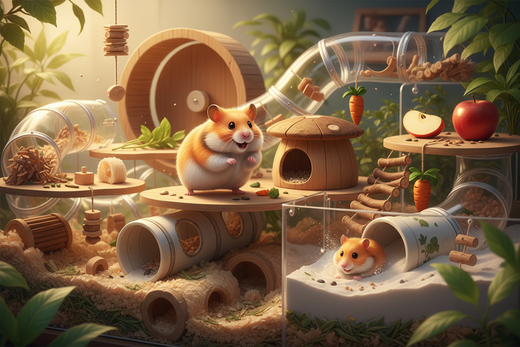
Why Hamsters Need More Than a Wheel
The whole guide, free to read right here — habitat, diet, lighting, troubleshooting and a first-48-hours quick start. No email required.
Hamsters are the most misunderstood small pet in America. They get sold in shoebox cages, sometimes two to a box, with a bag of colorful muesli and a three-inch wheel — then they get blamed for being bitey, boring, or short-lived. None of that is the hamster's fault. Get the enclosure, the bedding depth, the wheel, and the food right and you have a tidy, curious little engineer who rebuilds her world every night while you sleep. This is the husbandry we'd give our own kids before bringing one home. Read the Quick Start first — its first two rules save lives.
What has to be in the house on day one, and what to look for.
Ready to set up? Browse the essentials in our collections: Critter Enclosures and Critter Bedding and Accessories.
Skip on purpose: hamster balls, cotton-wool nesting "fluff," wire-rung wheels, multi-level plastic cages, scented bedding, and salt licks. Each is explained later.
Enrichment, one click away. Shop Critter Toys and Accessories.
All pet hamsters are desert and steppe animals, built for digging, hoarding, and moving fast in the dark. But the four species sold in the US are genuinely different animals, and the differences matter before you buy.
| Trait | Syrian | Roborovski | Russian / Winter White | Campbell's |
|---|---|---|---|---|
| Also sold as | Teddy bear, golden, black bear, fancy | Robo, desert hamster | Djungarian, Siberian dwarf | Campbell's Russian dwarf |
| Adult length | 5–7 in | 1.5–2 in | 3–4 in | 3–4 in |
| Adult weight | 120–200 g | 20–25 g | 30–45 g | 30–50 g |
| Typical lifespan | 2–3 years | 3–3.5 years | 1.5–2.5 years | 1.5–2.5 years |
| Social structure | Strictly solitary — never house together | Sometimes tolerant in sibling groups, often falls out | Often falls out; plan on solo | Often falls out; plan on solo |
| Handleability | Slowest, boldest, easiest to tame | Extremely fast; best watched, rarely held | Moderate; tames with patience | Most variable, can be nippy |
| Best for | First-timers, families with older children | Owners who enjoy observing | Patient owners wanting a tameable dwarf | Experienced dwarf keepers |
| Species health risk | Wet tail under 3 months, tumors with age | Hardy but stress-sensitive | Diabetes-prone | Strongly diabetes-prone |
A fifth animal turns up in some stores: the Chinese hamster, long and mouse-like with a visible tail. Not a true dwarf, a superb climber and escape artist, also best kept singly — use the dwarf figures throughout.
Two to three years is short, and it's the hardest part of hamster keeping, especially with children. A hamster's whole life fits inside a couple of school years — which is exactly why there's no such thing as "we'll upgrade the cage next year."
Hamsters are crepuscular — most active at dawn and dusk — with plenty of night activity on top. A healthy hamster covers several miles on her wheel between dusk and dawn, and relocates her entire food store at 3 a.m. for good measure. So a bedroom fails both ways: the noise wrecks human sleep, and a hamster kept where people are awake and flipping lights on through her active hours carries a disrupted rhythm and a chronic stress load. Waking her during the day to play — exactly what a child wants to do — is the same problem. Best spot: a quiet living room or spare room where the lights go off in the evening. A hamster who hides all day isn't sick or unfriendly. She's asleep.
Those pouches are a transport system, not a snack bag — a hamster can pack food equal to a serious fraction of her body weight and carry it to a cache underground. Hoarding, collecting and storing food in hidden larders, is core hamster behavior, not a sign you're underfeeding. Expect a food store and stop destroying it: pull out perishable items daily and leave the dry hoard alone. Avoid sticky, sharp, or stringy foods, which cause pouch impaction, a packed pouch that won't empty. A cheek that stays bulging, pawing at the face, or drooling needs a vet.
Hamsters squeeze through gaps that look impossible, chew soft plastic, lift unweighted lids, and climb wire walls to reach a seam — Roborovskis worst of all. So: correct bar spacing or solid walls, a latched or weighted lid, no soft plastic at a chewable edge, and floor time only inside a tall-sided pen you're sitting beside. Not "in the bathroom with the door shut."
Cage marketing sells levels, tubes, and towers. Hamsters don't use volume — they use continuous ground to cross and deep substrate to dig into. So judge an enclosure by unbroken floor space: one rectangular area measured at the base, with no shelves, platforms, or tubes counted toward it.
Guidance genuinely differs by country, so here's the honest range rather than false precision. The United States has no legal or veterinary standard; the figure used by most American small-mammal advocates and rescues is 450 square inches as a hard minimum. European guidance is considerably higher — commonly around 775 square inches (100 × 50 cm). Our position: 450 is the floor you never go below, and aim for 600–800 if space allows. Workable dimensions: 30" × 15" (450), 36" × 18" (648), 40" × 20" (800). Dwarfs aren't exempt — robos get shortchanged most often precisely because they're small. If you make one upgrade in your hamster's life, make it this one: bar-biting, climbing, and pacing overwhelmingly come from undersized enclosures and largely resolve in big ones.
| Species | Minimum floor space | Recommended | Minimum bedding depth | Minimum wheel | Recommended wheel |
|---|---|---|---|---|---|
| Syrian | 450 sq in | 650–800 sq in | 6 in, with 10–12 in in one zone | 10 in | 11–12 in |
| Roborovski | 450 sq in | 600–800 sq in | 6 in, with 8–10 in in one zone | 8 in | 8–9 in |
| Russian / Winter White | 450 sq in | 600–800 sq in | 6 in, with 8–10 in in one zone | 8 in | 9–10 in |
| Campbell's | 450 sq in | 600–800 sq in | 6 in, with 8–10 in in one zone | 8 in | 9–10 in |
| Chinese | 450 sq in | 600–800 sq in | 6 in, with 8–10 in in one zone | 8 in | 9–10 in |
The footprint is tiny — often 150–250 square inches of real floor, with the rest of the impression made by height and tubes. A two-inch base pan cannot hold six inches of substrate, so the behavior she needs most is designed out. Tubes are narrow, trap humidity where you can't see it, and jam a full-pouched hamster. Falls are real injuries: hamsters have almost no depth perception, walk off edges, and break legs and backs landing on a hard pan. Thin plastic gets chewed through at a seam, usually overnight. And wire mesh floors or shelves cause sore, inflamed feet and catch toes and nails — every walking surface should be solid, with bedding over it. Already own one? Keep it as a hospital or travel cage, not the home.
Barred cages with a deep solid base give the best airflow and are easy to attach things to, but bedding gets kicked out, bar-biting is possible, and spacing must be right (½ inch or less for Syrians, ¼–⅜ inch for dwarfs). A deep base pan or bedding guard is close to mandatory for real depth.
Glass, acrylic, or wooden-sided enclosures hold deep bedding beautifully, keep mess in, block drafts, and let you watch burrow tunnels from the side. Ventilation depends entirely on the lid, so use a full-surface mesh top, never a solid sheet with a vent hole and never an aquarium hood. A poorly ventilated tank concentrates ammonia at hamster height and causes respiratory disease; a mesh-lidded one with daily spot-cleaning is very well ventilated.
Keep the room at a steady 65–75°F: below about 60°F hamsters can drop into hibernation-like torpor mistaken for death, and above about 80°F heat stress sets in fast, since they can't sweat their way out of it. Keep her out of direct sun — a glass tank in a sunbeam becomes an oven in under an hour — and away from heat vents, radiators, and exterior doors, since dry forced air and drafts both cause respiratory trouble. Keep her from TVs, speakers, and washing machines too; hamsters hear into the ultrasonic range, so noise you can't perceive is still noise. Set her off the floor and out of reach of dogs, cats, and toddlers. And put her where you'll sit in the evening — a hamster you watch at dusk is one whose problems you catch early.
Think in zones, with deep bedding running under and between all of them: a deep-dig corner at one short end (10–12 inches, burrow entrance here); a nest hide set into the bedding rather than on top, roof removable; the wheel on firm footing on the opposite half; a sand bath in a heavy shallow dish offset from the nest, which will double as the latrine; the water bottle on a long wall at standing nose height; a forage field of open middle floor for the scattered ration; a chew and climb cluster along the back wall; and a second plain hide in the far corner.
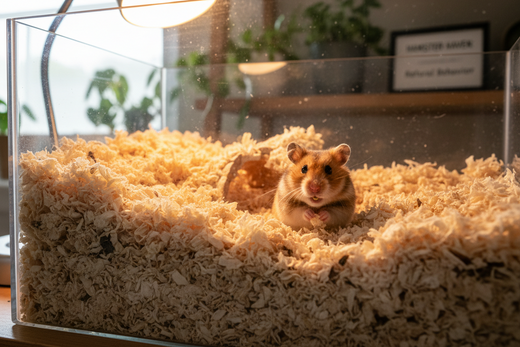
Bedding matters more for hamsters than for almost any other pet. For a rabbit it's comfort and hygiene; for a hamster, bedding is the habitat. Wild hamsters live in branching burrows a yard or more underground, with separate chambers for sleeping, hoarding, and the latrine. A hamster given two inches of shavings has nowhere to perform the behavior that organizes her whole day, and the result is the restless, bar-biting, pacing animal people mistake for a hamster's natural personality.
Depth: six inches minimum across most of the floor, plus 10–12 inches in one zone for a Syrian or 8–10 for a dwarf. Dwarfs burrow enthusiastically too; the old idea that only Syrians dig is wrong.
Depth only works if the substrate holds a tunnel, and fluffy paper alone collapses. So mix: paper or aspen as the base, blended with hemp and a generous handful of soft meadow or timothy hay. Lightly damp the mix when you pack it in — enough to clump in your fist, never wet — then let it dry. It sets like soft earth and tunnels beautifully.
| Bedding | How it performs | Burrow-holding | Notes |
|---|---|---|---|
| Paper-based, unscented, dust-extracted | Soft, absorbent, good odor control, safe if nibbled | Poor alone, good mixed | The default base; buy plain, not dyed confetti |
| Aspen shavings, kiln-dried | Hardwood, low dust, natural feel, good value | Moderate | The one safe wood shaving — the label must say aspen |
| Hemp | Low dust, excellent structure, resists collapse | Very good | Best structural partner for paper |
| Meadow or timothy hay | Nesting and tunnel reinforcement, forageable | Very good as reinforcement | Mix in, don't use alone; check for sharp stems |
| Coco fiber or additive-free topsoil | Earthy, superb tunnel integrity, ideal in dig boxes | Excellent | Keep it a minority of the mix; messy outside a tank |
| Washed play sand | Grooming, latrine use, digging variety | Not applicable | A layer or bath only, never the whole substrate |
| Plain shredded paper or tissue | Safe nesting she shreds herself | Not applicable | Offer loose; she nests better than you will |
| Cedar and pine shavings | Never use | Not applicable | Aromatic oils irritate airways and stress the liver |
| Cotton-wool "fluff" | Never use | Not applicable | Fibers wrap limbs and cut circulation; pouched fluff impacts |
| Scented or deodorized bedding | Never use | Not applicable | Perfume plus a sensitive airway plus a nest she buries her face in |
| Clay or clumping cat litter | Never use | Not applicable | Dusty, and clumping litter swells if eaten or pouched |
| Corn cob | Avoid | Poor | Molds when damp, poorly absorbent, often eaten |
| Newspaper and glossy print | Avoid | Poor | Ink and coatings; plain unprinted paper only |
Sand and hay layers. Two or three inches of plain washed play sand in one section gives a different digging texture, wears nails down, and usually becomes the latrine — which makes daily spot-cleaning a thirty-second job. Use washed, sieved, fully dry children's play sand, or sand sold for small-animal bathing. Do not use "chinchilla dust" or any powdered bathing dust; the fine particles irritate hamster airways and eyes, and skip calcium-based or dyed reptile sands too. Hay mixed through the upper bedding adds structure and forage — hamsters don't need it as food the way rabbits do, but they build with it constantly.
Hamsters are omnivorous granivores — seed and grain eaters with a real need for animal protein — and they're selective feeders who will happily eat the sunflower seeds and leave the pellets if you let them.
A quality seed-and-grain mix is the more natural option and far better for foraging. Look for a short, readable label: whole grains, identifiable seeds, dried legumes, modest dried vegetable or herb, and a dried insect or animal-protein component. Targets: protein 17–19% for Syrians and 18–20% for dwarfs (dwarfs run a faster metabolism), fat 4–7%, fiber 5–15%, and no added sugar, molasses, honey, dyes, or unnamed "derivatives."
A fortified lab block or extruded pellet is nutritionally bulletproof — every bite is complete, so selective feeding is impossible. Choose one for hamsters or omnivorous rodents at around 18% protein. It's dull and removes foraging, so our preferred setup is a good mix with one or two lab blocks alongside as insurance.
Why loose muesli mixes invite selective feeding. The colorful mixes with flaked bits, puffed pieces, molasses clusters, and dried fruit have a structural flaw: your hamster eats the fatty, sugary parts and leaves the fortified pellets. Over weeks that means far more fat and sugar, and far less protein and vitamins, than the bag's analysis claims — a leading contributor to obesity and, in Campbell's and Winter Whites, to diabetes. The tell is the same components turning up abandoned in the hoard. Switch mixes, or add lab blocks and don't top up until the leftovers get eaten.
Hamsters need more real animal protein than most owners offer — in the wild they eat insects routinely. A few times a week, give a small portion of dried or live mealworms, crickets, dubia roaches, or black soldier fly larvae; plain cooked egg; pea-sized plain cooked chicken; or cooked lentils or chickpeas, never raw. Frequency: a mealworm or two, two to four times weekly for a Syrian; one, two to three times weekly for a dwarf. Young, nursing, recovering, and elderly hamsters do well with a little more.
| Hamster | Dry food per day | Fresh produce per day | Animal protein | Notes |
|---|---|---|---|---|
| Syrian adult | 1.5–2 tbsp (about 10–12 g) | Thumbnail-sized, about 1 tsp | 2–4 times weekly | Scatter-feed; expect most of it hoarded |
| Roborovski | About 1 tbsp (5–7 g) | Pea-sized | 2–3 times weekly | Tiny animal, tiny portion, fast metabolism |
| Russian / Winter White | 1–1.5 tbsp (7–9 g) | Pea-sized, low-sugar only | 2–3 times weekly | Diabetes risk — see below |
| Campbell's | 1–1.5 tbsp (7–9 g) | Pea-sized, low-sugar only | 2–3 times weekly | Highest diabetes risk — see below |
| Juvenile under 4 months | Same amount, offered more often | One new item at a time | 3–4 times weekly | Growing animals need protein |
| Senior or underweight | Same, plus softened food | Same | 3–4 times weekly | Soak hard pieces; weigh weekly |
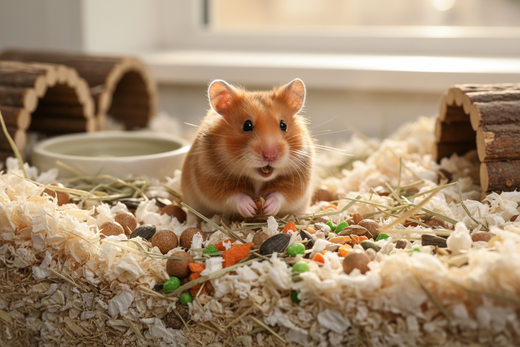
Scatter-feed instead of using a bowl. Spread the daily ration through bedding, sand, and hay. Foraging occupies her for much of her active period, gives low-impact exercise, channels the hoarding instinct, and prevents the one-sitting gorge a full bowl encourages. Keep one small dish for fresh food so you can see what's uneaten, and don't panic about the hoard — a hamster who packs away her ration is banking, not starving.
Fresh food is a daily supplement, not a meal: one thumbnail-sized portion for a Syrian, pea-sized for a dwarf. Introduce one item at a time, and skip it for a few days if you see soft stool. Wash everything, and remove uneaten fresh food within a few hours — a pouched slice of cucumber spoils fast in a warm nest.
| Safe, most days | Safe in moderation | Fruit — treat only, limited | NEVER |
|---|---|---|---|
| Broccoli, florets and leaves | Carrot (sugary — skip for dwarfs) | Apple, seeds removed | Citrus of any kind |
| Cucumber | Sweet bell pepper | Blueberry | Onion, garlic, leek, chive |
| Romaine and dark leaf lettuce | Kale and chard, small amounts | Strawberry | Chocolate and anything sweetened |
| Zucchini and summer squash | Spinach, small amounts | Banana, sliver only | Raw kidney and other raw beans |
| Cauliflower leaves and florets | Cooked plain sweet potato | Pear, seeds removed | Raw potato, sprouts, tomato leaves |
| Parsley, basil, cilantro, dill | Cooked peas and green beans | Melon, small piece, rarely | Rhubarb, including leaves |
| Dandelion greens, unsprayed clover | Pumpkin and squash flesh | Raspberry | Avocado, including skin and pit |
| Carrot tops, radish tops, bok choy | Cooked lentils and chickpeas | Grape, halved, rarely | Almonds, apple seeds, stone-fruit pits |
| Endive, celery leaf, kohlrabi leaf | Plain cooked mushroom | Dried fruit — best skipped | Sugary, sticky, honey-coated treats, yogurt drops |
| Mint, oregano, thyme | Corn, very occasional, not dwarfs | Peach or plum, no pit | Salted human food, salt licks, iceberg lettuce |
A bottle, not a bowl. A sipper keeps water free of bedding, sand, droppings, and hoarded food, and can't be tipped or dug into. Mount it at standing nose height and check it by eye every single day — press the ball and watch a drop form. A stuck sipper is a common and genuinely dangerous failure: a hamster can dehydrate in a day while the bottle looks full. Keep a spare, refresh daily, scrub weekly, and skip vitamin drops, which feed bacteria and discourage drinking. A heavy shallow dish is a reasonable addition for an elderly hamster who struggles with a bottle — change it twice daily.
Campbell's dwarf hamsters are strongly predisposed to diabetes mellitus, and Winter Whites — plus the hybrids of the two sold widely in US pet stores — carry meaningful risk too. The predisposition is genetic; diet is the lever you control. So for Campbell's, Winter Whites, and any dwarf of uncertain parentage, which is most of them:
Act on: the bottle emptying noticeably faster, a soaked latrine corner, weight loss despite a good appetite, lethargy, sweet-smelling urine, cloudy eyes, or hind-leg weakness. Any of those warrants an exotics vet — a urine glucose test is quick and cheap. Caught early, affected dwarfs often live well for a long time on diet discipline and veterinary support. Syrians rarely become diabetic, but they do get fat, with its own joint, heart, and liver costs, so the same discipline does every hamster good.
Shop the food and supplies: Browse Critter Food Treats & Feed.
A wild hamster covers serious distance nightly; a captive one does it on a wheel. Diameter comes first: in a too-small wheel she must arch her spine upward to fit the curve, and holding that posture for miles, night after night, causes real spinal damage over months. The test is her back staying flat and level as she runs — any arch means the wheel is too small. Syrians need 10 inches minimum (11–12 for large or long-haired ones); all dwarfs including Roborovskis need 8 inches, 9–10 for the larger dwarfs. The 4- and 6-inch wheels bundled with starter cages suit no adult hamster.
The running surface must be solid and continuous — no mesh, rungs, ladder treads, seam gaps, or axle bar crossing the track. Mesh and rung wheels break legs and tear off nails and toes, one of the most common hamster injuries and entirely preventable. Saucer wheels are fine if the surface is solid and the diameter right. Check nightly that it spins freely, and if it squeaks, fix the wheel rather than removing it.
A shallow heavy dish of plain washed play sand lets her roll, dig, and groom oil out of her coat, and wears nails naturally. Sand, not dust — chinchilla bathing dust irritates hamster eyes and airways. Sift the solids out daily and replace the sand weekly.
Inside a ball she can't see where she's going, can't smell her surroundings, and can't stop or get out. Ventilation slots catch toes and nails, she runs through her own urine, and collisions and stair falls are common — it looks like exploration and is closer to a stress response. For out-of-enclosure time use a tall-sided escape-proof pen with familiar hides and scattered food, and sit with her throughout. Better still, a bigger enclosure: a hamster with 650 square inches and a foot of bedding doesn't need letting out.
Hamsters are prey animals who live in the dark and sleep underground, so nothing about a large warm hand descending from above reads as friendly. Taming is just teaching her that your hand means food and never means being grabbed.
The slow-hands method, over about two weeks. Days 1–3: nothing at all, food and water only. Days 3–6: sit beside the enclosure at dusk and talk so she learns your voice and scent. Days 5–8: rest a flat open palm on the bedding with a seed on it and wait, however many sessions it takes, without chasing, petting, or closing your fingers. Days 8–12: once she takes food reliably, let her step onto your hand while it rests on the bedding. Day 12 onward: scoop with two cupped hands underneath, lifting an inch or two at first, always over the bedding or your lap.
Scoop, never grab. Hands come from the side or underneath, never down over the top like a hawk, and never lift a hamster by the scruff or tail.
Never wake a sleeping hamster to handle her. A startled hamster bites on reflex, and one bite can undo weeks of work. If she's in her nest she's off duty — wait for dusk, or tap the enclosure side and let her come out on her own terms.
Biting means something specific, and it's almost never aggression: startled awake, fingers that smelled like food, pain somewhere, held too high or too tightly, or simply not tame yet. Wash your hands first. A hamster who starts biting out of nowhere should be checked for injury, lumps, or illness. Don't punish a bite and don't flinch upward and drop her — lower your hands and let her off.
Children and supervision. Hamsters suit calm older children far better than toddlers: they're fragile, they sleep all day exactly when children want to play, and a drop from standing height is a serious or fatal injury. Rules that work: an adult present every time, handling on the floor over a blanket or inside a pen, two hands, quiet voices, five-minute sessions. Give younger children a job that isn't holding — scattering food, sifting the sand bath, choosing the chews. Roborovskis are too fast for small hands and are best watched rather than handled.
Hamsters decline fast, so nearly all of this is manageable if you catch it in the first day or two.
See: watery foul diarrhea, a soaked matted tail, hunched posture, no eating or moving — usually a Syrian under three months, newly home. Why: a severe bacterial gut infection triggered by stress, and contagious between hamsters. Do: keep her warm, hydrated, and isolated; no bathing, no fasting, no pet-store remedies. Vet: same day, no exceptions — untreated it kills within 24–72 hours and is often fatal even treated.
See: the bottle emptying faster, a soaked latrine corner, weight loss despite a good appetite, lethargy, sweet-smelling urine, hind-leg weakness. Why: genetic predisposition in Campbell's, Winter Whites, and hybrids, pushed over the edge by sugar. Do: cut all sugar, move to a low-sugar mix or lab block, reward with protein and greens, weigh weekly. Vet: within a few days for a urine glucose test, sooner if she's weak.
See: persistent gnawing on bars, climbing the walls and roof, hanging upside down. Why: nearly always an enclosure that's too small or bedding that's too shallow — she's trying to leave; a bad wheel, boredom, and a bright noisy room add to it. It's a stress signal, not a quirk, and it chips teeth and risks falls. Do: fix housing first — more floor space, deeper bedding, correct solid wheel, sand bath, chews, scatter-feeding. Glass or wooden sides remove the opportunity; bitter sprays treat only the symptom. Vet: for broken teeth or a fall injury.
See: the same loop walked over and over, identical every time, or endless digging in one spot with no burrow forming. Why: stereotypies — repetitive behaviors with no purpose that develop when an animal lacks space and outlets. Do: the full overhaul — more floor, deeper substrate, foraging, a dig box, multi-chamber hides. Improvement usually shows within a week or two. Vet: if it persists after a real upgrade, or comes with head tilt, tight circling, or lost balance, which point to neurological or inner-ear disease.
See: weeping, gumming shut on waking, a crusty rim, swelling, or a cloudy bulging eye. Why: bedding dust or a fiber scratch, conjunctivitis, a blocked tear duct, a dental abscess behind the eye, or cataracts in older and diabetic hamsters. One eye stuck shut is often minor; both eyes plus discharge usually isn't. Do: bathe with lukewarm water or sterile saline once or twice daily and switch to dust-extracted bedding; never use human eye drops. Vet: if it hasn't cleared in 48 hours, or the eye is swollen, cloudy, or painful.
See: drooling, dropping food, chewing on one side, weight loss, a long or crossed incisor; or curling claws that snag and change her gait. Why: incisors and nails grow continuously, and without hard things to gnaw and rough surfaces to walk on they outgrow their useful length; malocclusion — teeth meeting out of alignment — stops natural wear entirely. Do: add untreated wood chews and cork, plus a flat stone, tile, or sand layer so nails wear down, and never clip incisors yourself. Vet: promptly for any difficulty eating, since hamsters fail fast once they can't eat; malocclusion needs trims for life.
See: scratching, thinning fur or bald patches on the back, rump, or face, flaky crusty skin, scabs. Why: mites live on many healthy hamsters and flare when the immune system is suppressed by age, stress, poor diet, or illness; also ringworm, bacterial infection, bedding allergy, and in older hamsters hormonal or kidney disease. Do: get a skin scrape or tape test rather than guessing, since mite, fungal, and bacterial treatments differ; meanwhile use plain dust-extracted bedding and check dietary protein. Vet: within a week for spreading hair loss, sooner for open sores. Ringworm passes to people.
See: a firm or soft lump on the flank, belly, neck, armpit, or mammary area, sometimes growing or ulcerated. The raised, sometimes damp scent glands on a hamster's hips are normal and often mistaken for lumps. Why: benign and malignant tumors are genuinely common past about a year old, and abscesses, cysts, and impacted glands feel similar but are treatable. Do: measure it, photograph it with something for scale, and don't squeeze it. Vet: promptly for anything new — abscesses need draining, and some tumors are removable while small, which in a hamster is a window of a couple of weeks.
See: sprawling flat on a cool surface, panting or rapid shallow breathing, drooling, weakness — above roughly 80°F, developing fast. Why: hamsters handle heat by going underground, not by cooling their bodies, and can't sweat effectively, so a sunbeam on glass or a hot upstairs room causes heatstroke within an hour. Do: move her somewhere cooler and cool gradually — a wrapped cool pack outside the enclosure wall, a damp towel underneath, airflow, water available — never a cold bath or a refrigerator. Vet: same day for weakness, drooling, or odd breathing, since heatstroke damages organs even after she looks recovered.
See: a hamster who appears dead — cold, curled, utterly still, unresponsive. This is the call we get most often, and it has the most hopeful answer. Why: below roughly 60°F a hamster can enter a hibernation-like torpor, with greatly reduced body temperature, heart rate, and breathing. It's a survival response caused by a cold room. Telling it from death: a torpid hamster is limp and pliable, not stiff; whiskers may twitch faintly; breathing is present but extremely slow, so watch the flank for 20–30 seconds and you may catch a single breath; there's often a trace of warmth in the chest and under the arms. A hamster who has died stiffens within hours with no whisker response — when in doubt, assume torpor and warm her. Do: warm slowly over 30–60 minutes in a 70–75°F room, with cupped hands or a wrapped warm (never hot) water bottle outside the enclosure, then offer water and a little food as she rouses wobbly. No direct heat, no hot pad against her body, no bath. Vet: if there's no response after an hour, or she rouses but stays weak. Then fix the room — torpor should never happen twice.
See: an empty enclosure, usually in the morning. Why: bar spacing too wide, an unlatched lid, a chewed seam, or a pen wall she climbed. Do: shut doors, confine other pets, block stairs and gaps, then set a bucket trap — a deep smooth-sided bucket with bedding and food inside and a ramp of books to the rim — along walls or near warm dark spaces. Scatter sunflower seeds in several rooms to see which pile moves overnight, and leave her enclosure open on the floor with the nest inside; many hamsters return on their own. Hunt at night by listening, and never use a snap or glue trap. Vet: after recovery if she's limping, bleeding, chilled, or may have reached poisons, cable, or rodent bait.
See: a pear-shaped body with no neck definition, difficulty grooming her rear, reluctance to use the wheel, breathlessness, a climbing weekly weight. Why: too much fat and sugar, overfilled free-fed bowls, no proper wheel, too little floor to travel. Do: switch to a balanced mix or lab block, weigh the ration instead of eyeballing it, scatter-feed, cut treat sticks and nuts, check the wheel diameter, and add floor space — gradually, because crash dieting a hamster is dangerous. Vet: if weight climbs on a corrected diet, if she's breathless at rest, or if she can't groom. Rapid gain with a bloated belly isn't fat and needs same-week attention.
| What you see | Likely cause | What to do | Vet urgency |
|---|---|---|---|
| Watery diarrhea, matted tail, hunched | Wet tail | Warm, hydrated, isolated | Today — emergency |
| Drinking and urinating more, weight loss | Diabetes in a dwarf | Cut all sugar, weigh weekly | Within days |
| Gnawing bars, climbing, hanging | Enclosure too small or shallow | More space and depth, right wheel | Only if injured |
| Same loop repeated, aimless digging | Stereotypy from under-stimulation | Deeper substrate, foraging, dig box | If it persists, or with head tilt |
| Weepy, crusty, or closed eye | Dust, scratch, infection, abscess | Saline bathing, dust-free bedding | 48 hours, sooner if swollen |
| Drooling, dropping food, long incisors | Overgrown teeth or malocclusion | Hard chews, never clip yourself | Within days |
| Scratching, bald patches, crusty skin | Mites, ringworm, allergy | Vet skin test, plain bedding | Within a week |
| New lump anywhere | Tumor, abscess, cyst, scent gland | Measure, photograph, don't squeeze | Promptly |
| Sprawled, panting, weak when warm | Heat stress | Cooler room, cool pack outside | Same day |
| Cold, curled, limp but not stiff | Torpor from a cold room | Warm slowly, then fix the room | If no response in an hour |
| Empty enclosure | Escape via spacing, lid, or seam | Bucket trap, seed tracers | If injured or near poisons |
| Pear-shaped, off the wheel, gaining | Obesity | Weighed rations, scatter-feed | If gain continues |
| How often | What to do |
|---|---|
| Daily | Check the bottle by eye — press the ball and watch a drop form |
| Daily | Scatter the measured ration; offer a small piece of fresh food |
| Daily | Spot-clean the latrine corner and sift the sand bath |
| Daily | Pull perishable items out of the hoard |
| Daily | Watch her at dusk — posture, movement, appetite, wheel use |
| Daily | Check the wheel spins freely and the room sits at 65–75°F |
| Weekly | Weigh her on a gram scale and write it down |
| Weekly | Replace the sand; scrub the water bottle with a brush |
| Weekly | Top up bedding where it has compacted or been kicked out |
| Weekly | Check teeth, nails, eyes, nose, rear, and feel for lumps |
| Weekly | Inspect chews, replacing anything gnawed to a sharp point |
| Monthly | Partial bedding change — a quarter to a third, keeping the nest |
| Monthly | Wash hides, tunnels, wheel, and dishes in hot water and mild unscented soap, then dry fully |
| Monthly | Check bar spacing, lid latches, and plastic seams for chew damage |
| Monthly | Audit the food — is she sorting the mix? Is the bag in date? |
| Every 2–3 months | Refresh the dig box; rotate in a new chew or tunnel |
| Every 6 months | Review floor space, bedding depth, wheel size, and diet |
| Yearly, twice yearly past 18 months | Exotics vet wellness check |
A hamster's world is built on scent. She marks her tunnels, her pantry, and her nest, and that scent map is how she knows she's home. A full strip-out erases it in one go, and the aftermath is telling: frantic re-marking, bar-biting, hiding, sometimes defensive biting for days. It also collapses a burrow she may have spent weeks building — and because stress triggers wet tail, stripping a young hamster's enclosure is a real health risk, not just an upset. Instead: spot-clean daily, which is easy because hamsters use one consistent toilet spot; change a quarter to a third monthly, taking the soiled compacted parts; and always put back a handful of old bedding and the nest material, where she had it. Done this way, deep absorbent bedding stays fresh for weeks and needs full replacement only two or three times a year.
Hamsters hide illness until they can't, and then they go fast — in a 25-gram Roborovski, a day without food or water is a serious event. The rule we give every customer: when you're wondering whether to call, call.
Go today — same-day or emergency:
Book within a few days:
Ask clinics now whether they treat small exotic mammals and what their after-hours cover is. Bring your weight log and a photo of the enclosure, and travel her in her own carrier with her own nest material.
For Syrians, no — they are strictly solitary, and two housed together reliably ends in a fight to the death, often after weeks of apparent peace. Dwarf siblings raised together are sometimes tolerant but a large share fall out later and need splitting immediately. Plan for one hamster per enclosure.
Judge by unbroken floor space, not levels or tubes. The American minimum used by most rescues is 450 square inches of continuous floor (about 30" × 15"); European guidance is considerably higher, around 775 square inches. Aim for 600–800 with 12–14 inches of internal height, and remember dwarfs need the same floor space as Syrians.
The base should be a quality seed-and-grain mix or fortified lab block at roughly 17–20% protein and 4–7% fat, with no added sugar, plus animal protein a few times a week and a small daily portion of safe vegetables like broccoli, cucumber, and bell pepper. Never feed citrus, onion, garlic, chocolate, raw beans, raw potato, rhubarb, avocado, almonds, or sugary treats.
Two to three years is typical for a Syrian, and 1.5 to 2.5 years for Russian/Winter White and Campbell's dwarfs. Roborovskis are the longest-lived of the common pet species at roughly three to three and a half years. Good husbandry moves a hamster toward the top of her range rather than the bottom.
Almost always because the enclosure is too small or the bedding too shallow — bar-biting is a stress signal and an escape attempt, not a habit. A missing or undersized wheel, boredom, and a bright noisy room add to it. Fix the housing first: more floor space, six inches or more of bedding, a correct solid wheel, chews, and scatter-feeding.
Syrians need at least 10 inches of diameter, 11–12 for large or long-haired individuals, and all dwarfs including Roborovskis need at least 8 inches. The test is her posture: her back should stay flat and level as she runs, and any upward arch means the wheel is loading her spine badly over the miles she covers nightly. The surface must be solid — never mesh or rungs.
Because she's built to. Hamsters are crepuscular and nocturnal, most active at dawn and dusk, so daytime sleeping is normal and healthy rather than a sign of illness. Never wake her to play — a startled hamster bites on reflex, and repeated interruption causes real chronic stress. Visit her at dusk instead.
Syrians can have fruit as an occasional treat — a sliver of apple, pear, blueberry, or strawberry once or twice a week, with seeds and pits removed. For Campbell's, Winter Whites, and dwarf hybrids of uncertain parentage, fruit should be cut right back or skipped entirely, because these species are predisposed to diabetes. Dried fruit, yogurt drops, and honey treats are best avoided for every hamster.
Unscented dust-extracted paper bedding, kiln-dried aspen shavings, and hemp are the three safe choices, and mixing them gives bedding that holds a real burrow — six inches across most of the floor and 10–12 inches in at least one zone. Avoid cedar and pine shavings, whose aromatic oils irritate the airways, and never use cotton-wool nesting fluff, which wraps around limbs and causes impaction.
In a room below about 60°F a hamster can enter a hibernation-like torpor commonly mistaken for death: cold, curled, and unresponsive, but limp rather than stiff, with faint whisker twitches and one very slow breath every 20 or 30 seconds. Warm her slowly over 30 to 60 minutes in a 70–75°F room using indirect warmth, and offer water and food as she rouses. If there's no response after an hour, call an exotics vet — then fix the room temperature.
Ready to shop? Start with Critters!. 10% of every purchase supports no-kill animal shelters. Not sure this is the right pet? Compare your options in our Small Animal Guide.
Before we earn a dime, 10% of every purchase at Walnut Creek Supply goes to no-kill animal shelters across the country. Not rounded up at checkout, not an optional add-on — it comes off the top of every order, every day of the year, because responsible pet ownership and community care are the same thing wearing different hats.
That matters especially with hamsters. Small pets are among the most surrendered and least adopted animals in American shelters, usually because somebody bought one on impulse with a tiny cage and bad advice. The point of a guide like this is to make sure that never happens to your hamster — and if you're able to, we'd gently point you toward a rescue first.
We're a family business in Christiana, Lancaster County, Pennsylvania. We grow our own food, keep our own animals, and stock the clean-label, single-ingredient, American-made goods we'd put in front of our own pets — no mystery ingredients, no cheap filler toys, and no cage we wouldn't keep a hamster in ourselves. If you're not sure your bedding or your wheel is right, call us at (717) 983-8069. We'd much rather talk you through it than sell you the wrong thing.
Welcome to the family. Go build her a really deep burrow — and let us know what she names it.
From our family to yours, Walnut Creek Supply — Christiana, Pennsylvania walnutcreeksupply.com
For Syrians, no — they are strictly solitary, and two housed together reliably ends in a fight to the death, often after weeks of apparent peace. Dwarf siblings raised together are sometimes tolerant but a large share fall out later and need splitting immediately. Plan for one hamster per enclosure.
Judge by unbroken floor space, not levels or tubes. The American minimum used by most rescues is 450 square inches of continuous floor (about 30" × 15"); European guidance is considerably higher, around 775 square inches. Aim for 600–800 with 12–14 inches of internal height, and remember dwarfs need the same floor space as Syrians.
The base should be a quality seed-and-grain mix or fortified lab block at roughly 17–20% protein and 4–7% fat, with no added sugar, plus animal protein a few times a week and a small daily portion of safe vegetables like broccoli, cucumber, and bell pepper. Never feed citrus, onion, garlic, chocolate, raw beans, raw potato, rhubarb, avocado, almonds, or sugary treats.
Two to three years is typical for a Syrian, and 1.5 to 2.5 years for Russian/Winter White and Campbell's dwarfs. Roborovskis are the longest-lived of the common pet species at roughly three to three and a half years. Good husbandry moves a hamster toward the top of her range rather than the bottom.
Almost always because the enclosure is too small or the bedding too shallow — bar-biting is a stress signal and an escape attempt, not a habit. A missing or undersized wheel, boredom, and a bright noisy room add to it. Fix the housing first: more floor space, six inches or more of bedding, a correct solid wheel, chews, and scatter-feeding.
Syrians need at least 10 inches of diameter, 11–12 for large or long-haired individuals, and all dwarfs including Roborovskis need at least 8 inches. The test is her posture: her back should stay flat and level as she runs, and any upward arch means the wheel is loading her spine badly over the miles she covers nightly. The surface must be solid — never mesh or rungs.
Because she's built to. Hamsters are crepuscular and nocturnal, most active at dawn and dusk, so daytime sleeping is normal and healthy rather than a sign of illness. Never wake her to play — a startled hamster bites on reflex, and repeated interruption causes real chronic stress. Visit her at dusk instead.
Syrians can have fruit as an occasional treat — a sliver of apple, pear, blueberry, or strawberry once or twice a week, with seeds and pits removed. For Campbell's, Winter Whites, and dwarf hybrids of uncertain parentage, fruit should be cut right back or skipped entirely, because these species are predisposed to diabetes. Dried fruit, yogurt drops, and honey treats are best avoided for every hamster.
Unscented dust-extracted paper bedding, kiln-dried aspen shavings, and hemp are the three safe choices, and mixing them gives bedding that holds a real burrow — six inches across most of the floor and 10–12 inches in at least one zone. Avoid cedar and pine shavings, whose aromatic oils irritate the airways, and never use cotton-wool nesting fluff, which wraps around limbs and causes impaction.
In a room below about 60°F a hamster can enter a hibernation-like torpor commonly mistaken for death: cold, curled, and unresponsive, but limp rather than stiff, with faint whisker twitches and one very slow breath every 20 or 30 seconds. Warm her slowly over 30 to 60 minutes in a 70–75°F room using indirect warmth, and offer water and food as she rouses. If there's no response after an hour, call an exotics vet — then fix the room temperature.
Every hamster article we've published, in one place.