



Leaving already?
Can we tempt you with 5$ off your first order?
Min Order of $50


Care Guide & Supplies
Chinchillas require a low-fat, high-fiber diet of quality pellets and unlimited timothy hay. Discover chinchilla essentials.
Habitat, diet, lighting, troubleshooting and a first-48-hours quick start. Free, no email required — from our family in Lancaster County to yours.

Kaytee Chinchilla Lava Ledge
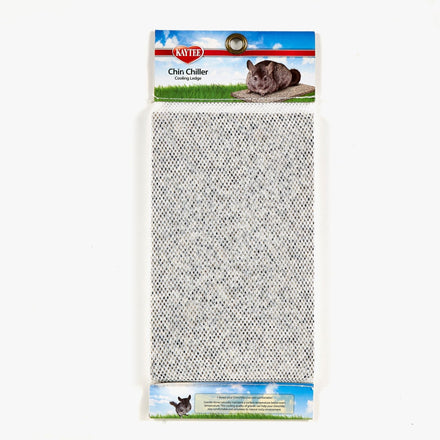
Kaytee Chinchilla Chiller Granite Stone Gray 1ea/6 in X 10in.

Kaytee Fiesta Chinchilla Food 2.5lb

Kaytee Food from the Wild Chinchilla 1ea/3 lb
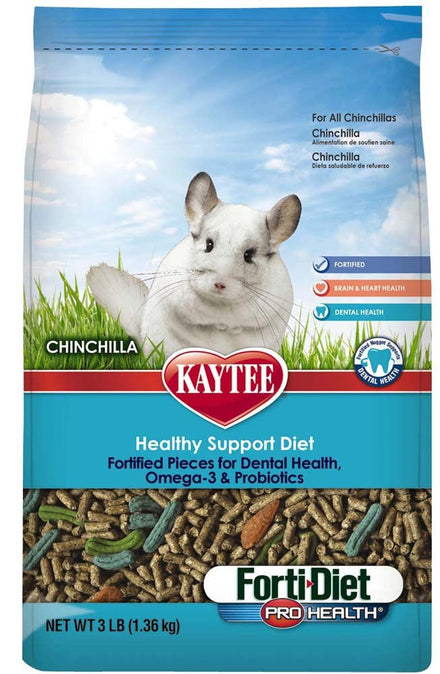
Kaytee Forti Diet Pro Health Chinchilla Food 1ea/3 lb

Kaytee Timothy Complete Chinchilla Food 1ea/3 lb

Oxbow Animal Health Essentials Chinchilla Food 1ea/25 lb

Oxbow Essentials Chinchilla Food 10lb

Oxbow Essentials Chinchilla Food 3lb

Oxbow Garden Select Chinchilla Food 3lb

Tiny Friends Farm Charlie Chinchilla Cookies w/Raisin & Carrot 1ea/4.2oz.

Dust Baths and Chinchilla Coat Care: Getting It Right Every Time
Chinchilla Housing: Height, Bar Spacing, and Why Plastic Is the Enemy
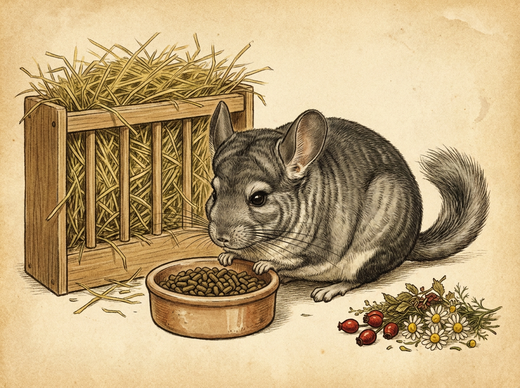
Chinchilla Diet: Why Simple and Boring Is the Right Answer

Chinchilla Care Guide: The Long-Lived Pet That Rewards Patient Owners

Why Dust Baths Matter for Chinchilla Health and Happiness
The whole guide, free to read right here — habitat, diet, lighting, troubleshooting and a first-48-hours quick start. No email required.
Welcome to the most particular little mountain animal you will ever share a home with! Chinchillas are gentle, wildly clever, astonishingly soft and — we'll be honest with you right up front — fussier about their environment than almost any other pet in our catalog. Get two things right, temperature and diet, and a chinchilla can be part of your family for fifteen years or more. Get those two things wrong and things go badly very fast. This guide is written by the family behind Walnut Creek Supply here in Christiana, Lancaster County, Pennsylvania, for the first-time owner who wants the honest version — no mystery ingredients, no marketing fluff, no advice that sells more treats at the expense of your animal. Read the first three sections before your chinchilla comes home. Everything else you can grow into.
Your chinchilla's first two days with you are about one thing: a cool, quiet, boring room. Not bonding. Not handling. Not showing the kids. Work this list in order.
Here's what actually matters, by category. Buy the cage, hay, pellets, dust and cooling slab before day one; the rest can follow in the first week.
Ready to set up? Browse the essentials in our collections: Critter Enclosures and Critter Bedding and Accessories.
Enrichment, one click away. Shop Critter Toys and Accessories.
Chinchillas routinely live 10–20 years in good care, with most landing somewhere in the 12–15 range. That is a genuinely long time — longer than many dogs, and long enough that a chinchilla bought for a ten-year-old will still be alive when that child finishes college. Please sit with that before you buy. It means planning for a decade and a half of air conditioning in summer, hay in the house, exotics vet bills in later life, and someone to care for them when you travel. Chinchillas are also creatures of deep routine; rehoming is hard on them. We'd much rather you take a week to decide than take one home on a Saturday whim.
In exchange you get an animal with real personality and a long memory. A well-socialised chinchilla recognizes their person, comes to the cage front, takes a chew from your fingers, and does spectacular vertical bounces off three walls in a row when they're pleased with life — the famous "popcorn." They are expressive, and they chirp, bark, squeak and grumble at each other and at you.
Adults run roughly 9–14 inches (23–36 cm) in body length with a bushy tail of another 3–6 inches (8–15 cm), and weigh 400–800 grams (about 1–1.75 lb). Females are typically the larger sex, which is unusual among rodents. Underneath all that fur is a surprisingly light, delicate, athletic animal built for leaping between rocks — fine bones, powerful hind legs, and a ribcage you can injure with a firm squeeze. They feel like a cloud and they handle like a soap bubble.
A chinchilla grows more than fifty hairs out of a single follicle — somewhere in the range of 50–80 depending on the animal and the body region — which gives them the densest fur of any land mammal. In the Andes that coat is survival equipment at high altitude. In your living room it is a liability, because the same density that traps warmth makes it nearly impossible for them to dump excess heat. They have no sweat glands to speak of and shed heat mainly through their big thin ears.
That coat is also why chinchillas never, ever get wet. Water soaks in, cannot dry out, and you end up with a chilled animal and a warm damp environment at skin level where fungus thrives.
Fur slip is a defense mechanism: when a chinchilla is grabbed or badly frightened, it voluntarily releases a clean patch of fur, leaving the predator — or you — holding a tuft while the animal escapes. It is startling the first time and it does not hurt them, but it leaves a bald, slightly uneven patch that can take several weeks to several months to grow back in fully. Fur slip is feedback. It means you grabbed instead of scooped, or something in the room frightened them badly. Repeated fur slip means your handling needs rethinking.
We say this kindly, because it disappoints people. Chinchillas are not cuddly pets. Most tolerate rather than enjoy being held, they do not like being restrained, they startle easily, they are most awake when children are asleep, and they are physically fragile — a dropped chinchilla is a badly injured chinchilla. They also chew absolutely everything, which means supervised out-of-cage time only. A chinchilla can absolutely be a wonderful family animal for a patient older child or teenager who finds watching and hand-feeding rewarding. For a five-year-old who wants to carry a soft thing around the house, a chinchilla will end in tears for everyone. A guinea pig or a well-socialised rabbit is a far kinder answer to that wish.
In the wild, chinchillas roll in fine volcanic dust to strip excess oil and moisture out of that dense coat. Without regular access to dust, the coat goes greasy, mats at the base, and becomes a hospitable place for fungal skin infection. So dust is husbandry, not enrichment — but like most good things it goes wrong when overdone, which is why we schedule it rather than leave the bath in the cage. Full details in the bedding and dust section.
This is the section that saves lives, so we're going to be blunt. Heat is the number one killer of pet chinchillas in American homes. Not diet, not predators, not accidents — heat. Every summer, exotics vets see chinchillas that were "fine yesterday" in a room that got to the low 80s while nobody was home.
| Condition | Temperature | Humidity | What it means | What to do |
|---|---|---|---|---|
| Ideal | 60–70°F (15–21°C) | 30–50% | Comfortable, safe year-round target | Maintain and monitor daily |
| Acceptable | 70–75°F (21–24°C) | Under 50% | Tolerable with airflow and a cooling slab | Add fan circulation, cool slab, check twice daily |
| Caution | 75–77°F (24–25°C) | Under 50% | Upper limit. Heat stress begins | Cool the room actively now. Do not leave unattended |
| Danger | Above 77°F (25°C) | Any | Real risk of heat stroke | Move to a cooler room or run A/C immediately |
| Emergency | Above 80°F (27°C) | Any | Heat stroke likely within hours | Treat as a medical emergency. Cool and call a vet |
| Humid risk | Any above 72°F (22°C) | Above 55% | Heat cannot be shed even at moderate temperature | Dehumidify and cool. Treat as one band hotter |
| Too cold | Below 50°F (10°C) | Any | Rarely a problem but avoid drafts | Move off cold floors, block drafts, no damp |
A useful shorthand many chinchilla keepers use is the combined heat index: add the temperature in °F to the relative humidity percentage, and keep the total under 150. So 75°F with 40% humidity (115) is fine; 75°F with 70% humidity (145) is borderline; 80°F with 70% humidity (150) is dangerous. Humidity matters because a chinchilla's limited cooling depends on moving heat out through the ears and respiratory tract, and muggy air shuts that down. A humid 76°F room is more dangerous than a dry 76°F room.
Where figures are genuinely debated — and the exact danger threshold is, with reputable sources placing it anywhere from 75°F to 80°F — we give you the cautious end. There is no benefit to running a chinchilla warm, and there is enormous downside.
Learn these cold. In order of escalating seriousness:
Chinchillas are mountain animals with a coat built for freezing nights, and a normally heated home is never too cold for them. Comfortable down into the 50s°F (10–15°C) without fuss. What they don't tolerate in winter is damp, drafts and sudden swings — a cage in front of a leaky window, or a room that goes from 68°F to 45°F overnight. Keep them dry, keep them out of the draft, give them a hideout to tuck into, and skip the heat lamps and snuggle pads sold for other small pets. Those are a genuine hazard here. If anything, winter is the season you get to relax a little.
A chinchilla cage is a climbing frame, not a floor plan. In the wild they live in rock crevices and move vertically, leaping confidently between ledges. The best enclosure you can build gives them height, multiple solid levels, and varied jump distances — a tall cage with four good shelves will be used far more completely than a wide flat cage with the same square footage, because flat space simply isn't how a chinchilla moves. If you're choosing between tall and wide at the same price, choose tall.
| Setup | Minimum width | Minimum depth | Minimum height | Levels | Notes |
|---|---|---|---|---|---|
| One chinchilla (absolute minimum) | 24 in (61 cm) | 24 in (61 cm) | 48 in (122 cm) | 3 | Workable only with daily out-of-cage time |
| One chinchilla (recommended) | 36 in (91 cm) | 24 in (61 cm) | 60 in (152 cm) | 4 | Comfortable long-term housing |
| Bonded pair (minimum) | 36 in (91 cm) | 24 in (61 cm) | 60 in (152 cm) | 4 | Two hideouts, two hay racks, two water bottles |
| Bonded pair (recommended) | 48 in (122 cm) | 24 in (61 cm) | 72 in (183 cm) | 5 | Room to avoid each other, which prevents fights |
| Bar spacing (adults) | 0.5–1 in (1.3–2.5 cm) | — | — | — | Never wider than 1 in; heads and legs get through |
| Bar spacing (kits under 6 months) | 0.5 in (1.3 cm) max | — | — | — | Young kits escape through 1 in bars |
| Shelf spacing | — | — | 10–16 in (25–40 cm) apart | — | Stagger them; avoid any single drop over 18 in |
| Wheel diameter | 14 in (36 cm) minimum | — | — | — | 15–16 in preferred. Solid running surface, metal |
Bigger is always better, and vertical inches are the cheapest improvement you can make. A tall cage also gives the animal a genuine choice of microclimates: cool slab at the bottom, cosy hideout in the middle, lookout perch at the top.
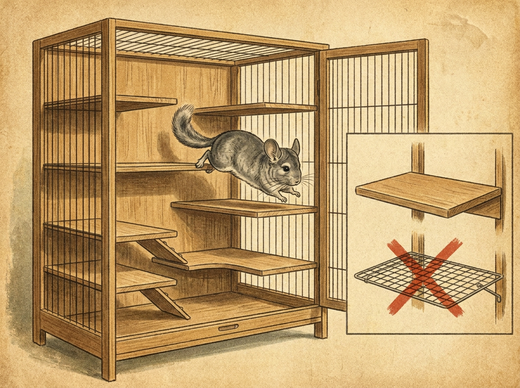
Metal and untreated wood. That's the list. Powder-coated or galvanized wire for the frame, solid wood for the shelves. Avoid cages with plastic shelves, plastic ramps, plastic bases, plastic trim or plastic corner clips, because a chinchilla will reduce all of it to splinters within a week or two. Swallowed plastic does not pass — it causes gut blockages that are expensive at best and fatal at worst. If a cage you already own has plastic parts, remove them and replace with wood or metal before the chinchilla moves in. The same goes for plastic hideouts, plastic wheels, plastic food bowls and plastic water bottles.
Solid floors and solid shelves only. Standing on wire causes sore, ulcerated hocks and footpads, and open wire shelving catches toes and legs — chinchillas jump hard and land fast, and a foot through a gap at speed means a broken leg. If your cage came with wire shelves, cover them with solid untreated wood or replace them outright. The same logic applies to the wheel: solid metal running surface, never wire mesh or rungs, which trap feet and tails.
Use untreated, unpainted, unvarnished, kiln-dried wood only.
Expect to replace shelves every so often. That's the system working — a chewed shelf is wear that didn't happen to their teeth.
Picture a tall rectangular cage, viewed from the front, with the following arrangement from top to bottom. This is a layout you can sketch straight onto paper and then build.
A few extra fitting notes: mount everything so there are no gaps a leg can slip through between shelf and wall; keep the full-depth shelves staggered so a fall from the top can't go all the way to the floor; and site the dust bath, when it's in, on the bottom level where spilled dust is easy to sweep up.
Bedding has one job: absorb urine and stay low-dust. Chinchillas don't burrow or nest the way hamsters do, so you need 1–2 inches (3–5 cm) in the tray and in the litter pan — not a deep bed.
| Bedding type | Verdict | Why |
|---|---|---|
| Paper-based (plain, unscented) | Best choice | Very absorbent, low dust, safe if nibbled, controls odour well |
| Kiln-dried pine shavings | Good choice | Kilning drives off the aromatic oils; absorbent and economical |
| Aspen shavings | Good choice | Naturally free of aromatic oils, low dust, widely available |
| Hemp bedding | Good choice | Low dust, very absorbent, compostable |
| Fleece liners over a solid base | Workable | Reusable and dust-free, but needs washing every 2–3 days and chinchillas chew edges |
| Shredded plain paper or paper towel | Backup only | Safe but poor odour control; fine in a pinch |
| Cedar shavings | Never | Aromatic phenols irritate the airway and stress the liver |
| Fresh, non-kiln-dried pine | Avoid | Same phenol problem as cedar, to a lesser degree |
| Scented or "odour-control" bedding | Never | Added fragrance irritates a sensitive respiratory tract |
| Any cat litter, especially clumping | Never | Clumping clay swells in the gut and causes fatal blockages; dusty and abrasive |
| Corn cob bedding | Avoid | Molds readily, poor absorbency, impaction risk if eaten |
| Straw | Avoid | Barely absorbent, sharp stems can injure eyes |
| Sawdust or very fine shavings | Avoid | Far too dusty for chinchilla lungs |
Spot-clean the tray and litter pan daily, strip and replace bedding weekly, and wash the tray with a mild unscented soap or a vinegar solution — not a strongly perfumed cleaner.
Chinchilla dust is a finely milled, almost powdery mineral product, usually pumice or a sepiolite-type clay. It is not sand. Sand grains are too coarse and too heavy to work their way to the skin and wick out oil and moisture, and coarse grit abrades the hair shaft. If it feels gritty between your fingers rather than slippery like talc, it's the wrong product.
Offer dust in a heavy, enclosed house or a deep, wide bowl they can't tip — chinchillas roll vigorously and will throw dust several feet in a cheerful whirl. Put 2–3 inches (5–8 cm) of dust in, enough that they can flip right over in it.
| Element | Guideline |
|---|---|
| Frequency (average home, normal humidity) | 2–3 times per week |
| Frequency (dry climate or winter heating) | 2 times per week |
| Frequency (humid summer weather) | 3–4 times per week |
| Session length | 10–15 minutes |
| Dust depth | 2–3 in (5–8 cm) |
| Dust replacement | Sift out droppings after each use; fully replace every 2–4 weeks |
| Left in the cage permanently | Never |
| Best time of day | Early evening, as they wake up |
Why removing the bath matters. Left in the cage, a dust bath becomes three problems at once. It turns into a latrine, because chinchillas will happily urinate in loose substrate — and then they roll in it. It gets over-used, because a chinchilla will bathe for the pleasure of it well past the point of usefulness. And it keeps a fine airborne dust in the enclosure permanently, which irritates eyes and airways. Ten to fifteen minutes, then out.
What happens if you get the frequency wrong. Too little dust and the coat turns greasy and limp, mats and clumps form at the skin, the fur loses its characteristic bounce, and you create warm damp conditions at skin level where ringworm takes hold. Too much dust and you swing the other way: dry, flaky, itchy skin, a brittle-looking coat, and irritated watery eyes or mild conjunctivitis from dust in the eyes. If your chinchilla's coat looks dull and separated into locks, add a session. If their eyes are weepy after bathing and the skin looks flaky, cut back and shorten sessions. Adjust seasonally — humid Pennsylvania Augusts need more dust than dry heated Januaries.
Finally, and this one is worth tattooing somewhere: never bathe a chinchilla in water. More on that in the FAQ, but the short version is that the coat does not dry, and a damp chinchilla is a hypothermic, fungal-infected chinchilla.
If temperature is the thing that kills chinchillas quickly, diet is the thing that ruins them slowly. A chinchilla's digestive system and teeth evolved for one job: processing enormous volumes of tough, dry, low-nutrient mountain grasses. Their gut is a fiber-fermentation engine that needs to be kept constantly turning, and their teeth need constant abrasive grinding to stay the right length. Feed them what the pet aisle sells as "chinchilla food" — the colorful mix with dried fruit and seeds and yogurt drops — and you will be paying an exotics vet to grind their teeth within three years.
The whole correct diet is this: unlimited grass hay, a measured portion of plain pellets, and fresh water. That's it. Everything else is garnish, and most of it is harmful.
Loose grass hay should make up 80–90% of what your chinchilla actually eats, available free-choice, twenty-four hours a day. Not a compressed cube, not a pressed stick, not a token sprig — a generous pile of long-strand loose hay, roughly the size of the chinchilla's own body, replaced daily even if some remains.
What to look for when you buy: green rather than yellow-brown, a sweet fresh smell, long flexible strands, visible seed heads, and minimal dust or shattered leaf at the bottom of the bag. Store it somewhere cool, dark and dry with airflow — never sealed in plastic, which traps moisture and grows mold. Reject anything that smells musty, sour or like a damp basement. Moldy hay causes serious illness.
Hay does two things no pellet can. It keeps the hindgut full and moving, which is the single best protection against the bloat and gut stasis that put chinchillas in emergency care. And it provides long, side-to-side chewing strokes that wear the molars evenly, which is the only real protection against dental disease.
Your pellet should be the most visually boring food in your house. Every single piece identical. Uniform color, uniform size, uniform shape. If you can pick out a green bit, an orange bit, a sunflower seed, a corn kernel, a raisin, a banana chip or anything shaped like a cereal loop, it is the wrong bag.
What to look for on the label:
| Life stage | Grass hay | Pellets per day | Alfalfa | Fresh water |
|---|---|---|---|---|
| Adult, 7 months and older | Unlimited timothy or orchard | 1–2 tbsp (about 25–35 g) | None, or an occasional single strand | Unlimited, changed daily |
| Juvenile, under 7 months | Unlimited timothy or orchard | 2 tbsp, free-choice if growing well | Alfalfa hay or alfalfa-based pellet appropriate | Unlimited, changed daily |
| Pregnant or nursing female | Unlimited timothy or orchard | Free-choice | Alfalfa hay offered daily | Unlimited, changed twice daily |
| Senior, 10 years and older | Unlimited soft orchard or meadow | 1–2 tbsp, adjusted to body condition | Only on vet advice | Unlimited, changed daily |
| Overweight adult | Unlimited timothy or orchard | 1 tbsp, no treats at all | None | Unlimited, changed daily |
| Underweight or recovering | Unlimited, plus a second hay type | 2 tbsp, vet-guided | Vet-guided | Unlimited, changed daily |
Measure the pellets. Don't eyeball them and don't top up a bowl that still has food in it. A chinchilla given unlimited pellets will eat pellets instead of hay, because pellets are easier, and that is how you get an overweight chinchilla with worn-out molars and a sluggish gut. One small, heavy ceramic or metal bowl, one measured portion, once a day, same time each day.
A mixed food with visible pieces invites selective feeding: the chinchilla eats the sugary, fatty, fun bits — the fruit, the seeds, the corn, the flakes — and leaves the fibrous pellet behind. You end up with an animal on a high-sugar, high-fat, low-fiber diet while the bag empties and you reasonably assume they're eating their food. From there, three things happen in sequence. Gut fermentation shifts toward the wrong bacteria, producing gas and setting up bloat and diarrhea. Soft, sugary food requires almost no chewing, so the molars stop wearing down evenly and begin to develop uneven surfaces and spurs. And calories creep up while fiber falls, so the animal gains weight and the gut slows further. Dental disease, obesity and GI upset in chinchillas are very often the same story told three ways, and the story usually starts with a mixed bag of food that looked generous and fun.
Chinchillas have an extremely limited ability to process sugar and fat. Their wild diet contains almost none of either. Sugar feeds the wrong gut flora and causes gas and bloat; fat causes liver problems and obesity; soft sweet food denies the teeth the abrasion they need. There is also credible concern that high sugar intake contributes to insulin dysregulation and cataract development in the species.
So here is the hard line, and we are sorry to be the ones to tell you that most of the "chinchilla treats" on the market belong on the right-hand column.
| Safe — occasional, tiny | Never feed |
|---|---|
| 1–2 plain dried rose hips, 2–3 times a week | All fresh fruit — apple, banana, berries, melon, grapes |
| A pinch of plain dried herbs: chamomile, dandelion leaf, plantain, nettle, rosehip leaf | All dried fruit — raisins, sultanas, cranberries, banana chips, papaya |
| A single dried calendula or hibiscus flower | Nuts of any kind, including peanuts and almonds |
| A few plain dried rose petals | Seeds of any kind — sunflower, pumpkin, flax, millet, birdseed |
| 1 inch of dried oat or wheat grass stem | Corn, in any form, fresh or dried |
| A plain untreated willow or apple stick (as a chew, not food) | Yogurt drops and any dairy product |
| An extra pinch of a second grass hay as novelty | Honey or molasses sticks, "bars" and glazed treats |
| A half-teaspoon of plain rolled oats, no more than weekly | Fresh vegetables in quantity — carrot, lettuce, spinach, cabbage, broccoli |
| Nothing else | Bread, crackers, cereal, pasta, human snack food |
| Nothing else | Chocolate, caffeine, anything processed |
| Nothing else | Meat, eggs, insects or animal protein |
| Nothing else | Lawn clippings, unknown garden plants, houseplants |
A note on vegetables, because people ask: a chinchilla's gut is not built for wet, fermentable fresh produce. A sliver of carrot or a leaf of romaine won't kill a healthy adult, but it offers nothing they need and is a very common cause of soft stool and diarrhea. Our honest advice is to skip fresh produce altogether and use dried herbs when you want to give something special. Total treats of any kind: no more than a teaspoon-sized amount per week, and nothing at all for an overweight or recovering animal.
Also: no store-bought "chinchilla salt licks" or mineral wheels with added molasses, and no vitamin supplements in the water unless your vet prescribed them. A correct hay-and-pellet diet needs no supplementation.
Fresh, cool water available at all times, changed every single day even if the bottle looks full. Use a glass bottle with a metal sipper tube and an external bracket, because plastic bottles get chewed through and plastic spouts get gnawed into leaky stubs. Scrub the bottle and sipper with a bottle brush weekly — biofilm builds up inside fast and is a genuine infection source. Check the ball bearing moves freely every day; a stuck bottle means a chinchilla with no water, and in a warm room that becomes an emergency within a day. Tap water is usually fine; if your water is heavily softened or you're on a questionable well, use filtered. Bowls are not recommended — they fill with dust and bedding and wet the fur.
If you keep a pair, two bottles on different levels. Water is a resource worth guarding, and resource guarding is how pairings sour.
Alfalfa is a legume, not a grass. It's much higher in protein, calcium and calories than timothy, which makes it exactly right for an animal that is building a skeleton or feeding kits — juveniles under about seven months, pregnant females and nursing mothers. For a healthy adult, a steady alfalfa diet means excess calcium (contributing to urinary sludge and bladder stones) and excess calories. Transition growing animals off alfalfa and onto timothy gradually between six and eight months, mixing the two over a couple of weeks. A single strand of alfalfa as an occasional treat for an adult is harmless; a bag of it as the daily hay is not.
You will, sooner or later, catch your chinchilla curled up eating a dropping. This is caecotrophy, and it is supposed to happen. Chinchillas ferment fiber in the caecum, a pouch in the hindgut, and some of the nutrients produced there — B vitamins, vitamin K, microbial protein — can only be absorbed by passing the material through the stomach and small intestine a second time. So the body produces two kinds of droppings: the dry, firm, oval fecal pellets you scoop out by the hundred, and softer, darker, shinier caecotrophs that the animal takes directly and eats, usually at rest and often overnight. You may never see one in the cage, which is normal — they rarely hit the floor.
What to do about it: nothing. Don't discourage it, don't clean it up, don't worry. It is a sign of a working digestive system. What is worth noticing is caecotrophs left uneaten and smeared around the cage, which can point to obesity (the animal physically can't reach), dental pain, arthritis, or a diet too rich in pellets. That's a vet conversation.
Shop the food and supplies: Browse Critter Food Treats & Feed.
Dental disease is the most common serious health problem in pet chinchillas, and the single most preventable one. Understanding why takes about two minutes and will shape every feeding decision you make for the next fifteen years.
A chinchilla has 20 teeth — four incisors at the front and sixteen cheek teeth (premolars and molars) behind — and every one of them is open-rooted, which means it grows continuously for life. The technical term is elodont, and the growth rate is substantial: incisors advance on the order of 2–3 inches (5–7 cm) per year. The crowns are also hypsodont, very tall, with a long reserve crown sitting inside the jaw.
Healthy incisors are a deep yellow-orange — that's normal enamel pigment, not plaque, and pale white or chalky incisors can actually indicate a problem. They should meet evenly, with the uppers just overlapping the lowers.
Nothing else does the job. Not wood chews (helpful for the incisors and for enrichment, but they barely touch the cheek teeth), not pumice stones, not mineral blocks, not pellets. Chewing long-strand grass hay produces the broad, lateral, grinding jaw motion that wears the molar surfaces flat and even — hours of it, every day. Pellets are chewed with a short vertical crush that takes far less time and wears the teeth unevenly. A chinchilla eating mostly pellets simply does not chew enough hours per day to keep 16 continuously growing cheek teeth in line.
This is why we are so insistent on unlimited hay. The hay isn't there to fill the cage. It's dental equipment.
When wear doesn't keep up with growth, the teeth go wrong in two directions at once.
Above the gumline, the cheek teeth develop uneven surfaces, sharp points and spurs — slivers of tooth that angle outward into the cheek or inward into the tongue, cutting the soft tissue and causing ulcers. Eating becomes painful, so the animal eats less, which means even less wear, which makes the spurs worse. It is a vicious spiral and it moves faster than owners expect.
Below the gumline, the reserve crowns and roots push backward into the bone. In the lower jaw you can sometimes feel these as hard bumps along the jawline. In the upper jaw the elongating roots press up into the bony socket that holds the tear duct and the eye — which is why a watery, weepy eye or persistent eye discharge in a chinchilla is very often a dental problem, not an eye problem. Owners bring in an animal for a runny eye and leave with a dental diagnosis. Root elongation is also the part that can't be fully fixed; crown spurs can be filed, but roots that have grown into the bone are managed, not cured.
Weigh your chinchilla weekly on a kitchen scale and you will catch dental disease months earlier than an owner who doesn't. Watch for:
Proper assessment requires sedation or anaesthesia and often skull X-rays, because the cheek teeth and roots simply cannot be seen properly in an awake chinchilla with an otoscope. Treatment is burring the crowns back to shape, trimming spurs, treating cheek and tongue ulcers, and sometimes extraction. Many chinchillas with established disease need this repeated every few months for life, alongside pain relief and sometimes assisted feeding with a herbivore critical-care formula.
Your side of the bargain is the easy part: unlimited hay, boring pellets, zero sugar, constant chew wood, a weekly weight on the scale, and an annual check that includes an oral exam. Do those six things and dental disease becomes unlikely rather than inevitable.
Twelve things that actually go wrong, with what you see, why it happens, what to do, and when to pick up the phone. Two of these are genuine emergencies, and they're first for a reason.
What you see: Bright red hot ears, lying flat and stretched out, drooling, rapid or open-mouthed breathing, lethargy, staggering, collapse. Room temperature over 77°F (25°C), or lower with high humidity.
Why: The densest fur of any land mammal, no meaningful sweating, and an inability to dump heat fast enough. Body temperature climbs until organs begin to fail. This can happen in a couple of hours on a hot afternoon.
What to do: Move to a room at 60–65°F (15–18°C) immediately. Put them on a chilled granite or ceramic slab. Circulate air with a fan, not aimed directly at the animal. Dab ears and footpads with a cool damp cloth. Offer cool water. Never soak the body, never use ice water. Then go to the vet.
Call a vet: Immediately, every time, even if they look fine twenty minutes later. Heat stroke does delayed organ and neurological damage. This is an emergency visit, not a wait-and-see.
What you see: A hunched, hard, visibly distended or drum-tight belly. No droppings or very few, very small ones. Refusing all food including hay. Teeth grinding, restlessness alternating with stillness, lying stretched out, pressing the abdomen to a cool surface, laboured breathing.
Why: Fermentation gas builds in a gut that has stopped moving. Triggers include sugary or starchy food, abrupt diet change, fresh vegetables, too little hay fiber, dehydration, pain from dental disease, stress, or an obstruction from swallowed plastic or fabric.
What to do: This is an emergency. Do not attempt home remedies, do not give human gas drops without veterinary instruction, do not force-feed a bloated animal. Keep them warm but not hot, keep them quiet, and get to an exotics vet now. Bring a photo of the cage droppings if you can.
Call a vet: Immediately. A chinchilla that has stopped eating or stopped passing droppings can die within 24–48 hours. There is no version of this where waiting until morning is the right call.
What you see: Weight loss, slobbers, dropping food, favoring pellets over hay, pawing at the mouth, weepy eye, smaller droppings.
Why: Continuously growing teeth outpacing the wear that hay chewing provides. Usually a diet too light on hay and too heavy on pellets or treats, sometimes genetics or old jaw injury.
What to do: Book a vet appointment, don't wait for it to resolve. Meanwhile remove all treats, make hay the only easy option, and weigh weekly. Expect sedation and X-rays for proper assessment.
Call a vet: Within days of noticing any sign. Weight loss plus drooling is a this-week appointment, not a next-month one.
What you see: Patches of short, chopped, uneven fur — most often on the flanks, shoulders, chest or forearms — with no bald skin showing and no crusting. Sometimes done to a cagemate rather than themselves.
Why: This is a stress and boredom behavior, and occasionally a pain behavior. Common causes: cage too small or with no height, nothing to chew, no hiding place, cage in a noisy or high-traffic spot, a dog or cat with sightlines to the cage, too much handling, an incompatible cagemate, heat stress, dental pain, or a diet with too little hay to occupy chewing time.
What to do: Treat it as a husbandry audit rather than a skin problem. Go down the list: more vertical space, more and more varied chew wood, two hideouts, a quieter and cooler location, more hay, less forced handling, a longer out-of-cage window. Rule out dental pain with a vet exam if it starts suddenly in a previously settled animal.
Call a vet: If it appears abruptly, is accompanied by weight loss, or if the skin underneath looks red, crusty or broken — then you're probably looking at fungus or pain, not boredom.
What you see: Circular patches of fur loss with flaky, crusty, reddened or scabby skin, classically around the nose, eyes, ears, feet and genitals. Unlike barbering, the skin itself looks wrong.
Why: Dermatophyte fungi, often Trichophyton species, thriving in warm humid conditions or in a greasy coat. Driven by high humidity, insufficient dust bathing, a damp cage, overcrowding or stress-lowered immunity.
What to do: See the vet for diagnosis — several conditions look similar. Treatment is usually topical or oral antifungals, sometimes an antifungal powder mixed into the dust bath on vet instruction. Strip and replace all bedding, disinfect the cage, wash and dry wooden items thoroughly or replace them, drop the room humidity, and keep the dust bath schedule consistent.
Call a vet: Within a week of noticing. Note that ringworm is zoonotic — it transmits to people, especially children — so wash hands after contact and mention it to your doctor if you develop a circular rash.
What you see: A watery, weepy, red or swollen eye, often just one. Tear staining down the cheek fur, or thick sticky discharge gluing the lids.
Why: Four main routes. Dust or bedding irritation (often from over-bathing or very fine bedding). A corneal scratch from hay or a cagemate. Bacterial infection. Or — very commonly — pressure from elongated upper cheek tooth roots on the tear duct, which is a dental problem presenting as an eye problem.
What to do: Remove the dust bath for a few days and switch to a lower-dust bedding while you observe. Gently clean discharge with sterile saline on a soft cloth, wiping away from the eye. Never use leftover eye drops from another animal or a human prescription.
Call a vet: Within 24–48 hours if it's not clearly improving, immediately if the eye is held shut, cloudy, bulging or obviously painful. Ask them to assess the teeth, not just the eye.
What you see: Droppings that are soft, misshapen, smeared, pale, unusually smelly, or outright liquid. Staining and matting around the rear.
Why: Almost always diet. Fresh fruit or vegetables, sugary treats, a sudden change of food or hay, moldy hay, too little fiber. Also antibiotics disrupting gut flora, stress, parasites such as Giardia, or the early phase of a serious gut infection.
What to do: Remove every treat and all fresh food immediately. Hay and water only for 24–48 hours — do not withhold hay, ever. Keep the rear end clean and dry with a dry cloth, not a wet one. Note whether they are still eating hay and still producing droppings.
Call a vet: Within 24 hours if droppings are watery, if the animal is lethargic or off food, if there's blood, or if it doesn't firm up within two days. Diarrhea dehydrates a small animal fast, and soft stool that progresses to no stool is turning into case #2.
What you see: A clean, sharply defined bald patch, usually right after handling or a fright. No blood, no crust, no irritation — just missing fur.
Why: A deliberate predator-escape reflex. The chinchilla released the fur because it was grabbed, restrained, chased, netted, or badly startled.
What to do: Nothing medical. Leave the patch alone; it will regrow over several weeks to a few months, sometimes in a slightly different shade at first. Review what happened: scoop rather than grab, stop chasing them around the cage, let them come to you, and give a few days of hands-off quiet. If it happened during a pair introduction, separate and restart the process more slowly.
Call a vet: Only if the skin is broken, bleeding or crusted, which means it wasn't simple fur slip.
What you see: Punctures or tears, commonly on ears, face, feet, flanks and tail base. Blood-matted fur, limping, a chinchilla hiding and refusing to come out, loud screeching or alarm barking, two animals wrestling, chasing or pinning rather than sitting together.
Why: An introduction moved too fast, or a previously bonded pair has fallen out over territory, a resource, hormones or the arrival of a new animal. Some chinchillas simply never accept a partner, and that is not a failure on your part.
What to do: Separate immediately and completely — not into a divided cage for now, but into two cages. Clean minor wounds with sterile saline. Puncture wounds look trivial and abscess readily under that thick fur, so they are a vet matter rather than a home matter. Do not re-introduce a pair that drew blood without a long reset, and sometimes not at all.
Call a vet: Same day for any puncture, any wound larger than a scratch, or any limping or swelling. Watch for abscesses appearing days later as firm lumps.
What you see: Long, curved nails catching on fleece, bedding, or the cage wire; an altered gait; occasionally a nail grown round into the pad.
Why: Less common in chinchillas than in some pets, because climbing on rough surfaces wears nails naturally. Shows up in older, arthritic or inactive animals, in cages with only smooth surfaces, and in chinchillas with no pumice or rough wood to work on.
What to do: Add a pumice stone, an unglazed ceramic slab and some rough-bark wood ledges — that solves most cases. If a trim is needed, use small animal nail clippers, take only the clear tip, and stay well back from the pink quick. Two people makes it far easier. If you're unsure, a vet tech will do it in two minutes.
Call a vet: If a nail has grown into the pad, is bleeding, or if the foot is swollen or sore.
What you see: Sneezing, nasal discharge, crusty nostrils, noisy or laboured breathing, wheezing, lethargy, loss of appetite, sometimes discharge from the eyes alongside.
Why: Bacterial infection, often opportunistic, taking hold in an animal stressed by heat, high humidity, poor ventilation, a dirty cage, dusty or cedar bedding, or crowding. Chinchillas have sensitive airways and irritants do real damage.
What to do: Improve the environment immediately — low-dust unscented bedding, good ventilation without drafts, clean cage, humidity under 50%, cut dust bath sessions back while symptoms persist. Then get them seen.
Call a vet: Within 24 hours of any laboured breathing or discharge, and immediately if breathing is open-mouthed or they are sitting hunched and struggling. Respiratory infections in chinchillas progress quickly and need prescription antibiotics; there is no home treatment.
What you see: No visible waist from above, a rounded rather than athletic profile, fat rolls at the neck and shoulders, reluctance to climb or use the wheel, uneaten caecotrophs smeared in the cage, and a weight well above the animal's own baseline on your scale.
Why: Overfeeding pellets — usually a bowl topped up rather than measured — plus treats, plus a cage with no height to climb and no wheel. Mixed "gourmet" foods are a reliable route here.
What to do: Measure pellets strictly at 1 tablespoon per day, cut every treat to zero, make unlimited hay the only thing available between meals, add vertical space and a correct-sized solid wheel, and give daily out-of-cage exercise. Change weight slowly — crash restriction in a herbivore risks gut stasis and liver problems. Track weekly weights and aim for gradual loss over months.
Call a vet: If they aren't losing on a strict hay-and-measured-pellet diet, if they are reluctant to move, or if they can't reach to groom themselves and eat caecotrophs. Also ask the vet to confirm it's fat and not fluid, abdominal swelling or pregnancy.
| What you see | Likely cause | What to do first | Vet urgency |
|---|---|---|---|
| Red hot ears, lying flat, drooling | Heat stroke | Cool room, chilled slab, fan, cool ears and feet | Emergency — now |
| No droppings, hard swollen belly, hunched | Bloat or GI stasis | Keep quiet and warm, no food forcing, transport | Emergency — now |
| Not eating at all | Dental pain, stasis, bloat, illness | Offer hay only, note droppings, go in | Emergency — now |
| Laboured or open-mouth breathing | Heat stress or respiratory infection | Cool, ventilate, transport | Emergency — now |
| Wet chin, dropping food, losing weight | Dental disease, malocclusion | Remove treats, hay only, weigh, book vet | Days |
| Watery or discharging eye | Dust irritation, scratch, infection, tooth root | Remove dust bath, saline clean, book vet | 24–48 hours |
| Chopped patchy fur, skin looks normal | Fur chewing from stress or boredom | Audit cage size, chews, location, hay, handling | Only if sudden or with weight loss |
| Crusty flaky bald patches on face or feet | Fungal infection (ringworm) | Vet diagnosis, lower humidity, clean out cage | Within a week |
| Soft or liquid droppings | Diet error, moldy hay, parasites | Remove all treats and fresh food, hay and water | 24 hours if watery or off food |
| Clean bald patch after handling | Fur slip | Leave it alone, review handling, hands-off days | Only if skin is broken |
| Blood, limping, screeching between two chins | Failed pairing or bite wounds | Separate into two cages, saline clean | Same day for punctures |
| Nails catching, altered gait | Overgrown nails | Add pumice and rough wood, careful tip trim | If grown into the pad |
| Sneezing, nasal crust, wheezing | Respiratory infection | Low-dust bedding, ventilate, clean cage | 24 hours |
| No waist, won't climb, uneaten caecotrophs | Obesity | 1 tbsp pellets, zero treats, unlimited hay, wheel | Routine, sooner if immobile |
The principle is simple: support the whole body, and never apply pressure to hold them in place.
Never: grab a handful of fur (instant fur slip), squeeze the ribcage, scruff them, hold them by the tail or restrain them by the tail base, lift them by the tail at all, chase them around the cage with a grabbing hand, or let a child carry one while walking. An older chinchilla's tail can be gently supported near the base while the body's weight rests in your palm — but the tail is never a handle.
Expect a month, maybe two. The sequence that works:
Some chinchillas become genuinely affectionate and will nap on a shoulder. Others stay friendly but never want to be held, and that is a perfectly good relationship — plenty of chinchillas prefer interaction through the cage bars and during free-roam time to being carried. Let the animal tell you which kind you have.
Chinchillas are social animals that live in colonies in the wild, and most do better in a same-sex pair than alone, provided the pairing works. A pair grooms each other, sleeps piled up, and is far less prone to boredom-driven fur chewing. Single chinchillas can be perfectly happy if you provide the social contact yourself — daily interaction, out-of-cage time, a genuinely enriched cage — but that is a real daily commitment, not a theory.
Here's the honest picture on introductions:
A chinchilla must chew every day — it is how the teeth stay viable and how the brain stays occupied. Keep three or four different safe woods available at all times and rotate them weekly so they stay interesting: apple, willow, hazel, kiln-dried pine, aspen, grapevine, manzanita for serious gnawers. Add woven seagrass mats and balls, loofah, plain cardboard tubes stuffed with hay, and a pumice stone. Replace anything chewed down to a nub. Expect to spend a small amount on wood every month forever, and consider it the cheapest dental insurance available.
Hay-based foraging beats treats every time. A cardboard tube packed with timothy and a dried rose hip buried in the middle will occupy a chinchilla far longer, and far more healthily, than anything from the treat aisle.
Daily free-roam time of 30–60 minutes in a safe room is wonderful for a chinchilla — real running, real climbing, real leaps. It is also the single most dangerous hour of their day if the room isn't prepared. Chinchilla-proofing means, genuinely, all of this:
A moderately sized bathroom with the toilet lid down and the cables gone is often the easiest room in the house to make genuinely safe.
| Frequency | Task |
|---|---|
| Daily | Check room temperature and humidity at cage height, at the warmest point of the day |
| Daily | Refill loose grass hay to a generous full pile |
| Daily | Measure out 1–2 tbsp of plain pellets; remove any uneaten from yesterday |
| Daily | Change water and check the bottle's ball bearing moves freely |
| Daily | Scoop the litter corner and spot-clean shelves |
| Daily | Count droppings by eye — volume and firmness consistent with yesterday |
| Daily | Watch appetite, posture, breathing and activity for 2 minutes |
| Daily | Supervised out-of-cage time, 30–60 minutes, in a proofed room |
| Daily | Confirm chew wood is present and not chewed to nothing |
| 2–4 times weekly | Dust bath, 10–15 minutes, then remove |
| Weekly | Weigh on a kitchen scale and write the number down |
| Weekly | Full bedding change; wash and dry the tray |
| Weekly | Scrub the water bottle and sipper tube with a bottle brush |
| Weekly | Rotate and replace chew toys; check wooden shelves for soiling or damage |
| Weekly | Sift droppings out of the dust; top up dust |
| Weekly | Hands-on check: ears, eyes, nose, teeth if they'll allow, feet, rear end, coat condition |
| Monthly | Deep clean the whole cage — wipe bars, shelves and base with mild unscented soap or vinegar solution, dry fully |
| Monthly | Replace the dust entirely |
| Monthly | Inspect the cage for chewed plastic, loose wire, worn shelves, failing wheel bearings |
| Monthly | Check nail length and pumice availability |
| Monthly | Review the weight log for a trend, not just a number |
| Seasonally | Reassess cage location for summer heat and winter drafts; test A/C or fan before the first hot week |
| Seasonally | Buy fresh hay; check stored hay for mold or musty smell |
| Annually | Wellness exam with an exotics vet, including an oral and dental assessment |
| Annually | Replace well-chewed shelves and ledges; re-evaluate cage size and layout |
| Annually | Review your emergency plan: vet numbers, after-hours clinic, carrier, power-outage cooling plan |
Chinchillas are prey animals and they hide illness until they can't. By the time something is obvious, it is usually well established — which is why the weekly weight and the daily two-minute watch matter so much. Find an exotics vet before you need one; a general small-animal practice may not have chinchilla experience or the right anaesthetic protocols.
Go today — this is an emergency:
Call within 24–48 hours:
Routine, but don't skip it: an annual wellness and dental exam for every chinchilla, moving to twice yearly from about eight years old or for any animal with a dental history.
When you go, bring useful information: your weight log, a note of what they're eating and how much, how long symptoms have been present, and a photo of the droppings and the cage. It genuinely changes the quality of the appointment.
Aim for 60–70°F (15–21°C) with humidity under 50%. Up to about 75°F (24°C) is tolerable with good airflow and a cooling slab, but above 77°F (25°C) your chinchilla is at real risk of heat stroke, and above 80°F (27°C) it is a genuine emergency. Humidity compounds everything — a useful rule is to keep temperature in °F plus humidity percentage under 150. Cold is rarely the problem; chinchillas are mountain animals and are comfortable down into the 50s°F.
Unlimited loose grass hay — timothy or orchard grass — plus 1–2 tablespoons of a plain, uniform, high-fiber pellet per day and fresh water. That really is the whole diet. Hay should make up the overwhelming majority of what they actually consume, because it's both their fiber source and the only thing that properly wears down their continuously growing teeth. Skip anything with seeds, fruit, nuts, corn or colorful pieces, however appealing the bag looks.
No. Not apple, not banana, not berries, and absolutely not raisins or dried fruit, despite how often those are sold as chinchilla treats. Chinchillas have a very limited ability to handle sugar — it feeds the wrong gut bacteria and causes gas, bloat and diarrhea, and soft sweet food gives the teeth none of the grinding they need. If you want to give something special, use one or two plain dried rose hips or a pinch of dried chamomile or dandelion leaf instead.
Think tall, not wide. The absolute minimum for one chinchilla is about 24 x 24 inches of floor space and 48 inches tall (61 x 61 x 122 cm) with at least three solid levels, and we'd honestly recommend 36 x 24 x 60 inches (91 x 61 x 152 cm). For a bonded pair, go to 48 inches wide and 72 inches tall if you can. Bar spacing should be no more than 1 inch, all shelves and the wheel must be solid rather than wire, and avoid plastic anywhere in the enclosure because they will eat it.
Two to four times a week, for 10–15 minutes each time, then take the bath out of the cage. Use chinchilla dust rather than sand, at a depth of 2–3 inches. Never leave the bath in permanently — it becomes a litter box, the animal over-bathes and ends up with dry irritated skin and weepy eyes, and the airborne dust bothers their airways. Increase to three or four sessions in humid summer weather and drop back to two in dry winter air.
10–20 years, with most pet chinchillas living 12–15 years in good care. That is a serious long-term commitment — longer than many dogs — and it includes a decade and a half of summer temperature control, hay in the house, and veterinary care that gets more involved as they age. Please plan for the whole fifteen years before bringing one home, including who will care for them if your circumstances change.
Yes, but it takes real effort from you. Chinchillas are naturally colonial and most do better in a same-sex pair, which reduces boredom-driven problems like fur chewing. A single chinchilla can be perfectly content if you provide daily interaction, daily out-of-cage time, and a genuinely enriched cage with plenty to chew. Never house a male and female together unless you intend to breed, and introduce any two adults very slowly over four to eight weeks — some pairings simply fail.
Fur chewing, or barbering, is almost always a stress or boredom signal rather than a skin disease — look for chopped uneven patches with normal-looking skin underneath. Work through the causes: cage too small or lacking height, not enough chew wood, no hideout, a noisy or too-warm location, a dog or cat in sightline, too much handling, an unhappy cagemate, or not enough hay to occupy chewing time. If it starts suddenly in a settled animal, or the skin looks crusty or red, see a vet — that can mean dental pain or a fungal infection instead.
No — never. That extraordinarily dense coat soaks up water and will not dry for many hours, which leaves the animal chilled and creates warm damp conditions at the skin where fungal infection takes hold. Dust is how chinchillas clean themselves, and it works beautifully. If something sticky gets on the coat, spot-clean with a barely damp cloth on that small area only and dry it thoroughly, or ask your vet.
Treat this as an emergency. A chinchilla that stops eating, or stops passing normal droppings, can deteriorate within 24–48 hours because their gut has to keep moving constantly. The most common causes are dental pain, bloat or gut stasis, heat stress and systemic illness — none of which resolve on their own. Offer hay, note when you last saw normal droppings, and call an exotics vet or an after-hours emergency clinic today rather than waiting until morning.
Ready to shop? Start with Critters!. 10% of every purchase supports no-kill animal shelters. Not sure this is the right pet? Compare your options in our Small Animal Guide.
Before we earn a single dime, 10% of every purchase at Walnut Creek Supply goes to no-kill animal shelters across the country. Not after costs, not at the end of a good quarter, not as a seasonal promotion — front-loaded, every order, all year. The shelters doing this work are usually small, usually stretched thin, and usually staffed by people who show up at 6am to clean kennels before their paying job. We think they deserve a cut of what we do.
It matters to us for chinchillas in particular. Chinchillas are surrendered more often than most people realize, usually by families who were told they were easy starter pets and then discovered a fifteen-year, air-conditioned, hay-everywhere, don't-touch-the-fur commitment. Every owner who reads a guide like this one and goes in with clear eyes is one less chinchilla in a rescue. That's genuinely why we write these.
So thank you — for doing the homework, for buying the cooling slab before you needed it, for choosing the boring pellet over the colorful bag, and for giving one small, soft, slightly absurd mountain animal a very good life.
From our family in Christiana, Lancaster County, to yours and your critters — welcome to the Best Life Family! If you get stuck, send us a note or give us a call. We're real people, we've kept these animals, and we'd much rather answer a question today than hear about a problem next month.
Walnut Creek Supply — clean fuel, no junk. No mystery ingredients, ever.
Aim for 60–70°F (15–21°C) with humidity under 50%. Up to about 75°F (24°C) is tolerable with good airflow and a cooling slab, but above 77°F (25°C) your chinchilla is at real risk of heat stroke, and above 80°F (27°C) it is a genuine emergency. Humidity compounds everything — a useful rule is to keep temperature in °F plus humidity percentage under 150. Cold is rarely the problem; chinchillas are mountain animals and are comfortable down into the 50s°F.
Unlimited loose grass hay — timothy or orchard grass — plus 1–2 tablespoons of a plain, uniform, high-fiber pellet per day and fresh water. That really is the whole diet. Hay should make up the overwhelming majority of what they actually consume, because it's both their fiber source and the only thing that properly wears down their continuously growing teeth. Skip anything with seeds, fruit, nuts, corn or colorful pieces, however appealing the bag looks.
No. Not apple, not banana, not berries, and absolutely not raisins or dried fruit, despite how often those are sold as chinchilla treats. Chinchillas have a very limited ability to handle sugar — it feeds the wrong gut bacteria and causes gas, bloat and diarrhea, and soft sweet food gives the teeth none of the grinding they need. If you want to give something special, use one or two plain dried rose hips or a pinch of dried chamomile or dandelion leaf instead.
Think tall, not wide. The absolute minimum for one chinchilla is about 24 x 24 inches of floor space and 48 inches tall (61 x 61 x 122 cm) with at least three solid levels, and we'd honestly recommend 36 x 24 x 60 inches (91 x 61 x 152 cm). For a bonded pair, go to 48 inches wide and 72 inches tall if you can. Bar spacing should be no more than 1 inch, all shelves and the wheel must be solid rather than wire, and avoid plastic anywhere in the enclosure because they will eat it.
Two to four times a week, for 10–15 minutes each time, then take the bath out of the cage. Use chinchilla dust rather than sand, at a depth of 2–3 inches. Never leave the bath in permanently — it becomes a litter box, the animal over-bathes and ends up with dry irritated skin and weepy eyes, and the airborne dust bothers their airways. Increase to three or four sessions in humid summer weather and drop back to two in dry winter air.
10–20 years, with most pet chinchillas living 12–15 years in good care. That is a serious long-term commitment — longer than many dogs — and it includes a decade and a half of summer temperature control, hay in the house, and veterinary care that gets more involved as they age. Please plan for the whole fifteen years before bringing one home, including who will care for them if your circumstances change.
Yes, but it takes real effort from you. Chinchillas are naturally colonial and most do better in a same-sex pair, which reduces boredom-driven problems like fur chewing. A single chinchilla can be perfectly content if you provide daily interaction, daily out-of-cage time, and a genuinely enriched cage with plenty to chew. Never house a male and female together unless you intend to breed, and introduce any two adults very slowly over four to eight weeks — some pairings simply fail.
Fur chewing, or barbering, is almost always a stress or boredom signal rather than a skin disease — look for chopped uneven patches with normal-looking skin underneath. Work through the causes: cage too small or lacking height, not enough chew wood, no hideout, a noisy or too-warm location, a dog or cat in sightline, too much handling, an unhappy cagemate, or not enough hay to occupy chewing time. If it starts suddenly in a settled animal, or the skin looks crusty or red, see a vet — that can mean dental pain or a fungal infection instead.
No — never. That extraordinarily dense coat soaks up water and will not dry for many hours, which leaves the animal chilled and creates warm damp conditions at the skin where fungal infection takes hold. Dust is how chinchillas clean themselves, and it works beautifully. If something sticky gets on the coat, spot-clean with a barely damp cloth on that small area only and dry it thoroughly, or ask your vet.
Treat this as an emergency. A chinchilla that stops eating, or stops passing normal droppings, can deteriorate within 24–48 hours because their gut has to keep moving constantly. The most common causes are dental pain, bloat or gut stasis, heat stress and systemic illness — none of which resolve on their own. Offer hay, note when you last saw normal droppings, and call an exotics vet or an after-hours emergency clinic today rather than waiting until morning.
Every chinchilla article we've published, in one place.