




Leaving already?
Can we tempt you with 5$ off your first order?
Min Order of $50


Care Guide & Supplies
Universal dog products — from grooming and flea care to training tools and travel gear. Good for every dog, every breed, every age.
Habitat, diet, lighting, troubleshooting and a first-48-hours quick start. Free, no email required — from our family in Lancaster County to yours.

Dog Owners: 5 Checks to Spot Misleading Dog Food Labels in the Aisle

Prevent Dog and Cat Fights: 3-3-3 Rule and 5–10 Minute Sessions

Start Your First 72 Hours Right: New Dog Checklist for Adopters

95–97% vs 60–75%: Vet-Backed Freeze-Dried or Dehydrated Dog Food for Dog Owners

Dog Owners: Vet Supervised 8 to 12 Week Dog Allergy Diet Trial

Dog Owners: 15 Minute DIY Paw Balm and Vet Safe Wax vs Butter Use

Pumpkin for Dogs: 4 Vet Recommended Doses by Dog Size

Veterinary Take on Raw Dog Food: Why 95% of DIY Plans Fail for Dog Owners
The whole guide, free to read right here — habitat, diet, lighting, troubleshooting and a first-48-hours quick start. No email required.
Somewhere in the first week, nearly every new dog owner has the same quiet moment: the house is dark, the dog is finally asleep, and you are standing in the hallway thinking, "Okay. This is real. This is ours." Dogs have shared our homes, farms, and front porches for well over 15,000 years, and they have never treated the arrangement as casual. This guide covers dogs of every size and age, from an 8-week-old puppy who fits in two cupped hands to a gray-muzzled senior who has earned the best spot on the couch. Where puppies, adults, seniors, small breeds, and large breeds need different care, we say so plainly. Where a decision belongs to your veterinarian (vaccine schedules, spay and neuter timing, medications, raw feeding), we give you solid general guidance and then point you to the person who can examine your actual dog. We are a family business in Christiana, Lancaster County, Pennsylvania, and we grow our own food and keep our own animals, so none of this is theory to us. Start with the Quick Start, keep the toxic foods table handy, and know that you are already doing the most important thing: showing up.
What needs to be in the house on day one, and what to look for in each category. Your vet and your dog's size and age will refine this list, but this is a sound starting point for any dog.
Ready to set up? Browse the essentials in our collections: Dog Food, Dog Harness, Collar & Tag and Dog Beds.
Enrichment, one click away. Shop Dog Toys and Dog Treats.
The domestic dog (_Canis lupus familiaris_) descended from wolves and has lived alongside humans for well over 15,000 years, longer than we have farmed, longer than we have built permanent villages. No other animal has co-evolved so closely with us. Dogs read our faces, follow our pointing fingers, and respond to the tone of our voices in ways even our closest primate relatives cannot. Today there are roughly 200 recognized breeds, plus uncounted millions of mixed breeds, ranging from a 3-pound Chihuahua to a 200-pound Great Dane, and the care a dog needs varies enormously with its size and age. The table below gives the shared picture; the sections that follow show where it differs.
| Trait | Detail |
|---|---|
| Common name | Domestic dog |
| Scientific name | _Canis lupus familiaris_ |
| Origin | Domesticated from wolves more than 15,000 years ago |
| Adult weight range | 3 lb to 200+ lb, depending on breed |
| Typical lifespan | 10–13 years overall; small breeds often 12–16; giant breeds often 7–10 |
| Activity pattern | Flexible; most dogs adapt to the family's daily rhythm |
| Social structure | Highly social: dogs do best as part of a family, not alone for long stretches |
| Temperament | Varies by breed tendencies, early socialization, training, and individual personality |
| Diet | Omnivore with a carnivore-leaning digestive system: meat, plus digestible grains, vegetables, and fruits |
| Vet visits | At least yearly for healthy adults; every 6 months for seniors; frequent in the first year |
Size is the single most useful way to predict how a dog will eat, grow, exercise, age, and what health issues to watch for. The categories below are general guides; your vet may adjust them for a particular breed.
| Size category | Adult weight | Example breeds | Typical lifespan | Full-grown at about |
|---|---|---|---|---|
| Small (including toy) | Under 25 lb | Chihuahua, Yorkshire Terrier, Dachshund, Shih Tzu, Pug, Jack Russell Terrier | 12–16 years | 9–12 months |
| Medium | 25–50 lb | Beagle, Cocker Spaniel, Border Collie, Basset Hound, Bulldog | 11–14 years | 12–15 months |
| Large | 50–100 lb | Labrador Retriever, Golden Retriever, German Shepherd, Boxer, Rottweiler | 9–12 years | 15–24 months |
| Giant | 100+ lb | Great Dane, Mastiff, Saint Bernard, Newfoundland, Bernese Mountain Dog | 7–10 years | 18–24 months |
Mixed breeds follow the same size rules, but predicting adult size from a puppy takes some guesswork. Your vet can plot your puppy's weight on a growth curve and give you a reasonable estimate, and a DNA test can offer clues about the mix. Weigh your puppy regularly; steady gain is what you want, not a sudden jump.
Dogs do not all age at the same speed. Larger dogs grow faster, mature later in absolute terms, and enter their senior years sooner. The table compares when each stage typically begins.
| Life stage | Small breeds (under 25 lb) | Medium breeds (25–50 lb) | Large breeds (50–100 lb) | Giant breeds (100+ lb) |
|---|---|---|---|---|
| Puppy | Birth to about 9–12 months | Birth to about 12 months | Birth to about 12–18 months | Birth to about 18–24 months |
| Adolescent (a gawky, testing-the-rules phase) | About 6–12 months | About 6–15 months | About 6–18 months | About 6–24 months |
| Adult | About 1–9 years | About 1–8 years | About 1.5–7 years | About 2–5 years |
| Senior (starts at roughly) | 10–12 years | 8–10 years | 7–8 years | 5–6 years |
| Typical senior check-up schedule | Every 6 months | Every 6 months | Every 6 months | Every 6 months |
| Puppy feeding frequency | 3–4 meals a day until about 6 months | 3 meals a day until about 6 months | 3 meals a day until about 6 months | 3 meals a day until about 6 months |
| Adult feeding frequency | 2 meals a day | 2 meals a day | 2 meals a day | 2 or more smaller meals a day |
Breeds were developed for jobs, and many of those instincts remain. Herding breeds (Border Collies, Australian Shepherds, Corgis) may nip at heels and need a job to do. Retrievers love to carry things in their mouths. Terriers were bred to dig and chase small animals. Hounds follow their noses, sometimes right out of the yard. Livestock guardians are independent and protective. Brachycephalic ("short-faced") breeds like Pugs, Bulldogs, and French Bulldogs tend to be affectionate but struggle in heat and with strenuous exercise. Knowing the tendencies helps you channel them instead of fighting them.
But breed is a tendency, not a guarantee. Two Labrador puppies from the same litter can differ wildly in confidence, energy, and sensitivity, and a mixed-breed dog can be anything. The things that shape temperament most are the dog's genetics, its experiences in the early weeks and months, how consistently it is trained, and how well its needs for exercise and mental work are met. Judge your dog as an individual, and give it the chance to show you who it is.
Five things catch most new dog owners off guard. The first is how much of a dog's behavior is just being a dog. Digging, chewing, barking, sniffing everything on the walk, rolling in dead things: these are not misbehavior, they are the species. The goal is to give those instincts an acceptable outlet. The second is how much sleep puppies need: 18 to 20 hours a day for a young puppy. A puppy who is wild, mouthy, and biting everything at 7 p.m. is often simply overtired, the way a toddler melts down past bedtime. The third is adolescence: somewhere between 6 and 18 months, a well-behaved puppy can suddenly "forget" every cue you taught. This is a normal developmental phase, not a sign you failed. Stay consistent and it passes. The fourth is the cost: food, preventive care, grooming, boarding, and the occasional emergency add up, and a single emergency surgery can run into the thousands. Setting aside a pet emergency fund or exploring pet insurance early is wise. The fifth is how fast time passes: a 12-year commitment feels long at the start and short at the end. The best dogs are the ones whose people made the most of the years.
A dog-ready home is less about gear than about management: arranging things so your dog can succeed and can't get hurt while it learns the rules.
A crate is a tool for house training, safe travel, vet visits, and recovery from surgery, and most dogs come to treat it as their own bedroom. Choose one big enough for the adult dog to stand, turn around, and lie flat, with a divider if you are buying for a puppy. Make it inviting: a cozy bed, a safe chew, a cover over the top and sides if your dog likes a darker den. Feed some meals in there. Never use the crate as punishment, and never leave a dog crated for longer than it can physically hold its bladder. As a rough guide, a puppy can wait about one hour per month of age, and that is the limit, not the target; healthy adults should not go much beyond four to six hours. Adult dogs should not be crated all day while the family is at work; if your schedule requires that, arrange a midday walker or visit.
Place the dog's main bed in a family area, not an isolated back room. Dogs want to be near their people. Provide a firm, supportive bed for large breeds and seniors, and a warm, snug one for small and short-coated dogs. Use baby gates or a pen to keep puppies out of trouble spots when you can't supervise, and keep a drag line or leash on a new adult dog inside the house for the first few days so you can calmly guide it away from problems.
| Area | Common hazard | What to do |
|---|---|---|
| Kitchen | Counter-surfing for chocolate, onions, grapes, xylitol-sweetened foods, bones | Keep food out of reach; use a latching or lidded trash can; never leave a hot pan or open dishwasher unattended |
| Living room | Electrical cords, remote controls, small toys, houseplants, candles | Bundle or cover cords; check plants against a poison list; keep candles on high shelves |
| Bathroom | Medications, razors, cleaning products, toilet bowl cleaner | Keep the door closed and medications in a closed cabinet; never leave pills on a counter |
| Bedroom | Socks, underwear, jewelry, hair ties (common causes of intestinal blockage) | Keep a closed hamper or door |
| Garage and basement | Antifreeze (sweet-tasting and deadly), rodent bait, fertilizer, paint, windshield fluid | Store in latched cabinets; clean up spills immediately; use pet-safe antifreeze |
| Yard and garden | Cocoa-bean mulch, slug bait, compost piles, fertilizers, sago palms, sharp tools, toxic mushrooms, pools | Fence off gardens and compost; choose dog-safe mulch; supervise near water |
| Farm and homestead | Livestock feed, manure, chicken coops, ponds, machinery, snakes | Keep dogs away from medicated feed and fertilizer; supervise around animals and equipment |
A fence is only as good as the dog's determination. Check the height (small dogs squeeze through gaps; athletic dogs clear 4 feet easily), look for dig-out spots along the base, and check gate latches regularly. Underground "invisible" fences do not keep other animals out and can be crossed by a dog in a high state of excitement. Never leave a dog tied outside unattended, and never leave one in an open truck bed.
A collar with a tag is the first thing a finder looks for. A microchip is a rice-grain-sized transponder placed under the skin between the shoulder blades by your veterinarian; it is not a GPS tracker, but any shelter or vet can scan it to find your contact information. The chip only helps if the registration is current. Register it with the manufacturer's database right away, confirm the details are in your name, update them whenever your address or phone number changes, and ask your vet to scan the chip at the annual exam to make sure it still reads. Note, too, that in Pennsylvania dogs three months and older must be licensed each year through the county treasurer's office, and the license tag is a second form of identification. Local leash and confinement rules vary by township, so check yours.
Check collar fit monthly in puppies, who outgrow collars fast. Two fingers should slide comfortably under it. In the car, a dog should be secured by a crash-tested harness clipped to a seat belt or inside a secured crate, because an unrestrained dog can be injured in a sudden stop and can injure you. Keep heads and paws inside the window.
Supervise all interactions between dogs and young children, always. Teach kids to pet gently, never to hug or climb on a dog, never to disturb it while eating or sleeping, and to recognize the warning signs of a stressed dog: a stiff body, "whale eye" (showing the whites), repeated lip licking, yawning, turning away, a tucked tail, and growling. A growl is communication, not defiance; never punish it, because a dog that is punished for warning may skip the warning next time.
Dogs are omnivores with a carnivore-leaning digestive system. They thrive on animal protein but digest cooked grains, vegetables, and fruits well, and the right balance depends on age, size, activity, and health. Our approach is the same one we use for every animal we care about: no mystery ingredients, clean fuel, no junk. Ingredients you can recognize, in amounts that actually fit the dog.
The most important phrase on any dog food bag is a small one. Look for a statement saying the food is "formulated to meet the nutritional levels established by the AAFCO Dog Food Nutrient Profiles" for a specific life stage. AAFCO is the Association of American Feed Control Officials, the body that sets nutrient standards for pet food in the US (it does not approve or "certify" individual products). The statement should name a life stage: "growth" (puppies), "adult maintenance," or "all life stages." A food that lacks this statement is a treat or a supplement, not a meal, and should not be your dog's main diet.
Two important details: "all life stages" foods must meet the puppy standard, which means they may be too calorie-dense and calcium-rich for adult or senior dogs prone to weight gain. And large-breed puppies need a food that specifically says it is formulated for "growth, including growth of large-size dogs (70 lb or more as an adult)." That phrase is the AAFCO signal for the controlled calcium and calories those growing joints need.
Wet and dry foods cannot be compared by the label's protein percentage, because the water content is so different. Dry matter is the food's nutrients with the water taken out. The formula: protein % ÷ (100 − moisture %) × 100.
| Food | Protein on label | Moisture | Dry matter protein |
|---|---|---|---|
| Dry kibble | 26% | 10% | 26 ÷ 90 × 100 = 28.9% |
| Canned food | 8% | 78% | 8 ÷ 22 × 100 = 36.4% |
| Freeze-dried | 38% | 5% | 38 ÷ 95 × 100 = 40.0% |
The canned food's 8% looks tiny, but on a dry matter basis it has more protein than the kibble. Apply the same math to fat. Adult maintenance minimums are about 18% protein and 5.5% fat on a dry matter basis; most good foods exceed these comfortably.
The bag's feeding chart is a starting point, not a prescription. Adjust to your dog's body condition, which you can check with the rib check: you should be able to feel the ribs easily with light pressure (like the back of your hand), see a visible waist when looking down from above, and see a slight tuck of the belly from the side. If you have to press to find ribs, your dog is overweight; if the ribs are sharply visible, underweight.
The table below shows approximate daily calories for a neutered adult of average activity, with the equivalent in cups of a typical 375 kcal/cup kibble. Use your food's actual kcal per cup from the label. Reduce by 10 to 20 percent for inactive or senior dogs; increase for very active or working dogs.
| Adult weight | Approximate daily calories | Approximate cups (375 kcal/cup) | Meals per day |
|---|---|---|---|
| 5 lb | 200 | ½ cup | 2 |
| 10 lb | 350 | 1 cup | 2 |
| 20 lb | 585 | 1½ cups | 2 |
| 30 lb | 790 | 2 cups | 2 |
| 50 lb | 1,160 | 3 cups | 2 |
| 70 lb | 1,500 | 4 cups | 2 |
| 100 lb | 1,950 | 5 cups | 2 or more |
| 130 lb | 2,400 | 6½ cups | 2 or more |
Puppies need far more calories per pound than adults to fuel growth, and their needs change by the month, so follow the puppy food's chart and your vet's growth-curve advice.
| Life stage | Meals per day | Notes |
|---|---|---|
| Puppy, 8–12 weeks | 4 | Toy and tiny breeds: stay on 4 meals to protect against low blood sugar |
| Puppy, 3–6 months | 3 | Measure portions; do not free-feed |
| Puppy, 6–12 months | 2–3 | Large-breed puppies: lean growth, never chubby |
| Adult, all sizes | 2 | Splitting the day into two meals is gentler on the stomach |
| Senior | 2 | Often fewer calories, with attention to protein and joint support |
Puppies need a "growth" food. Large and giant breed puppies need a large-breed puppy formula: carefully controlled calories and calcium keep them growing at a steady pace instead of too quickly, which protects developing joints. Do not add calcium supplements to a large-breed puppy's diet; extra calcium can cause skeletal problems. Small breeds have fast metabolisms and tiny stomachs; they need smaller kibble, calorie-dense meals, and (for tiny puppies) frequent feeding to avoid low blood sugar. Adults need a maintenance diet matched to their activity level. Seniors often need fewer calories to prevent weight gain, joint-supportive nutrients (omega-3 fatty acids), and enough high-quality protein to preserve muscle; contrary to old myths, healthy older dogs do not need low-protein diets, and your vet can tailor the plan if kidney disease or another condition is present.
Many of our customers ask about alternatives to kibble, and we want to give you the honest picture.
If you choose any raw or fresh diet, talk to your vet first, wash your hands, bowls, and surfaces thoroughly after every meal, and keep the dog's licks away from small children.
Dogs have sensitive digestive systems, and abrupt changes cause diarrhea. Transition over 7 to 10 days, or longer for sensitive dogs.
| Days | Old food | New food |
|---|---|---|
| 1–3 | 75% | 25% |
| 4–6 | 50% | 50% |
| 7–9 | 25% | 75% |
| 10 | 0% | 100% |
If stools turn loose, slow down and return to the previous ratio for a few days. Rotating between protein sources within the same brand or line can add variety, but make each change gradually, too. Persistent diarrhea, vomiting, or itching warrants a vet check.
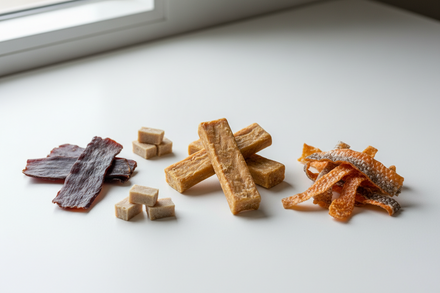
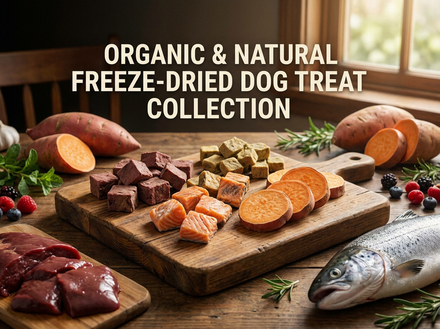
Treats should make up no more than about 10% of daily calories. Count them. For a 10-pound dog on 350 calories a day, that's 35 calories, which is fewer than most commercial biscuits. Choose single-ingredient treats (freeze-dried meat, dehydrated sweet potato), tiny training treats, or healthy human foods from the safe list below. If you use lots of treats for training, reduce meals slightly to compensate.
| Food | How to serve | Notes |
|---|---|---|
| Cooked chicken, turkey, lean beef | Plain, boneless, unseasoned | Great training reward; trim fat and skin |
| Cooked egg | Scrambled or hard-boiled, plain | Cook thoroughly; a few times a week for most dogs |
| Carrots | Raw or cooked, in pieces | Crunchy, low calorie, mild dental benefit |
| Blueberries | Fresh or frozen | Antioxidants; tiny, low-calorie treats |
| Plain pumpkin | Canned, 100% pumpkin only (not pie filling) | Spoonful can ease mild diarrhea or constipation |
| Green beans | Plain, cooked or raw | Low-calorie filler for dogs on diets |
| Plain cooked white rice | Small amount | Bland-diet component for mild upset stomach |
| Apple slices | Seeds and core removed | Fiber and crunch |
| Seedless watermelon | Small cubes | Hydrating summer treat |
| Plain peanut butter | Small amount, xylitol-free only | Check the label every time |
Some of the most dangerous items live in an ordinary kitchen. If your dog eats any of these, call your vet, an emergency clinic, or a poison control line right away, without waiting for symptoms. The ASPCA Animal Poison Control Center is at (888) 426-4435 and the Pet Poison Helpline is at (855) 764-7661; a consultation fee may apply, and it is worth it.
| Item | Why it's dangerous | What you may see |
|---|---|---|
| Xylitol (birch sugar; in sugar-free gum, candy, baked goods, some peanut butters, some toothpastes) | Triggers a rapid insulin release and sudden low blood sugar; larger doses can cause liver failure | Vomiting, weakness, stumbling, seizures within 30–60 minutes; emergency |
| Chocolate and cocoa (dark and baking chocolate are worst) | Theobromine and caffeine overstimulate the heart and nervous system | Vomiting, restlessness, rapid heartbeat, tremors, seizures |
| Grapes, raisins, currants | Unknown toxin; can cause sudden kidney failure, with no reliably safe dose | Vomiting, lethargy, decreased urination |
| Onions, garlic, chives, leeks | Damage red blood cells and cause anemia; cooked, raw, and powdered forms all count | Pale gums, weakness, dark urine; may be delayed 1–3 days |
| Macadamia nuts | Unknown toxin | Weakness (especially hind legs), vomiting, tremors, fever |
| Alcohol (including in foods and mouthwash) | Causes drops in blood sugar, body temperature, and breathing | Stumbling, vomiting, slow breathing |
| Caffeine (coffee grounds, tea, energy drinks, pills) | Overstimulates heart and nervous system | Restlessness, racing heart, tremors |
| Raw yeast dough | Expands in the stomach and ferments into alcohol | Swollen belly, retching, stumbling |
| Cooked bones | Brittle bones splinter and can puncture the gut or cause obstruction | Vomiting, straining, bloody stool |
| Corn cobs | Don't digest; a common cause of intestinal blockage | Repeated vomiting, loss of appetite, no stool |
| Cocoa bean mulch | Contains theobromine, with a sweet smell that attracts dogs | Same as chocolate |
| Sago palm and lily-of-the-valley | Sago palm seeds cause liver failure; lily-of-the-valley affects the heart | Vomiting, bloody stool, collapse |
| Avocado (use caution) | Dogs are less sensitive than some animals, but the pit is a choking and obstruction hazard and the fat can cause pancreatitis | Vomiting, belly pain |
| Fatty table scraps and grease | Can trigger pancreatitis | Vomiting, hunched posture, belly pain |
| Medications (ibuprofen, acetaminophen, naproxen, antidepressants) | Never give human pain relievers; many cause stomach ulcers or organ damage | Vomiting, black stool, lethargy |
Fresh water should be available all day, in a bowl that is cleaned daily. A rough guide is about one ounce of water per pound of body weight per day, more in hot weather, with exercise, or on dry food. Sudden increases in drinking or urination in an adult or senior dog are worth a vet visit, because they can signal diabetes, kidney disease, or other illnesses. Bring a water bottle and collapsible bowl on every walk, drive, and hike.
Shop the food and supplies: Browse Dry Dog Food and Dog Wet Food.
A tired dog is a good dog, but a mentally tired dog is a happy one. Most behavior problems come down to unmet needs for movement, sniffing, chewing, and company.
| Dog | Daily exercise | Notes |
|---|---|---|
| Puppy | Several short play and walk sessions | A common rule of thumb is about 5 minutes per month of age, twice a day; it is a guide, not a law |
| Large and giant puppy | Gentle, free play only | No forced running, repetitive jumping, or long hikes until growth plates close (roughly 12–24 months); ask your vet |
| Small adult | 30–60 minutes | Short legs take more steps; indoor play counts |
| Medium and large adult | 60–120 minutes | Sporting, herding, and working breeds need the high end plus a job |
| Brachycephalic breeds | Short, easy sessions | Avoid exertion in warm weather |
| Senior | Shorter, more frequent walks | Keep moving; steady activity protects joints and muscle |
Let your dog sniff. A slow "sniffari" where the dog chooses the route is more mentally satisfying than a fast march, and it tires them out more than you'd expect.
Rotate toys so they stay interesting. Use puzzle feeders, lick mats, and snuffle mats at mealtime. Scatter a handful of kibble in the grass. Hide treats around the house for a nose-work game. Teach a new trick every few weeks. Arrange safe social time with friendly, vaccinated dogs and people. Dogs left bored will invent their own entertainment, and you won't like it.
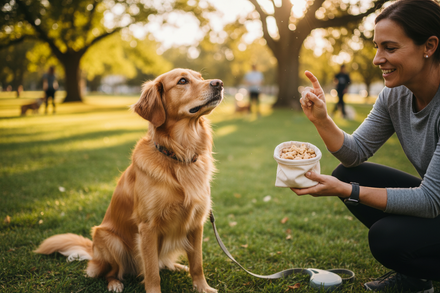
Reward what you want; calmly prevent or redirect what you don't. Keep sessions short (five minutes, several times a day), end on success, and use treats the dog values. Start with sit, down, come, leave it, drop it, wait, and loose-leash walking. Never use physical punishment, shock, or intimidation; research consistently shows it increases fear and aggression without teaching the dog what to do instead. Find a certified trainer for group classes, which are also socialization.
The most important learning window is roughly 3 to 14 weeks of age, and it continues through adolescence. During this time, gently introduce your puppy to a wide variety of people, surfaces, sounds, other dogs, car rides, and handling, always with treats and at the puppy's pace. Because puppies are not fully vaccinated until about 16 weeks, ask your vet how to socialize safely in the meantime: carry your puppy around the neighborhood, host healthy vaccinated dogs at home, and attend puppy classes that require vaccines. Skip dog parks and pet-store floors until your vet clears you. The behavioral damage of under-socialization generally outweighs the infection risk when you are careful.
Heatstroke is an emergency. A dog's normal temperature is 101 to 102.5°F; 104°F is dangerous, and at 106°F organs begin to fail. Never leave a dog in a parked car, not even with the windows cracked; the inside of a car can rise 20 degrees in ten minutes. Walk in early morning and evening. Test the pavement with the back of your hand for five seconds; if it's too hot for you, it's burning paws. Carry water, offer shade, and avoid hard exercise in the heat. Dogs at higher risk include brachycephalic breeds, thick-coated dogs, puppies, seniors, and overweight dogs. Signs include heavy panting, thick drool, bright red gums, vomiting, stumbling, and collapse. If you see them, move the dog to shade or air conditioning, wet it with cool (not ice-cold) water, run a fan, and head to the vet immediately, even if the dog seems to recover.
Small, short-coated, thin, and senior dogs chill fast. Below about 45°F, many small dogs need a coat; below 32°F, limit outdoor time; below 20°F, even hardy breeds need caution. Wipe paws after walks to remove road salt and ice melt, and clean up spills of antifreeze, which is sweet and deadly. Winter is a good season to indoor-train and play.
| Coat type | Examples | Brushing | Baths |
|---|---|---|---|
| Short, smooth | Beagle, Boxer | Weekly | Every 6–8 weeks or as needed |
| Double coat | Husky, Golden Retriever, German Shepherd | 2–3 times a week; daily in shedding season | Every 6–8 weeks; do not shave |
| Long, silky | Shih Tzu, Yorkshire Terrier | Daily | Every 3–4 weeks |
| Curly or wiry | Poodle, Schnauzer | Daily comb-out; professional trims every 4–8 weeks | Every 3–4 weeks |
Nails should be trimmed every three to four weeks; when you hear them clicking on the floor, they're too long. Ears should be checked weekly: healthy ears are pale pink and nearly odor-free. Clean only as your vet advises, and never push cotton swabs deep. Check paws for cuts, burrs, and ticks after every walk. Mats should be gently removed or shaved by a groomer, never pulled.
By age three, most dogs have some degree of dental disease, and untreated gum disease can affect the heart and kidneys. Brush daily with dog toothpaste and a soft brush; start slow and make it a treat. Dental chews and diets approved by the Veterinary Oral Health Council can help. Avoid very hard chews (antlers, hooves, real bones, hard nylon) that crack teeth; if you can't dent it with a thumbnail, it's too hard. Schedule an oral exam at every annual visit and professional cleanings when your vet recommends them.
Core vaccines protect against the most serious, widespread diseases. The DHPP combination covers distemper, adenovirus (hepatitis), parvovirus (a highly contagious, often fatal viral gut disease that survives in soil for months), and parainfluenza. Rabies is required by law. Puppies typically start vaccines at 6 to 8 weeks, with boosters every 3 to 4 weeks until about 16 weeks, then another booster a year later. Your vet will advise on non-core vaccines (Bordetella for kennel cough, Lyme, leptospirosis) depending on lifestyle and Pennsylvania's local risks. The schedule is the vet's to set.
Never use a dog's flea product on a cat; some (permethrin) are toxic to cats.
Spaying and neutering prevents unwanted litters and some cancers and infections. Timing varies: many vets now advise waiting longer for large breeds because early surgery is linked to joint problems. Discuss the right time for your dog with your vet.
Puppies visit every 3 to 4 weeks until 16 weeks. Healthy adults need an exam once a year, and seniors every six months with blood and urine tests. Do not skip them: dogs hide pain and illness.
Puppies should stay with their mother until at least 8 weeks. Expect rapid learning, 18 to 20 hours of sleep daily, teething from 3 to 6 months (provide safe chews), and a fear period around 8 to 10 weeks and again during adolescence. House training takes consistency: take the puppy out after waking, eating, playing, and every one to two hours; praise and reward immediately; clean accidents with enzymatic cleaner; never punish. Most puppies are reliable by 4 to 6 months, though small breeds can take longer. Tiny puppies can develop hypoglycemia (low blood sugar), with weakness, trembling, and wobbling; rub a bit of honey or corn syrup on the gums and head for the vet.
Adulthood is the long, steady middle of a dog's life, and the goal is to keep it that way. Maintain a lean body weight, daily exercise and mental work, dental care, and annual exams. Adults can still learn new skills at any age.
Seniors begin to slow, and signs include graying muzzles, stiffness after rest, a bluish haze in the eyes (usually harmless lens aging), hearing loss, and sleeping more. Care shifts to comfort: orthopedic bedding, ramps and traction rugs, shorter walks, regular nail trims, and a vet visit every six months with blood work. Watch for canine cognitive dysfunction: disorientation, staring at walls, night waking, and new house-soiling. Keep a quality-of-life journal marking good and bad days, and talk to your vet honestly and early. The right time is hard to know, but you will not face it alone.
| Topic | Small breeds (under 25 lb) | Large and giant breeds (50 lb and up) |
|---|---|---|
| Lifespan | Longer, often 12–16 years | Shorter, 7–12 years |
| Growth | Mature by 9–12 months | Mature slowly, 15–24 months |
| Puppy food | Small-breed or standard puppy food; frequent meals | Large-breed puppy formula with controlled calcium and calories |
| Metabolism | Fast; low blood sugar risk in tiny puppies | Slower; weight gain strains joints |
| Common health concerns | Dental disease, collapsing windpipe, luxating kneecaps, heart valve disease | Hip and elbow dysplasia, arthritis, GDV (bloat), some cancers |
| Exercise | Moderate; indoor play counts; protect from jumping off furniture | Substantial, but gentle on growing joints |
| Housebreaking | Often slower (tiny bladders) | Usually quicker; more room to make mistakes |
| Weather | Chill easily in winter | Overheat more easily in summer |
| Handling | Can be picked up, but support the whole body | Cannot be lifted easily; teach manners early |
GDV (gastric dilatation-volvulus), or bloat, is a life-threatening emergency in which the stomach fills with gas and may twist. It strikes deep-chested breeds (Great Danes, Standard Poodles, German Shepherds, Weimaraners, Irish Setters). Signs include unproductive retching, a swollen hard belly, restlessness, and drooling. It can kill within hours. To lower risk, feed two or more smaller meals, discourage gulping with a slow feeder, and avoid heavy exercise right after meals. Ask your vet about a preventive stomach-tacking surgery (gastropexy), often done at spay or neuter time for high-risk breeds.
For small breeds, protect tiny knees and backs by limiting jumping, use a harness rather than a collar, and brush teeth daily.
What you see: no waist, ribs hard to feel, slow to play, panting on short walks. Why: too many calories and too little exercise; extra weight shortens life and worsens arthritis. What to do: measure meals, count treats, add walks, and follow your vet's weight-loss plan. When to call a vet: before starting any diet, or if weight changes without a diet change.
What you see: stiffness after rest, hesitation on stairs, limping, reluctance to jump. Why: aging, injury, or developmental problems such as dysplasia, worsened by extra weight. What to do: keep your dog lean, use ramps and rugs, ask about joint-support supplements with omega-3s, and never give human pain relievers. When to call a vet: any persistent limp over a day or two, or sudden inability to stand.
What you see: bad breath, red gums, tartar, drooling, dropping food. Why: plaque turns to tartar and infects the gums. What to do: brush daily and schedule exams. When to call a vet: loose teeth, swelling under the eye, or refusal to eat.
What you see: head shaking, scratching, odor, redness, dark discharge. Why: yeast or bacteria, often from allergies or moisture in floppy ears. What to do: dry ears after swimming and keep them clean per your vet's guidance. When to call a vet: at the first signs, since infections rarely resolve on their own and can reach the middle ear.
What you see: itching, paw licking, red belly, recurring ear infections. Why: fleas, food, or environmental allergens like pollen. What to do: keep up flea prevention and bathe with a gentle shampoo. When to call a vet: open sores, constant scratching, or recurring infections; your vet can identify the cause.
What you see: vomiting, diarrhea, gas, reduced appetite. Why: diet changes, scavenging, parasites, or infection. What to do: in an otherwise bright adult, a short bland meal of plain cooked chicken and rice may help. When to call a vet: puppies and tiny dogs promptly, any dog with blood, repeated vomiting, lethargy, or symptoms past 24 hours.
What you see: howling, destruction, or accidents when left alone, drooling, frantic greetings. Why: distress at being alone. What to do: practice very short absences, keep departures calm, provide chews, and increase exercise. When to call a vet: when it is severe or injurious; behavior plans and medication may help.
What you see: ruined shoes, furniture, and trim. Why: teething, boredom, or stress. What to do: manage the environment, provide safe chews, and exercise first. When to call a vet: if the dog is swallowing non-food items.
What you see: accidents in a previously trained dog. Why: schedule changes, stress, urinary tract infection, or age. What to do: return to basics and clean with enzymatic cleaner. When to call a vet: sudden new accidents, straining, or frequent urination.
What you see: stiffening, growling, or snapping over food, toys, or spots. Why: instinct to protect valued items. What to do: never punish; trade for better treats and give the dog space. When to call a vet: a sudden change may be pain; involve a certified trainer or veterinary behaviorist.
What you see: panting, trembling, hiding, escaping. Why: noise sensitivity. What to do: offer a quiet den, play white noise, and make sure ID is current, since July 4th is the busiest day for lost dogs. When to call a vet: well beforehand, to discuss training and medication.
What you see: straining, lunging, jumping on guests. Why: it works for the dog. What to do: stop moving when the leash tightens, reward loose-leash walking, and ignore jumping. When to call a vet: if behavior suddenly worsens.
| How often | What to do |
|---|---|
| Daily | Feed measured meals; fresh water; two or more walks; training and play |
| Daily | Check eyes, nose, and stools; brush teeth |
| Weekly | Brush coat; check ears, paws, and skin; weigh puppies |
| Monthly | Heartworm, flea, and tick prevention as prescribed; trim nails; check collar fit; wash bedding and toys |
| Every 3 months | Review food, treats, and weight; groomer visit for curly coats |
| Every 6 months | Senior and giant breed wellness exam |
| Annually | Wellness exam, vaccines as advised, heartworm test, stool test, dental check, microchip scan, license renewal |
When in doubt, call. Your dog cannot tell you where it hurts.
Go today: emergency:
Book within a day or two:
Feed a complete and balanced food that carries an AAFCO statement for your dog's life stage, with a named meat as the first ingredient. Puppies need a growth formula, and large-breed puppies need one made for large breeds. Adults and seniors do well on maintenance or senior formulas matched to activity and body condition. Kibble, canned, and gently cooked foods can all work; raw and homemade diets need extra caution and your vet's guidance. Introduce any new food gradually over 7 to 10 days.
Start with the feeding chart on the bag, then adjust to your dog's body condition. A typical neutered adult needs roughly 200 calories a day at 5 pounds, 585 at 20 pounds, and 1,160 at 50 pounds, though activity, age, and metabolism all matter. Use the rib check: you should feel the ribs easily and see a waist. Keep treats under about 10 percent of daily calories and ask your vet to review portions at each visit.
Most healthy adult dogs need at least two walks a day plus play, totaling between 30 minutes for small or low-energy dogs and two hours for high-energy breeds. Puppies need shorter, more frequent outings, seniors benefit from shorter, steadier ones, and brachycephalic breeds need gentler routines in warm weather. Let your dog sniff, since that is mental exercise too.
The most dangerous are xylitol (found in sugar-free gum and some peanut butters), chocolate, grapes and raisins, onions, garlic, chives, macadamia nuts, alcohol, caffeine, and raw yeast dough. Cooked bones and corn cobs can cause blockages or punctures, and avocado calls for caution. If your dog eats any of them, call your vet or a poison control line right away instead of waiting for symptoms.
Take your puppy to the same spot first thing in the morning, after every meal, nap, and play session, and about every one to two hours in between. Reward the instant it goes outside with praise and a treat. Use a crate when you can't supervise, since dogs avoid soiling their sleeping areas, and clean accidents with an enzymatic cleaner. Never scold; the pup only learns to hide. Most puppies are reliable between 4 and 6 months, though small breeds often take longer.
It depends on size. Small dogs are usually considered seniors around 10 to 12 years, medium dogs at 8 to 10, large dogs at 7 to 8, and giant breeds as early as 5 to 6. Senior dogs benefit from veterinary exams every six months, with blood and urine tests, along with joint support, weight management, and gentle exercise.
Puppies see the vet every 3 to 4 weeks until about 16 weeks for vaccines and checks. Healthy adults should have a wellness exam at least once a year, including parasite testing and a dental check. Senior dogs, and dogs with chronic conditions, should be seen every six months. Call sooner for any sign of illness.
Choose a food labeled for the growth of large-size dogs (70 pounds or more as an adult). These formulas control calories and calcium so bones and joints grow steadily instead of too fast. Feed measured meals rather than free-feeding, keep the puppy lean with visible ribs and a waist, and do not add calcium supplements. Your vet can help you track growth on a curve and tell you when to switch to adult food.
Raw diets carry real risks. Raw meat can harbor Salmonella and Listeria, which dogs can pass to people even when they seem healthy, and homemade raw recipes are often nutritionally unbalanced. Many owners report benefits, but the evidence is mostly anecdotal, and the FDA, CDC, and AVMA discourage raw feeding. If you want to try it, choose a complete and balanced formula, practice strict kitchen hygiene, and talk to your vet first, especially with children or anyone immunocompromised at home.
Walk in the early morning and evening, test pavement with the back of your hand, and always carry water. Provide shade, a cooling mat, or a kiddie pool, and never leave your dog in a parked car. Brachycephalic, thick-coated, overweight, and senior dogs are at higher risk. If you see heavy panting, thick drool, bright red gums, or stumbling, move the dog to a cool place, wet it with cool water, and go to the vet at once.
Ready to shop? Start with Dogs!. 10% of every purchase supports no-kill animal shelters.
Before we earn a dime, 10% of every purchase at Walnut Creek Supply goes to no-kill animal shelters across the country. Not an add-on, not an option at checkout. It comes off the top of every order, every day, because we believe responsible pet ownership and caring for the community are one commitment pointed in two directions.
For dog people, that hits close to home. Shelters are full of dogs who were somebody's puppy once. If you are still deciding, consider adopting: a gray-muzzled senior who knows how to be a good dog is a gift. And if you already have yours, thank you for being the person every dog hopes will walk through the door.
We're a family business in Christiana, Lancaster County, Pennsylvania. We grow our own food and keep our own animals, and we stock goods we'd put in front of our own dogs: no mystery ingredients, Clean Fuel, No Junk. If you have a question about food, gear, or care, call us at (717) 983-8069. We'd rather talk it through with you.
Here's to many years of muddy paws and happy tails.
_From our family to yours,_ Walnut Creek Supply — Christiana, Lancaster County, Pennsylvania _walnutcreeksupply.com_
Feed a complete and balanced food that carries an AAFCO statement for your dog's life stage, with a named meat as the first ingredient. Puppies need a growth formula, and large-breed puppies need one made for large breeds. Adults and seniors do well on maintenance or senior formulas matched to activity and body condition. Kibble, canned, and gently cooked foods can all work; raw and homemade diets need extra caution and your vet's guidance. Introduce any new food gradually over 7 to 10 days.
Start with the feeding chart on the bag, then adjust to your dog's body condition. A typical neutered adult needs roughly 200 calories a day at 5 pounds, 585 at 20 pounds, and 1,160 at 50 pounds, though activity, age, and metabolism all matter. Use the rib check: you should feel the ribs easily and see a waist. Keep treats under about 10 percent of daily calories and ask your vet to review portions at each visit.
Most healthy adult dogs need at least two walks a day plus play, totaling between 30 minutes for small or low-energy dogs and two hours for high-energy breeds. Puppies need shorter, more frequent outings, seniors benefit from shorter, steadier ones, and brachycephalic breeds need gentler routines in warm weather. Let your dog sniff, since that is mental exercise too.
The most dangerous are xylitol (found in sugar-free gum and some peanut butters), chocolate, grapes and raisins, onions, garlic, chives, macadamia nuts, alcohol, caffeine, and raw yeast dough. Cooked bones and corn cobs can cause blockages or punctures, and avocado calls for caution. If your dog eats any of them, call your vet or a poison control line right away instead of waiting for symptoms.
Take your puppy to the same spot first thing in the morning, after every meal, nap, and play session, and about every one to two hours in between. Reward the instant it goes outside with praise and a treat. Use a crate when you can't supervise, since dogs avoid soiling their sleeping areas, and clean accidents with an enzymatic cleaner. Never scold; the pup only learns to hide. Most puppies are reliable between 4 and 6 months, though small breeds often take longer.
It depends on size. Small dogs are usually considered seniors around 10 to 12 years, medium dogs at 8 to 10, large dogs at 7 to 8, and giant breeds as early as 5 to 6. Senior dogs benefit from veterinary exams every six months, with blood and urine tests, along with joint support, weight management, and gentle exercise.
Puppies see the vet every 3 to 4 weeks until about 16 weeks for vaccines and checks. Healthy adults should have a wellness exam at least once a year, including parasite testing and a dental check. Senior dogs, and dogs with chronic conditions, should be seen every six months. Call sooner for any sign of illness.
Choose a food labeled for the growth of large-size dogs (70 pounds or more as an adult). These formulas control calories and calcium so bones and joints grow steadily instead of too fast. Feed measured meals rather than free-feeding, keep the puppy lean with visible ribs and a waist, and do not add calcium supplements. Your vet can help you track growth on a curve and tell you when to switch to adult food.
Raw diets carry real risks. Raw meat can harbor Salmonella and Listeria, which dogs can pass to people even when they seem healthy, and homemade raw recipes are often nutritionally unbalanced. Many owners report benefits, but the evidence is mostly anecdotal, and the FDA, CDC, and AVMA discourage raw feeding. If you want to try it, choose a complete and balanced formula, practice strict kitchen hygiene, and talk to your vet first, especially with children or anyone immunocompromised at home.
Walk in the early morning and evening, test pavement with the back of your hand, and always carry water. Provide shade, a cooling mat, or a kiddie pool, and never leave your dog in a parked car. Brachycephalic, thick-coated, overweight, and senior dogs are at higher risk. If you see heavy panting, thick drool, bright red gums, or stumbling, move the dog to a cool place, wet it with cool water, and go to the vet at once.
Every all dogs article we've published, in one place.