


Dog Owners: Vet Supervised 8 to 12 Week Dog Allergy Diet Trial
Vet-first steps to confirm a dog food allergy: run a strict 8 to 12 week elimination diet, avoid treats and cross contamination, and use single ingredient...

If you suspect your dog has a food allergy, the only reliable first step is a veterinary-supervised elimination diet using a prescription hydrolyzed or veterinary novel-protein formula. Skip the over-the-counter “limited ingredient” bags and skin/blood allergy tests; neither one confirms a food allergy. The trial itself typically runs 8 to 12 weeks for skin symptoms, with zero treats, chews, or flavored medications allowed during that window.
TL;DR:
- An elimination diet must be strictly followed without treats or flavored medications for 8 to 12 weeks, using prescription hydrolyzed or novel-protein formulas.
- Protein sources like beef, dairy, and chicken cause most dog food allergies, while grains are rarely the culprit, with cross-reactivity posing additional challenges.
- Owners must meticulously prevent cross-contamination from household pets and over-the-counter products, as these can invalidate the trial results.
- Supplement supportive measures like omega-3 oils or colloidal oatmeal baths with vet approval, but avoid unlisted flavorings that could reintroduce allergens.
- Food allergies in dogs are relatively rare; environmental factors cause most year-round itchiness, so proper diagnosis is crucial before changing diets.
Table of Contents
- What Does a Dog Allergy Diet Actually Need to Address?
- How Common Are Different Food Allergens in Dogs?
- How Do You Run a Valid Elimination Diet Trial?
- Which Type of Diet Fits Your Dog’s Trial?
- Can Supplements Help While You Manage a Dog Allergy Diet?
- When Should You Escalate Beyond Diet Management?
- Walnut Creek Pet’s Role in Supporting Diet Trials
- How Do Food Allergies Affect a Dog’s Nutrition and Growth?
- Are There Risks to Running an Elimination Diet?
- How Do You Transition a Dog Onto a New Diet Safely?
- What Mistakes Most Often Undermine a Dog Allergy Diet Plan?
- The Real Talk on Dog Allergy Diets
- Where to Find Trial-Safe Products for Your Dog
- Sources
What Does a Dog Allergy Diet Actually Need to Address?
Food allergies in dogs show up almost entirely on the skin. Chronic, year-round itching around the paws, ears, face, and belly is the hallmark sign, and it doesn’t ease up with the seasons the way pollen or grass allergies do. Roughly 20% of confirmed cases also involve gastrointestinal symptoms like soft stool, vomiting, or excessive gas, but skin problems come first for most dogs.

The pattern matters more than any single symptom. A dog scratching in August and fine by November is probably dealing with something environmental, like ragweed or fleas. A dog chewing its paws in January exactly like it did in July is a much stronger candidate for a diet-related cause.
Before assuming food is the culprit, run through a quick checklist:
- Rule out fleas first. Even one or two bites can trigger intense itching in a sensitive dog.
- Note any recent food, treat, or supplement changes in the past 4 to 8 weeks.
- Track whether baths or omega-3 supplements bring temporary relief (environmental allergies often respond better to these than food allergies do).
- Start a symptom journal with dated, timestamped photos. Patterns that are invisible day to day often jump out after two or three weeks of notes.
That journal becomes essential once you sit down with your vet to plan an actual trial.
How Common Are Different Food Allergens in Dogs?
Protein sources cause the overwhelming majority of canine food allergies, not grains. A review of 297 dogs with confirmed cutaneous adverse food reactions found:
- Beef: 34% of cases
- Dairy: 17%
- Chicken: 15%
- Wheat: 13%
- Lamb: 5%
Beef, dairy, and chicken account for two-thirds of all confirmed food allergy cases in dogs despite grain-free marketing suggesting otherwise. Wheat lands in the middle of the pack, and lamb, often marketed as a “hypoallergenic” protein, still shows up as an allergen in some dogs.
Cross-reactivity complicates things further. A dog allergic to beef may also react to lamb, since the proteins share enough molecular similarity to confuse the immune system. The same overlap can occur between chicken and other poultry, or occasionally between chicken and fish. This is one reason a vet might steer you toward a hydrolyzed diet instead of simply swapping one novel meat for another.
How Do You Run a Valid Elimination Diet Trial?
An elimination trial only works if it’s airtight. Half measures don’t just slow down the process, they produce false results that send you back to square one.
- Book a vet consult before changing anything. Your vet will factor in your dog’s age, any existing health conditions, and a full diet history (including every treat, chew, and supplement) before recommending a hydrolyzed or novel-protein prescription diet.
- Feed the trial diet exclusively. A properly performed elimination trial requires 100% of daily calories to come from that one diet. No table scraps, no flavored heartworm chews, no flavored toothpaste, nothing.
- Hold the course for the full timeline. Veterinary dermatologists recommend at least 8 to 12 weeks for skin issues and 3 to 4 weeks when GI symptoms are the primary complaint.
- Log everything. Weekly photos and a simple 1 to 10 itch score turn a vague “seems better” into data your vet can actually use.
- Re-challenge deliberately. Once symptoms resolve, your vet may have you reintroduce the old diet, or individual ingredients one at a time, to confirm the trigger and rule out coincidence.
The most common way owners sabotage their own trial is cross-contamination. A multi-pet household where one dog snags a bite from another’s bowl, a well-meaning neighbor slipping over a biscuit, or a “hypoallergenic” treat that was manufactured on shared equipment with chicken byproduct can all invalidate weeks of careful feeding. Over-the-counter limited-ingredient diets are especially prone to cross-contact contamination during manufacturing, which is exactly why prescription-grade diets exist.
Pro Tip: Put a note on the treat cabinet, the counter, and anywhere else food lives in your house. “Dog on strict diet trial through [date], no exceptions” stops well-meaning family members from quietly breaking the rules.
Which Type of Diet Fits Your Dog’s Trial?
Not every elimination diet works the same way, and the choice usually comes down to your dog’s history and how strict the trial needs to be.
- Hydrolyzed diets break proteins down into fragments small enough that the immune system usually can’t recognize them as a threat. Vets often prefer these for skin disease specifically because they sidestep the cross-reactivity problem between related proteins that novel-protein diets can’t always avoid.
- Novel-protein diets use a protein and carbohydrate source your dog has genuinely never eaten (kangaroo, rabbit, venison paired with an unusual starch). They work well when the diet history is truly clean, but any prior exposure, even a one-time treat years ago, can undermine the whole point.
- Elemental diets use free amino acids instead of intact or hydrolyzed proteins. They’re the most hypoallergenic option available but are typically reserved for dogs that fail both hydrolyzed and novel-protein trials.
- Home-prepared diets can work for an elimination trial, but only when formulated by a board-certified veterinary nutritionist. A homemade diet built from a random internet recipe risks nutritional gaps that create new problems while you’re trying to solve the original one.
Whatever the format, avoid grabbing a bag off a pet store shelf labeled “limited ingredient” and calling it a trial diet. Retail limited-ingredient formulas aren’t held to the same manufacturing controls as prescription diets, and the insight from veterinary nutrition sources is consistent: they’re not a substitute for the real thing during diagnosis.
Can Supplements Help While You Manage a Dog Allergy Diet?
A handful of supportive measures have real backing, and they can make a miserable few weeks more bearable without derailing your trial, as long as you time them correctly.
- Omega-3 fish oil provides anti-inflammatory support, but it takes time to show full effect, usually 4 to 8 weeks of consistent dosing.
- Colloidal oatmeal baths offer fast, topical relief for itchy skin and are safe to use throughout a trial since they’re applied externally.
- Canine-specific probiotics paired with a prebiotic like plain canned pumpkin can support gut health, though noticeable changes usually take 8 to 16 weeks.
The catch: never add a new protein source, treat, or “natural” supplement with unlisted flavoring during an active trial. A fish oil capsule flavored with chicken liver, for instance, quietly reintroduces the exact allergen you’re trying to rule out.
Pro Tip: Ask your vet to confirm the exact ingredient list on any supplement before adding it mid-trial. “Fish oil” and “fish flavor” are not the same product.
When Should You Escalate Beyond Diet Management?
Most food allergy cases are manageable at home once identified, but a few situations call for immediate attention rather than watchful waiting.
- Seek urgent care for severe vomiting, collapse, or signs of systemic infection.
- Get a vet visit promptly if secondary skin infections (pyoderma) develop from constant scratching.
- If the trial diet resolves symptoms, work with your vet on a re-challenge to confirm the exact trigger, then build a permanent avoidance plan around it.
- If symptoms persist despite a strict trial, dermatology referral is the next step, since the cause is likely environmental rather than dietary.
Walnut Creek Pet’s Role in Supporting Diet Trials
A carefully selected range of single-ingredient and organic products supports trial-friendly feeding, which depends on knowing exactly what’s in the bag. A portion of profits goes toward no-kill shelters, and the care guides on the site exist to help owners navigate exactly this kind of diagnostic process. Products that support strict feeding typically include single-ingredient treats, freeze-dried toppers, and supplements with clear, simple ingredient lists.
How Do Food Allergies Affect a Dog’s Nutrition and Growth?
A dog stuck with an undiagnosed food allergy for months isn’t just uncomfortable, it’s often nutritionally shortchanged. Chronic GI inflammation from an ongoing allergic reaction can interfere with nutrient absorption, even when the dog is eating a technically balanced diet. Puppies are particularly vulnerable here, since growth plates and developing joints depend on consistent, absorbable protein and mineral intake during the first year.
Constant low-grade itching and GI upset also burn through calories. Dogs that scratch, lick, or chew excessively expend energy that would otherwise go toward maintenance or growth, and chronic skin inflammation increases the body’s overall metabolic demand. Some allergic dogs show up at the vet underweight or with a dull coat despite eating what looks like plenty of food, simply because their body is fighting an internal battle around the clock.
The flip side matters too. A poorly managed elimination trial, one that drags on for months without resolution, or a home-cooked diet built without professional guidance, can introduce its own nutritional gaps. This is why board-certified nutrition input matters for any homemade approach, and why prescription hydrolyzed or novel-protein diets are formulated to be nutritionally complete rather than just allergen-free. Getting the diagnosis right quickly isn’t only about comfort. It protects a growing puppy’s development and helps an adult dog rebuild condition once the trigger is removed.
Are There Risks to Running an Elimination Diet?
Elimination trials are safe for the overwhelming majority of dogs, but they aren’t entirely risk-free, and owners should go in with realistic expectations.
The most common issue is short-term nutritional imbalance if the trial diet is chosen poorly or fed inconsistently. Novel-protein and hydrolyzed diets from reputable veterinary manufacturers are formulated to be complete, but a homemade trial diet assembled without professional guidance can fall short on calcium, certain amino acids, or trace minerals, especially over an 8 to 12 week stretch.
Some dogs also experience temporary GI upset when switching onto a new diet format, particularly hydrolyzed formulas, which have a distinct texture and smell that some dogs initially resist. Picky eaters may lose weight during the first week or two if they refuse to eat enough of the new food, which is worth monitoring closely rather than assuming it will resolve on its own.
There’s also a psychological risk worth naming: owner fatigue. Eight to twelve weeks of strict feeding, with family members, dog walkers, and visiting friends all needing the same instructions, is a long stretch to maintain perfectly. A single slip, even a well-intentioned one, can force a restart of the entire timeline. Going in with a clear, written plan and buy-in from everyone in the household reduces the odds of an accidental reset.
How Do You Transition a Dog Onto a New Diet Safely?
Switching foods too fast is one of the easiest ways to create GI symptoms that muddy your trial results before it even begins. A gradual transition avoids confusing new symptoms with actual allergy signs.
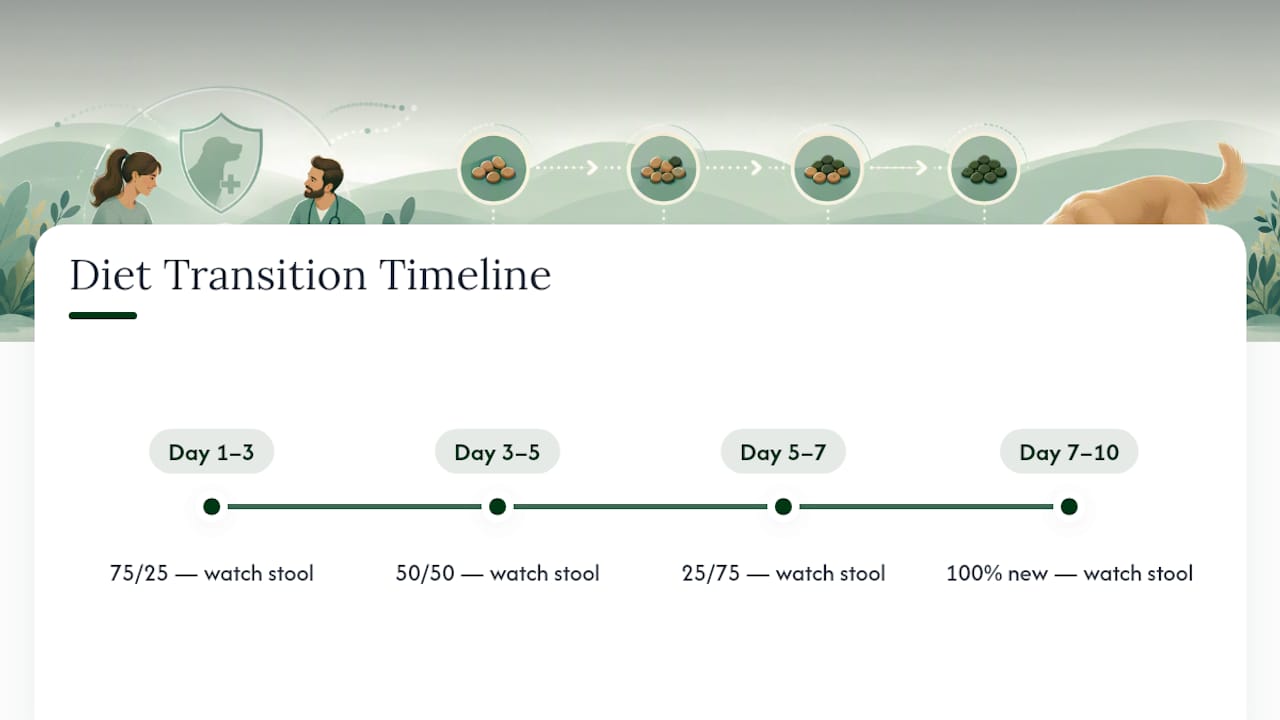
The standard approach spreads the change over 7 to 10 days: start with roughly 75% old food and 25% new food for two or three days, move to a 50/50 mix for two or three more, then 25% old and 75% new, before finally landing on 100% of the new diet. Watch stool consistency at each stage. Loose stool during the transition is usually just the gut adjusting, not a sign the new diet is wrong.
For dogs starting a prescription hydrolyzed diet, the smell and texture can be off-putting at first since it’s noticeably different from standard kibble. Warming the food slightly or adding a small amount of warm water to release aroma can help reluctant eaters adjust without introducing anything new to the ingredient list. Avoid the temptation to sprinkle in a favorite topper to coax them along. Anything added during this window needs to be cleared with your vet first, since even a “safe” old favorite could contain the very ingredient you’re trying to isolate.
What Mistakes Most Often Undermine a Dog Allergy Diet Plan?
The same handful of errors show up again and again in failed elimination trials, and nearly all of them are avoidable with a little upfront planning.
Cutting the trial short is the biggest one. Symptoms often improve somewhat within the first few weeks, and owners understandably assume they’ve found the answer and start reintroducing old treats too soon, only to see symptoms flare back up. The full 8 to 12 week window exists because partial improvement isn’t the same as full resolution.
Treating the flavored heartworm or flea preventive as harmless is another frequent slip. These products often contain animal proteins or flavoring agents that can contain trace allergens, undermining a trial that’s otherwise perfectly executed. Ask your vet about an unflavored or compounded alternative during the trial period.
Forgetting other pets in the house rounds out the top mistakes. A cat’s food left out overnight, or a housemate dog’s bowl within reach, can quietly reintroduce a suspect protein without anyone noticing. And relying on blood or saliva allergy panels instead of a proper feeding trial remains one of the most persistent and costly misconceptions in dog allergy management.
The Real Talk on Dog Allergy Diets
Here’s what gets lost in most advice on this topic: true food allergies are genuinely uncommon in dogs. Environmental allergies to pollen, dust mites, and fleas cause far more chronic itching than diet ever does, yet food gets blamed first because changing a diet feels more actionable than treating an environmental trigger. That instinct leads a lot of owners into years of unnecessary grain-free switching, novel-protein hopping, and expensive boutique kibble that never actually addresses the problem.
The conventional wisdom of “just try a hypoallergenic food” falls short because it skips the diagnostic step entirely. A trial without veterinary structure, without a full 8 to 12 week commitment, without eliminating every treat and flavored chew, isn’t a diagnosis. It’s a guess dressed up as one.
If your dog is genuinely itchy year-round, prioritize getting an actual answer over guessing your way through bag after bag of food. Confirm the trigger, then build a permanent, boring, reliable diet around it. Boring is the goal here. Boring means it’s working.
— Timothy
Where to Find Trial-Safe Products for Your Dog
Keeping a strict feeding trial on track gets a lot easier when you know exactly what’s in every treat and topper your dog touches. Some companies offer product lines built around single-ingredient and organic options to help owners managing restrictive diets avoid complex ingredient labels.

During a trial, stick to treats with one listed ingredient and nothing else. A bag of beef liver treats or pork treats works well when those proteins aren’t the suspected allergen, and turkey chips are worth a look if turkey is genuinely novel for your dog. For everyday feeding once a trigger is confirmed, Earthborn’s grain-free Meadow Feast formula offers a simplified protein source for long-term management. If chicken isn’t on your dog’s avoid list, a topper like Stella & Chewy’s Dinner Dust or their Meal Mixers can make a bland prescription diet more appealing without piling on extra ingredients.
Before adding anything to your cart during a trial, check the label for exactly one named protein, no “natural flavor” or “meat byproduct” listed vaguely, and no shared-equipment warnings for allergens you’re avoiding. Browse Walnutcreekpet’s single-ingredient treats and toppers to build a trial-safe rotation your dog will actually enjoy.
Sources
- Mueller et al., cutaneous adverse food reactions review (PMC4710035)
- Tufts Petfoodology — Eliminating mistakes in elimination diet trials
- DVM360 — Identifying food allergies: elimination diet trial
- AAHA 2023 guidelines — management of allergic skin disease


