


Dog Owners: 5 Checks to Spot Misleading Dog Food Labels in the Aisle
Use five quick aisle checks to read dog food labels: nutritional adequacy, named protein, guaranteed analysis, calories, and red flag additives.

Five checks tell you almost everything: the nutritional adequacy statement, a named protein among the first five ingredients, the guaranteed analysis, the feeding directions, calorie count, and a scan for red-flag additives or toxins. Labels are governed by FDA guidance and AAFCO model rules, so a legitimate bag has to include manufacturer contact information and a best-by date, too. Run through those five checks in the aisle and you’ll know more about a bag of food than most people learn in years of shopping.
TL;DR:
- Always verify that the ingredient list includes a named protein or meal in the top five ingredients to ensure genuine meat content.
- Check that the nutritional adequacy statement is based on actual feeding trials rather than just calculations, for more reliable dietary validation.
- Compare calorie counts per cup, as similar feeding instructions can deliver different energy levels, affecting your dog’s weight management.
- Ensure the label lists a full manufacturer address and a recent best-by date to confirm product freshness and traceability.
- Be cautious of labels claiming “natural,” “organic,” or “human-grade,” as only the USDA organic seal or certified standards guarantee strict quality definitions.
Table of Contents
- What Does the Front of the Bag Actually Tell You?
- What Should You Check on the Information Panel?
- How Should You Read the Ingredient List?
- What Do “Natural,” “Organic,” and “Human-Grade” Actually Mean?
- Which Additives and Toxins Should Send You to a Different Bag?
- How Do Calorie Counts and Best-By Dates Affect Your Dog?
- How Do You Verify the Company Behind the Bag?
- What Do Grain-Free, Limited-Ingredient, and Allergy Claims Really Mean?
- How Walnut Creek Pet Backs Up What It Sells
- What the Manufacturer Contact Line Really Tells You
- A Practical Note on Reading Labels in the Aisle
- Shop Transparent Labels With Walnut Creek Pet
- Sources
- FAQ
What Does the Front of the Bag Actually Tell You?
The front of the bag is marketing space with a few legal guardrails. Every principal display panel has to carry the product name, a statement that it’s for dogs, and the net weight. Everything else, the happy golden retriever, the farm scene, the word “premium,” is decoration with zero legal weight.
Where the real information hides is in the product name itself. AAFCO’s naming rules turn a few words into a math problem, and once you know the pattern, you’ll never misread a bag again.
- “Beef Dog Food” (the 95% rule): at least 95% of the product (excluding water for processing) must be beef.
- “Beef Dinner,” “Beef Entrée,” or “Beef Formula” (the 25% rule): beef only needs to make up 25% to 94% of the product, so three-quarters of the bag could be something else entirely.
- “With Beef”: requires just 3% beef. This is the one that catches shoppers off guard.
- “Beef Flavor”: requires no minimum percentage of actual beef, just enough to be detectable. A flavor claim can be met with beef digest or broth alone.
That single word choice, “dinner” versus straight “dog food,” changes the actual math dramatically. Read the ingredient list before trusting the name.
What Should You Check on the Information Panel?
The information panel, usually on the back or side, carries the four things that actually determine nutritional value: the ingredient list, the guaranteed analysis, the nutritional adequacy statement, and feeding directions.
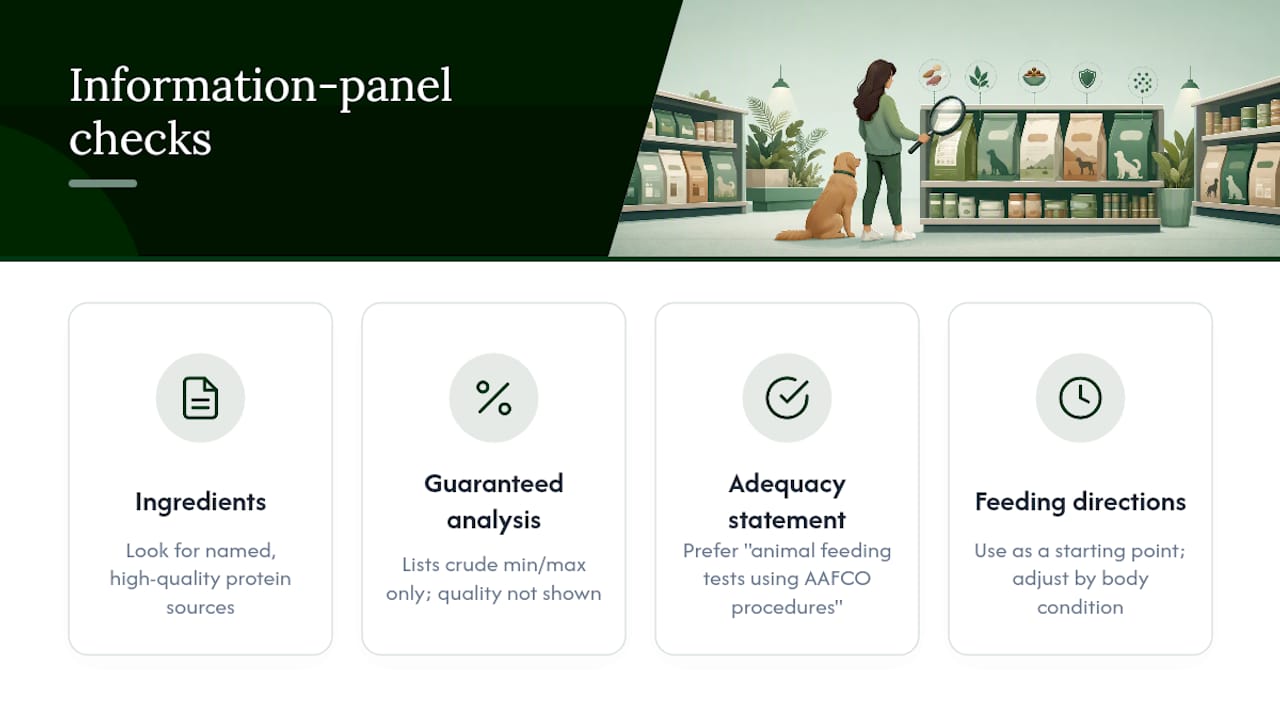
The guaranteed analysis lists minimum rough estimates of crude protein and crude fat, plus maximum rough estimates of crude fiber and moisture. “Crude” doesn’t describe quality. It refers to the lab method used to measure the nutrient (a Kjeldahl test for protein, for instance), and it tells you nothing about how digestible or bioavailable that nutrient actually is, according to the Pet Food Institute. A 30% crude protein food made from poor-quality sources can deliver less usable nutrition than a 24% food built on named, high-quality proteins.
The nutritional adequacy statement is arguably the single most important sentence on the entire package. It tells you whether the food is “complete and balanced” for a specific life stage, and how the manufacturer proved it.
Pro Tip: Look for the phrase “animal feeding tests using AAFCO procedures” versus “formulated to meet AAFCO nutrient profiles.” The first means the recipe was actually fed to dogs and monitored; the second means it was calculated on paper. Feeding trials are the stronger substantiation, according to University of Nebraska Extension.
Feeding directions are estimates built around an average dog, and your dog is not average. A neutered, low-activity dog might need 20% less than the bag suggests, while a working or intact dog might need more. Use the printed amount as a starting point, then adjust based on your dog’s body condition, not the number on the bag.
How Should You Read the Ingredient List?
Ingredients appear in descending order by weight, measured before cooking or processing. That single rule explains most of the confusion pet owners run into at the shelf.
- Understand the water effect. Fresh chicken contains a high percentage of water. Once it’s weighed for the label, that water inflates its position, so “chicken” can legally appear before “chicken meal” even though the meal supplies far more actual protein once moisture is removed. Wet and dry formulas from the same brand can list ingredients in a completely different order for exactly this reason, per AAFCO.
- Know the difference between meat, meal, and by-products. “Chicken” is fresh muscle tissue with the water still in it. “Chicken meal” is chicken with the water and fat already removed, a concentrated protein source. “Meat by-products” is a vaguer category covering organs and other parts, legal and often nutritious, but harder to evaluate because it isn’t a named source.
- Watch for ingredient splitting. A manufacturer can list “corn,” “corn gluten meal,” and “corn bran” as three separate entries to push each one lower on the list, even though combined they might outweigh the named meat. Mentally add up related entries before judging a formula, a tactic UNL Extension flags as one of the most common ways labels obscure true composition.
- Scan the first five ingredients specifically. That’s usually where 50% or more of the formula’s weight sits. Prioritize bags where a named animal protein or named meal (chicken, chicken meal, salmon meal) sits at or near the top.
What Do “Natural,” “Organic,” and “Human-Grade” Actually Mean?
These three words get thrown around like they’re interchangeable. They’re not, and only one of them carries a strict government definition.
Organic is regulated by the USDA National Organic Program, and a product can only use the USDA Organic seal if it meets specific certification standards for how ingredients were grown and processed. Human-grade is also a regulated claim, technically, meaning every ingredient and the facility itself must meet standards for human food production, not just pet food standards. Natural, by contrast, is largely a marketing term. AAFCO does define it (essentially meaning no synthetic ingredients except added vitamins and minerals), but it’s a much looser bar than either of the other two and doesn’t say anything about overall nutritional quality.
- Look for the actual USDA Organic seal, not just the word “organic” printed somewhere on the bag.
- A genuine human-grade claim should be backed by a statement about facility inspection, not just bold packaging text.
- None of these three claims substitute for checking the nutritional adequacy statement and the first five ingredients. A “natural” bag can still be nutritionally mediocre.
Which Additives and Toxins Should Send You to a Different Bag?
Some ingredient fears circulating online are overblown; others are entirely legitimate. Telling the two apart matters more than avoiding every syllable you don’t recognize.
BHA, BHT, and ethoxyquin are synthetic preservatives that keep fat from going rancid. Regulatory agencies permit them at approved levels, but plenty of owners prefer to avoid them when a safer option exists, and ethoxyquin in particular has been voluntarily reduced by many manufacturers because of lingering questions about long-term exposure, especially in fish meal where it can persist upstream in the supply chain even when it’s not listed directly on the final label. Artificial colors serve no nutritional purpose at all. Dogs don’t choose food by color; that dye is there purely for the human shopping experience.
Then there’s a category that isn’t a judgment call. Xylitol, onions, garlic, grapes, and raisins are genuinely toxic to dogs, and none of them belong in a legitimate dog food formula under any circumstances, according to veterinary toxicology guidance on common canine toxins. If you ever see one of these on an ingredient panel, put the bag back immediately, no exceptions.
- Prefer mixed tocopherols (a natural vitamin E blend) or rosemary extract over synthetic preservatives when a formula offers the choice.
- These natural preservatives generally mean shorter shelf stability, so check the best-by date more carefully.
- A shorter ingredient list with recognizable names is usually easier to evaluate than a long one full of chemical abbreviations.
How Do Calorie Counts and Best-By Dates Affect Your Dog?
The calorie statement lives near the guaranteed analysis, expressed in kilocalories per kilogram and ideally per a familiar unit like a cup or a can. That second number is the one that actually helps at feeding time.
Two bags with identical feeding directions (“1 cup twice daily”) can carry very different calorie densities. If one delivers 400 kcal per cup and another delivers 500, following the same cup measurement means one dog gets 25% more energy than the other for zero extra effort. That gap adds up fast, especially for smaller breeds or dogs already managing their weight.
- Compare caloric density, not just cup measurements, when switching formulas.
- Manufacturers that print calories per cup transparently make weight management noticeably easier; a bag that omits this number is a real usability gap worth noting.
- Best-by or manufacture dates indicate freshness and nutrient stability; older bags may provide less nutritional value due to ingredient degradation over time.
How Do You Verify the Company Behind the Bag?
Every legitimate dog food label has to list the manufacturer or guarantor’s name and address, per FDA labeling requirements. This isn’t a throwaway detail. It’s your recourse if something goes wrong, and it’s a quick way to separate an established company from an anonymous private-label operation you can’t easily trace.
Check whether the label lists an actual street address or just a website and a P.O. box. A company willing to print a full address and a working phone number, and to answer questions about sourcing when you call, is telling you something about how it operates. If a bag makes it hard to find out who actually made the food, that’s worth weighing against everything else on the label.
The best-by date sits near this contact information on most labels. It reflects when the manufacturer expects vitamin content and fat stability to start declining, not a hard safety cliff like a “use by” date on dairy. Still, treat it seriously: buy from retailers with enough turnover that you’re not getting a bag that’s been sitting in a warehouse for a year already. A fresher bag closer to its production date gives you a better shot at getting the nutrient levels printed on the guaranteed analysis, rather than a version that’s already lost some potency sitting on a shelf.
What Do Grain-Free, Limited-Ingredient, and Allergy Claims Really Mean?
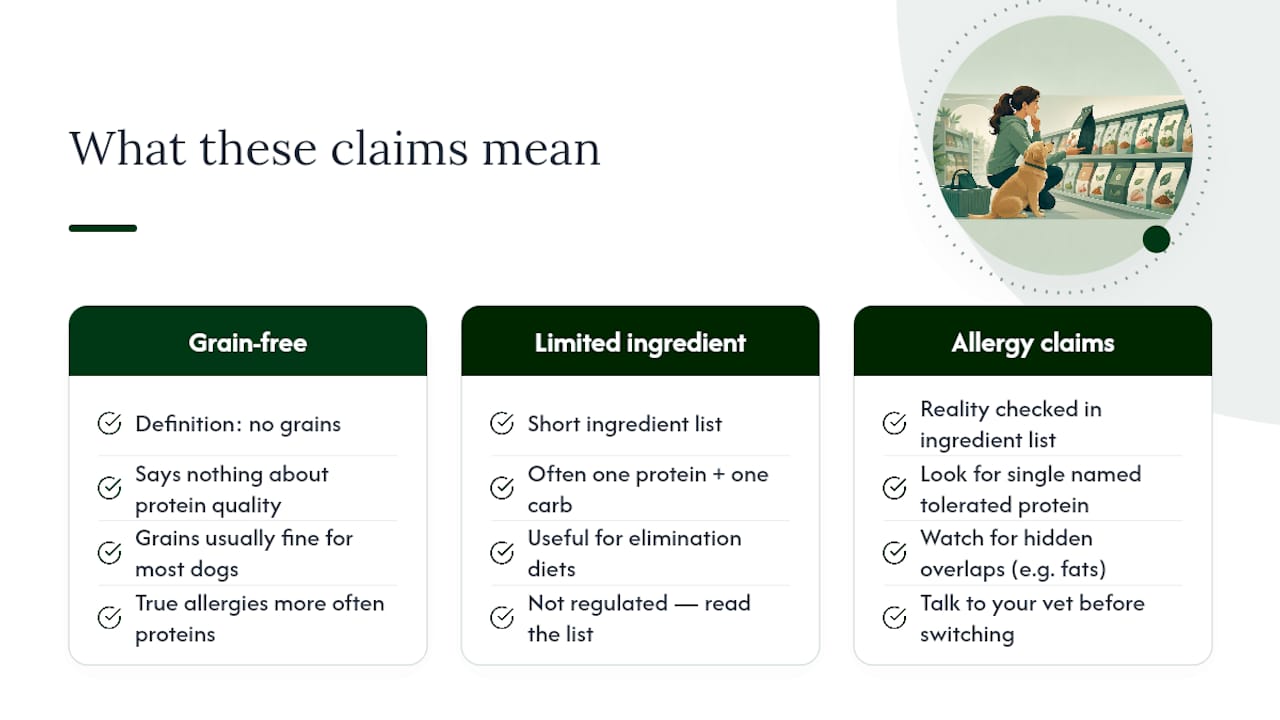
“Grain-free” simply means no wheat, corn, rice, oats, or other grains, nothing more. It says nothing about protein source, quality, or overall nutrition, and grains themselves are not inherently a problem for the vast majority of dogs. The stigma around grains as dog food villains is largely undeserved; genuine allergy triggers are far more often specific proteins than grains as a category, according to veterinary nutrition sources.
“Limited ingredient” diets are built for dogs with suspected food sensitivities, using a short ingredient list, often a single named protein and a single carbohydrate source, to make it easier to identify what’s triggering a reaction. These formulas can be genuinely useful for elimination diets, but “limited ingredient” isn’t a regulated term with a fixed ingredient cap, so always confirm by reading the actual list rather than trusting the phrase on the front.
If your dog has a diagnosed or suspected allergy, the real work happens in the ingredient list, not the marketing claim. Look for a single named protein you know your dog tolerates, confirm there’s no hidden overlap (a “duck” formula that also lists chicken fat further down defeats the purpose), and talk to your vet before switching, since true food allergies are less common than owners assume and symptoms often trace back to something else entirely.
How Walnut Creek Pet Backs Up What It Sells
Reading a label is only half the job. Finding brands that make it easy to trust what’s printed on it is the other half, and that’s the standard behind every product Walnutcreekpet carries. A portion of profits support no-kill shelters, and the product lineup favors natural, single-ingredient options where the label is easy to read.
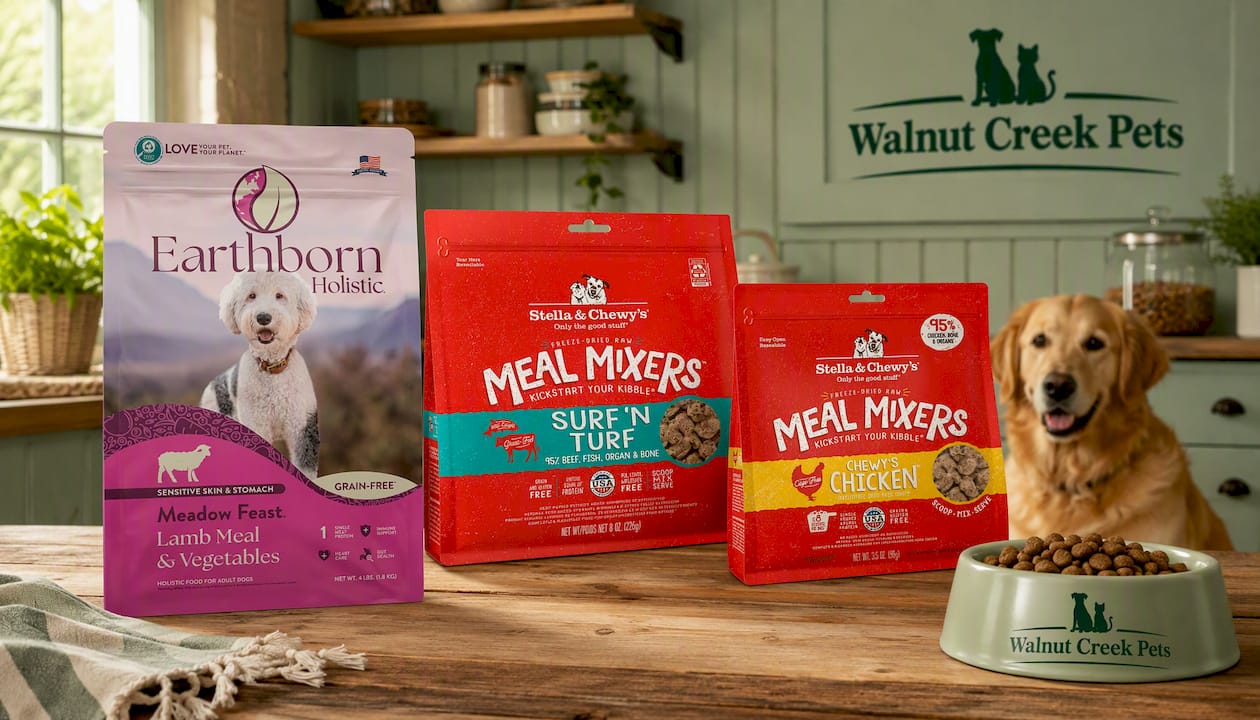
Look at Earthborn Grain Free Meadow Feast Dry Dog Food as a working example. The ingredient panel leads with named meats, exactly the pattern this guide walks through. Or check the Stella & Chewy’s Surf & Turf freeze-dried mixer and the Stella & Chewy’s Chicken mixer, both built around a single named protein rather than a blur of by-products.
What the Manufacturer Contact Line Really Tells You
Beyond the required address, look at how a company handles the follow-up. Does the packaging list a phone number that connects to an actual person, or just a generic web form? Does the company publish sourcing details beyond the bare legal minimum? The approach to this is built into the product pages themselves: care guides and new-adopter discounts exist specifically to help customers understand labels better. A shopper who understands the difference between “chicken” and “chicken meal” is in a much stronger position to ask a manufacturer the right follow-up questions, and to notice when a company doesn’t answer them well.
A Practical Note on Reading Labels in the Aisle
My take: skip the front of the bag entirely and go straight to the nutritional adequacy statement and the first five ingredients. Everything else on the package is negotiable; those two items are not. If a bag fails either check, put it back, no matter how good the marketing looks.
Before you check out, run this: adequacy statement present and life-stage appropriate, named protein in the first five ingredients, guaranteed analysis reasonable for that protein claim, calories printed per cup, and zero red-flag additives.
— Timothy
Shop Transparent Labels With Walnut Creek Pet
This company offers products that lean toward organic, natural, and single-ingredient formulas, so the label-reading skills from this guide can pay off at checkout instead of getting buried under vague marketing claims.
Start with the 100% Beef liver dog treats or the 100% Turkey dog treats if you want to practice reading a label with exactly one ingredient on it, zero ambiguity, zero splitting tricks. If you’re feeding a multi-dog household with different needs, the beef and chicken combo meals show how a mixed-protein product still lists everything in plain, checkable order. New to a puppy? The Puppy Packs 'n Snacks starter pack pairs training-sized treats with feeding guidance sized for a growing dog. A portion of every purchase supports no-kill shelters, so the label you’re reading may also contribute beyond your own dog’s bowl. Browse the full lineup at Walnut Creek Pet or reach out to customer service with label questions before you buy.
Sources
- Reading Labels
- Animal Food Labeling and Pet Food Claims
- Pet Foods: How to Read Labels (UNL Extension)
- Veterinary literature on common canine toxins
- What is guaranteed analysis? (Pet Food Institute)
FAQ
What Should You Look for on a Dog Food Label?
Start with the nutritional adequacy statement to confirm the food is complete and balanced for your dog’s life stage, then check that a named protein sits among the first five ingredients. Follow up with the guaranteed analysis and a scan for red-flag additives like xylitol or artificial colors.
What Are the New Dog Food Labeling Requirements?
There’s no sweeping nationwide overhaul of pet food labeling rules on the immediate horizon; AAFCO and FDA continue to refine model regulations covering label format, intended-use statements, and the “Pet Nutrition Facts” box gradually rather than through one single mandate. Check AAFCO’s model regulations for the current format standards before assuming a specific new rule applies.
What Dog Food Brands Should You Stay Away From?
Rather than a blanket brand blacklist, check every bag for the same red flags: no nutritional adequacy statement, vague “meat by-products” with no named source dominating the ingredient list, or the presence of onions, garlic, xylitol, grapes, or raisins. Any brand failing those checks deserves skepticism regardless of its name or price point.
What Is the 95% Rule in Dog Food?
Compare that to “Beef Dinner” or “Beef Formula,” which only require 25% to 94% beef, a gap wide enough to change what you’re actually feeding your dog.
What Does “Crude” Mean in Guaranteed Analysis?
“Crude” refers to the laboratory testing method used to measure a nutrient, not the ingredient’s quality or origin. A high crude protein percentage doesn’t guarantee that protein is easily digestible, according to the Pet Food Institute, so pair that number with a look at the named protein sources in the ingredient list.


