


Are Bully Sticks Safe for Puppies? A Complete Safety Guide
Are bully sticks safe for puppies? Learn the 3 age checks, right size, and chew limits that prevent choking so your pup chews safely.

Last Updated: November 14, 2026
Quick Summary
Yes, bully sticks can be safe for puppies with the right size, timing, and supervision. Most puppies can try a thin bully stick around 12 to 16 weeks, but young puppies, gulpers, and unsupervised chewers face real choking risk. Treat bully sticks as a supervised chew, never a leave-behind toy.
- Skip all hard chews under 8 weeks and offer only soft chews from 8 to 12 weeks.
- Remove the last two inches of a bully stick before your puppy can swallow it.
- Cap chew sessions at 15 minutes for puppies under six months, two to three times a week.
- Keep treats to about 10 percent of daily calories; a six-inch stick often runs 50 to 100 calories.
- Call your vet if a puppy swallows a piece but is breathing normally; never induce vomiting yourself.
Not sure which bully stick fits your puppy?We carry single-ingredient bully sticks in sizes for every puppy stage, with guidance to match.
Shop Bully Sticks
Table of Contents
- Are Bully Sticks Safe for Puppies? The Short Answer
- What Age Can Puppies Have Bully Sticks?
- Are Bully Sticks Safe for Puppies Teeth?
- Choking Risk, Supervision, and End Pieces
- Best Bully Sticks for Puppies: Size, Thickness, and Quality
- How Long Should Puppies Chew Bully Sticks?
- Digestibility, Calories, and Treat Budget
- Choosing the Right Bully Stick for Your Puppy at Walnut Creek Supply
- Frequently Asked Questions
Are Bully Sticks Safe for Puppies? The Short Answer
Yes, bully sticks can be safe for puppies, but only with the right size, timing, and supervision. A bully stick is a single-ingredient dog chew made from beef pizzle, and it is fully digestible when sourced and processed well.
So are bully sticks safe for puppies in every case? No. Young puppies, gulpers, and unsupervised chewers face real choking risk. The sections below cover age, teeth, size, timing, and what to do when something goes wrong.
What Age Can Puppies Have Bully Sticks?
Most puppies can try a bully stick around 12 to 16 weeks, once they have enough jaw control to chew rather than gulp. Before that, their puppy teeth are small and sharp, and their chewing ability is still developing.
Here is how we think about readiness by stage:
- Under 8 weeks: still nursing or just weaning, skip all hard chews
- 8 to 12 weeks: soft chews only, no bully sticks yet
- 12 to 16 weeks: small, thin bully sticks with close supervision
- 4 to 6 months: teething peaks, thicker sticks help
Small breed puppies mature faster in some ways and slower in others. A tiny Chihuahua mix may be ready later than a large breed puppy of the same age. Judge the puppy, not the calendar.
Are Bully Sticks Safe for Puppies Teeth?
Bully sticks are generally safe for puppy teeth when the stick matches the puppy's jaw strength. The chew is firm but gives slightly, which suits puppy teeth better than hard antlers or bones.
The risk shows up with sticks that are too hard or too thick. A puppy that has to fight a rock-hard stick can chip a puppy tooth or wear the enamel down. Watch for these signs that the stick is too much:
- The puppy gives up after a few minutes
- You see blood at the gumline
- The puppy chews only one corner and stops
If any of those happen, drop down a thickness. A softer, thinner stick is the better call for a young puppy.
Choking Risk, Supervision, and End Pieces
Choking is the number one bully stick hazard, and the end piece is the culprit. Once a stick gets short enough to swallow whole, it can lodge in the throat or esophagus.
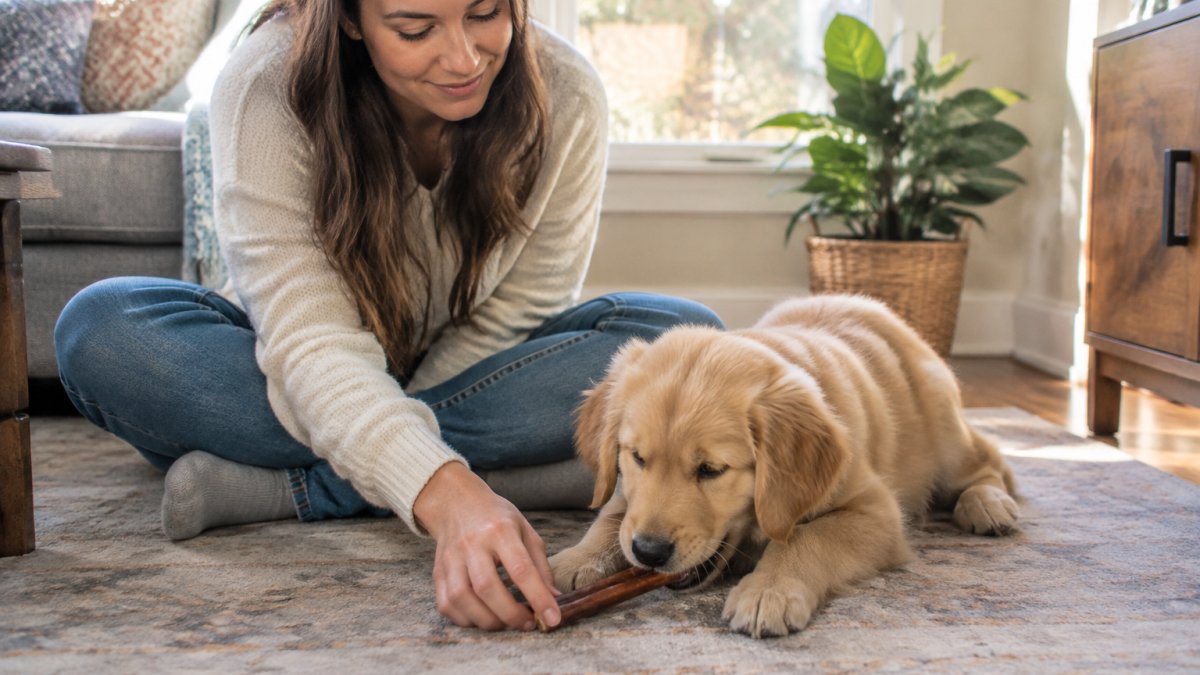
Follow these supervision rules every single time:
- Stay within arm's reach for the whole chew session
- Take the stick away when it shrinks to about two inches
- Never leave a bully stick in the crate or on the floor
- Watch for gagging, pawing at the mouth, or heavy drooling
What to do if your puppy swallows a large piece
A swallowed piece is not automatically an emergency, but it is a watch-and-decide moment. Work through these steps in order:
- Check the mouth only if the piece is visible. Sweep a finger only when you can clearly see the piece and can reach it safely. Blind finger sweeps can push an object deeper into the airway.
- Let a coughing puppy cough. A strong, forceful cough means the airway is partially open and the cough is doing its job. Do not intervene with back blows or abdominal thrusts on a coughing puppy unless the cough weakens or stops.
- If breathing stops or the puppy goes limp, act immediately. For a puppy that cannot breathe, call your veterinarian or an emergency clinic on the way and follow their phone instructions. Do not wait to see if it passes.
- If the puppy swallowed the piece and is breathing normally, call your vet. Describe the size of the piece, the time it was swallowed, and your puppy's weight. Your vet will decide whether to induce vomiting, monitor at home, or bring the puppy in. Never induce vomiting yourself without veterinary direction.
Signs that need urgent veterinary care
Call an emergency clinic right away if you see any of these after a chew session:
- Repeated gagging or retching with nothing coming up
- Pawing at the mouth or neck persistently
- Difficulty breathing, noisy breathing, or blue-tinged gums
- Drooling that will not stop
A piece that passes into the stomach often moves through, but a piece that lodges in the esophagus or intestines can cause an obstruction that shows up hours later. A common pattern is a puppy that seems fine right after the swallow and then starts vomiting or goes off food the next day.
For puppies that chew hard and fast, durable chew toys for aggressive chewers offer a safer outlet between bully stick sessions.
Best Bully Sticks for Puppies: Size, Thickness, and Quality
The best bully sticks for puppies are thin to medium thickness, about five to six inches long, and made from a single ingredient. Thickness matters more than length. A thin stick gives a puppy a fair fight. A thick stick can be too much for a small jaw.
Quality checks to look for:
- One ingredient: beef pizzle, nothing added
- No artificial preservatives
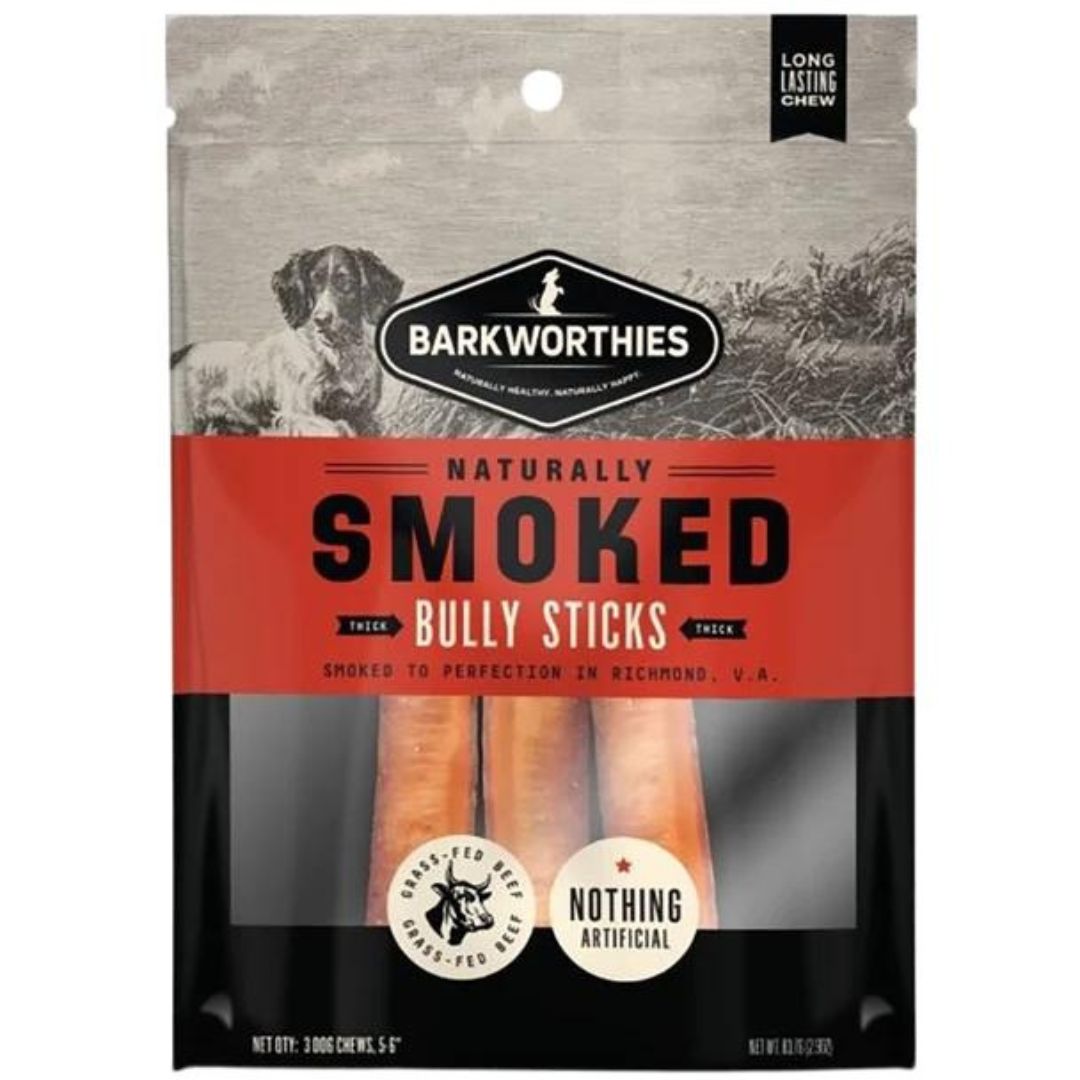
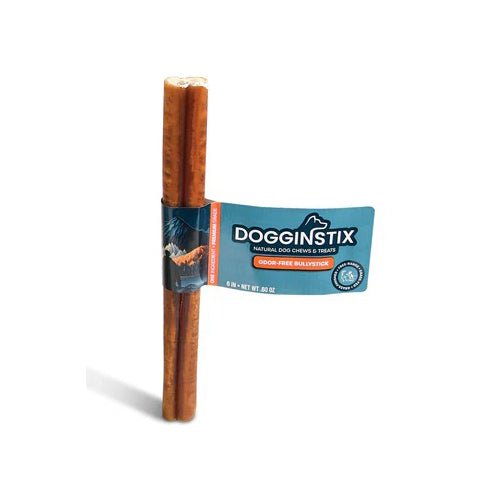
Two options we carry fit this profile well. The Barkworthies Smoked Thick Bully Sticks run about six inches and are well-suited to strong, enthusiastic chewers. The Dogginstix all-natural, odor-free bully stick is a single-ingredient, grass-fed beef chew that is fully digestible and high in protein.
| Puppy Stage | Stick Thickness | Length | Chew Time |
|---|---|---|---|
| 12-16 weeks | Thin | 5-6 in | 5-10 min |
| 4-6 months | Medium | 6 in | 10-15 min |
| 6+ months | Medium to thick | 6 in | 15-20 min |
| Strong adult chewer | Thick | 6 in | 20+ min |
How Long Should Puppies Chew Bully Sticks?
Puppies should chew a bully stick for about 10 to 15 minutes per session, a few times a week. Long sessions tire the jaw and load the stomach with too much protein at once. Short, supervised sessions work better for digestion and behavior.
A few timing rules that keep chew time safe:
- Cap sessions at 15 minutes for puppies under six months
- Give a bully stick two to three times per week, not daily
- Skip chew time right before or after meals
- End the session before the puppy loses interest
Puppies that chew too long often get loose stool the next day. Cutting session length fixes most of that.
Digestibility, Calories, and Treat Budget
Bully sticks are still a protein- and calorie-dense treat, and portions count. A bully stick is not a meal replacement. It belongs in the daily treat budget alongside training treats and table scraps.
The treat budget math
A widely used rule of thumb is that treats should make up no more than about 10 percent of a dog's daily calories. For a puppy, that ceiling matters more, because puppies need their main food to carry the right balance of protein, fat, calcium, and phosphorus for growth. Bully sticks vary by brand and size, but a typical six-inch stick often lands in the range of roughly 50 to 100 calories. Check the package label for the specific product you buy, because thickness and drying method change the number.
Here is how that plays out for a few common puppy sizes. These are illustrative ranges, not prescriptions, and your veterinarian can give you a target based on your puppy's body condition and growth curve:
| Puppy weight | Estimated daily calories (rough) | 10% treat ceiling (rough) | What that means for bully sticks |
|---|---|---|---|
| 5 lb | 200-250 | 20-25 | A fraction of one stick, split across sessions |
| 10 lb | 350-450 | 35-45 | About half a typical six-inch stick per day at most |
| 20 lb | 600-800 | 60-80 | One typical six-inch stick fits, but not plus other treats |
| 40 lb | 1,000-1,300 | 100-130 | One to one and a half sticks, still within budget |
If a bully stick session pushes your puppy over the treat ceiling, cut back the next meal slightly or skip other treats that day. Do not cut the main diet long-term to make room for chews; puppies need that food for growth.
Digestion signals to watch
Watch for these after a chew:
- Soft stool the next day
- Vomiting within a few hours
- Gas or stomach gurgling
- Loss of appetite at the next meal
If you see any of these, shorten the session or switch to a thinner stick. Puppies with a known beef allergy or food sensitivity should skip bully sticks entirely, since the chew is beef-based.
Adjusting the rest of the day
A bully stick session is easiest to fit when you plan the rest of the day around it. Skip training treats in the hour before and after a chew, and do not stack a bully stick on top of a meal. For puppies in training, low-calorie training treats help keep the daily treat total in check while bully sticks stay a weekly chew.
Choosing the Right Bully Stick for Your Puppy at Walnut Creek Supply
Picking the right bully stick comes down to three things: age, jaw strength, and supervision habits. Get those right and a bully stick becomes a safe, enriching chew that supports dental health and satisfies the natural urge to gnaw.
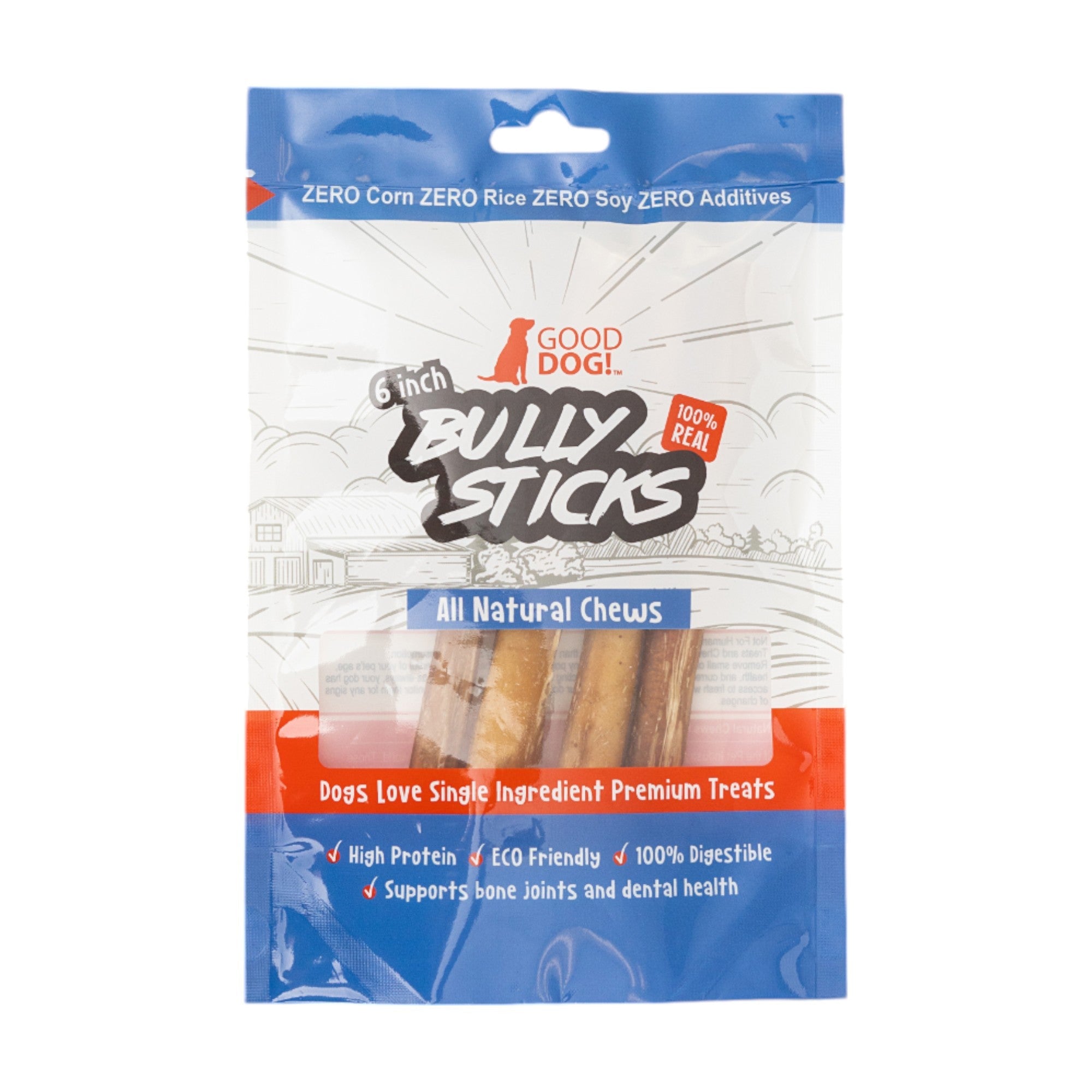
At Walnut Creek Supply, we are a family-owned, USA-based shop focused on high-quality pet supplies and clear guidance. If you are ready to buy, the 6-inch all-natural beef bully stick 4-pack is a solid standard size for most puppies past the 12-week mark.
Start with one stick, one short session, and your full attention. That is the safest way to find out whether bully sticks work for your puppy.
The challenge with any chew is matching it to the dog in front of you, not the dog in the reviews. We stock single-ingredient bully sticks and natural chews, and we write the guidance to go with them.
Frequently Asked Questions
Are bully sticks safe for puppies to eat?
Bully sticks are safe for most puppies once they have their adult teeth and can chew efficiently, usually around 4 to 6 months of age. Always supervise your puppy while they chew, choose a stick thick enough that they cannot swallow it whole, and remove the last 2 to 3 inches before it becomes a choking hazard. Puppies with sensitive stomachs or beef allergies should try a small piece first.
Are bully sticks safe for 4-month-old puppies?
Many 4-month-old puppies can chew bully sticks if they are teething and have enough jaw strength, but readiness varies by breed and size. Small or toy breeds may still struggle with thick sticks, so choose a thinner, appropriately sized option. Supervise closely, limit sessions to 10 to 15 minutes, and take the stick away once it shrinks to a swallowable length.
Can bully sticks damage a puppy's teeth?
Bully sticks are softer than bones or antlers and are generally gentle on puppy teeth when sized correctly. Avoid very hard or thick sticks for young puppies with baby teeth, and never let your puppy chew for hours without a break. If you notice bleeding gums or a cracked tooth, stop using the chew and consult your veterinarian.
How do you stop a puppy from swallowing the end of a bully stick?
The safest approach is to remove the bully stick once it shrinks to about 2 to 3 inches, before your puppy can swallow it whole. Hold one end while your puppy chews, or use a bully stick holder to keep the last piece secure. Always supervise, and if your puppy does swallow a large piece, monitor for gagging, vomiting, or distress and call your veterinarian immediately.
What are the best bully sticks for puppies?
The best bully sticks for puppies are single-ingredient, fully digestible options made from grass-fed beef, sized to your puppy's breed and chewing style. Thinner sticks suit small breeds and teething puppies, while thicker sticks work for strong chewers. Look for single-ingredient, odor-free, preservative-free options, and always match the stick thickness to your puppy's size to reduce choking risk.


