


Best Ferret Cage Enrichment Ideas: 12 Setups That Work
Discover the best ferret cage enrichment ideas, from tunnels and hammocks to safe toys and DIY projects. Build a setup your ferret will actually use.

Table of Contents
- Why Ferret Cage Enrichment Changes Behavior
- Ferret Cage Setup: Planning the Layout Before You Buy
- Ferret Tunnels and Tubes: The Non-Negotiable Enrichment
- Hammocks, Hideouts, and Soft Resting Spots
- Safe Toys for Ferrets: A Material and Hazard Checklist
- DIY Ferret Toys You Can Build This Weekend
- Dig Boxes, Foraging, and Sensory Play
- Rotating Enrichment and Adapting to Age and Mobility
- Frequently Asked Questions
Last Updated: October 19, 2026
Why Ferret Cage Enrichment Changes Behavior
A ferret that paces, chews cage bars, or sleeps out of boredom is not "bad", it is under-stimulated.
Ferret owners often find that even with a large cage, their ferrets can remain restless. The cage itself is rarely the problem, the empty space inside it often is.
Ferrets are curious, high-energy hunters. They want to dig, tunnel, climb, stash, and investigate every corner. When a cage offers none of that, behavior problems follow fast:
- Bar biting and cage scratching
- Chewing on bedding or bowls
- Over-grooming cage mates
Add enrichment and most of that fizzles out within a week or two.
Key Takeaway
A cage packed with random toys is not enrichment. A cage with zones for sleeping, tunneling, digging, and playing is. Plan the space first, then buy.
Ferret Cage Setup: Planning the Layout Before You Buy
Start with the layout, not the cart. A good ferret cage setup divides space into zones so your ferret can move from rest to play to digging without crossing the same toy twice.
Most cages fail because everything sits on one level. Ferrets burrow and climb, so they need vertical and floor space that each do a different job.
Mapping Zones by Activity Level
Think of the cage as four zones stacked or side by side:
- Sleep zone: a dark, enclosed hideout or hammock, placed high and away from the door
- Active zone: tunnels and climbing routes, ideally in the middle of the cage
- Dig zone: a dig box or litter pan with safe material, on the lowest level
If you are starting from scratch, a multi-level enclosure gives you room for these zones. Our 3-Tier Cat Cage Enclosure ($105.99) includes a hammock, ladder, and toy ball, and its modular shelves adjust as your ferret's needs change.

Keep heavy items low, ferrets climb and knock things over, and a falling hideout can injure an animal. Line the bottom with a soft, absorbent bedding such as CareFRESH bedding ($30.99), made from reclaimed natural fiber.
Watch Out
Never stack a heavy hideout or dig box on a high shelf. A ferret that climbs onto it can tip it over and get pinned. Put weight at the bottom, soft items up top.
Ferret Tunnels and Tubes: The Non-Negotiable Enrichment
If you buy one thing for your ferret, buy a tunnel.
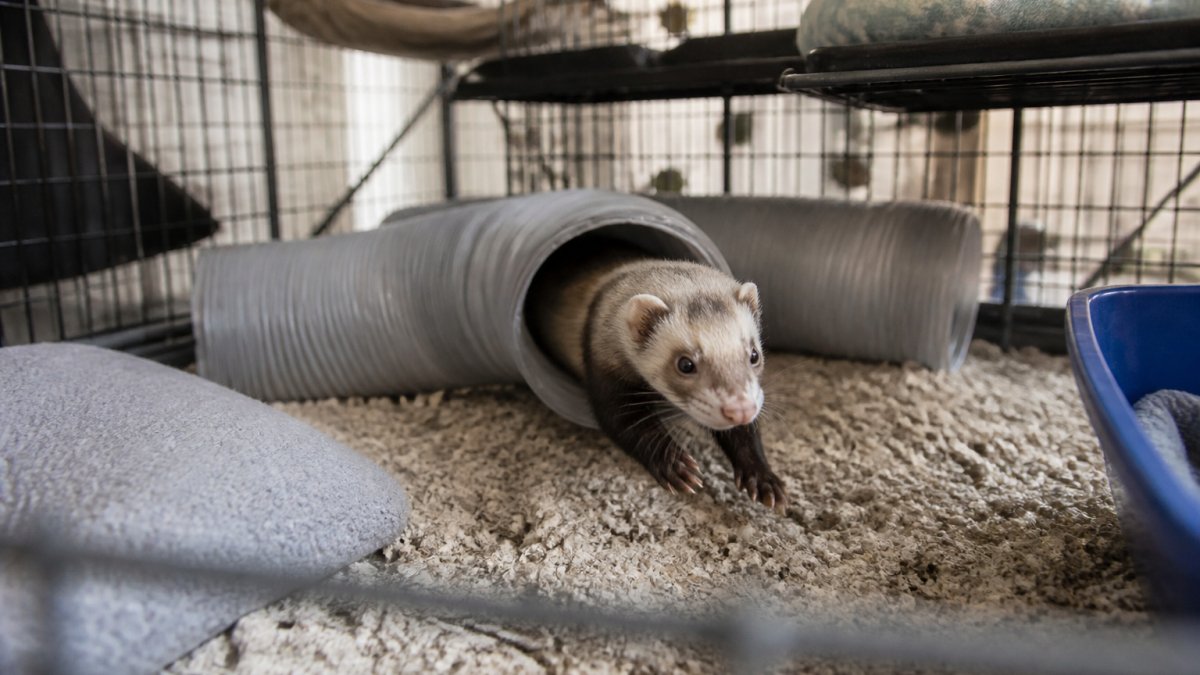
You have three good options, each with a different job:
- Corrugated plastic tubes: cheap, flexible, easy to bend into curves. Look for tubes at least 4 inches in diameter so a full-grown ferret can turn around inside without getting stuck. The ridges give paws something to grip.
- Fleece tunnels: soft, machine washable, good for sleeping inside. These work best as a resting tunnel rather than a running tunnel because they collapse under a hard pounce.
- Cardboard tubes: free, and ferrets love to shred them. Use them as a disposable outer layer or a dig-box filler, not as a permanent structural tunnel.
Link two or three tubes into a longer run and change the shape every couple of weeks so the route feels new.
Ferrets love a tunnel they can enter from two ends.
Sizing and Placement Rules That Actually Matter
A tunnel too narrow is a hazard; one too wide is ignored. A 4- to 6-inch interior diameter generally suits adult ferrets, with kits and smaller females often fine at the low end. Measure the widest part of your ferret's shoulders and add an inch of clearance.
Placement matters as much as size:
- Run at least one tunnel horizontally along the cage floor so your ferret can sprint through it.
- Angle a second tunnel from a shelf down to the floor to create a ramp-and-burrow route.
- Keep tunnel openings clear of water bowls and litter pans so a wet or soiled ferret does not track mess through the tube.
Cleaning and Inspection
Tunnels get chewed, soiled, and stretched. Check every tube weekly for cracks, sharp edges, and loose zip ties; sand smooth or replace corrugated plastic with jagged splits. Wash fleece tunnels weekly on a gentle, cold cycle and air-dry. Swap cardboard tubes as soon as they soften or tear, since a soggy tube collapses and can trap a ferret.
Watch Out
Never leave a ferret unsupervised in a tube with loose string, frayed fleece, or exposed wire. A ferret that gets a paw or jaw caught in a collapsing tunnel can panic and injure itself trying to back out.
Pro Tip
Rotate tunnel shapes, not just tunnel locations. A straight run, an L-shape, and a U-shape each ask your ferret to move differently, which keeps the route mentally interesting even when the tubes are the same ones.
Hammocks, Hideouts, and Soft Resting Spots
Ferrets sleep up to 18 hours a day, so where they rest matters as much as where they play. A hammock, hideout, and soft bedding give your ferret a safe, dark place to crash.
The Marshall Pet Hangin' Monkey Hammock ($31.99) is made of soft fleece with two openings, working as both a bed and a tunnel.

Hang it so it does not swing into cage sides or shelves.
Pair the hammock with:
- A hideout: an enclosed sleeping box or a fleece sack
- Soft bedding: fleece cozies and blankets for burrowing
- A second resting spot: ferrets like options, and they move between them
Wash soft items weekly.
Safe Toys for Ferrets: A Material and Hazard Checklist
Safe toys for ferrets are toys a ferret cannot chew apart, swallow, or get a toe caught in. That rules out a lot of what pet stores sell for other animals.
Marshall Pet Ferrets Hangin' Monkey Hammock Brown →
Run every toy through this checklist before it goes in the cage:
- No small parts that can break off and be swallowed
- No loose strings, threads, or fraying edges
- No soft rubber or foam that tears into chunks
Materials to Avoid
Some materials look fine on the shelf and turn dangerous fast. Skip these:
- Soft rubber and foam: ferrets shred them and swallow the pieces
- Loose rope and string: can wrap around a limb or get swallowed
- Small bells and beads: choking hazards
Safe materials include hard plastic, fleece, untreated wood, and pet-safe straw. Our Nibbles Straw Ball ($2.99) is made with pet-friendly straw and supports chewing, exploring, and hiding. You can tuck treats inside for extra fun.

Pro Tip
Rotate toys through a "quarantine" bin. Any toy that comes out of the cage goes into a box for a week. Inspect it for cracks or loose pieces before it goes back in. Most toy injuries come from a toy that was already failing.
DIY Ferret Toys You Can Build This Weekend
DIY ferret toys cost little and keep your ferret busy, which is why so many owners build their own. But a homemade toy is only as safe as its weakest material, so check every toy against the same hazard list you would use for a store-bought one.
Here are five you can make with things you likely already have.
- Sock toy: Stuff an old, clean sock with fleece scraps and knot the end. Ferrets love to grab and shake it. Use a sock with no holes and no loose thread at the toe, and retire it the moment the knot starts to unravel.
- Cardboard tube maze: Tape three or four empty paper towel tubes into a tunnel system. Swap them out when they get shredded. Use plain paper tape, not duct tape, because a ferret will chew the adhesive.
- Small ball pit: Fill a shallow plastic bin with lightweight balls or crumpled paper. Ferrets dive and dig through it. Keep the bin shallow enough that your ferret can climb out on its own, and skip any ball small enough to fit in a mouth.
- Treat ball: Put a few treats inside a straw ball or a hard plastic ball with holes. Your ferret has to work to get them out. Check that the holes are larger than a treat but smaller than a ferret's jaw, so the toy rewards effort instead of inviting a stuck snout.
- Fleece braid: Braid three strips of fleece into a tug toy. Check it weekly for fraying. A braid that comes untied becomes a string hazard, so knot both ends tightly and trim loose strands.
The DIY Material Rules
Before you build, run the material through this short list:
- Safe to reuse: fleece, untreated hardwood, plain cardboard, paper, hard plastic containers with no sharp cut edges.
- Not safe to reuse: soft rubber, foam, loose rope, string, yarn, small bells, beads, and anything with adhesive residue.
- Wash first: any fabric or container that held food, soap, or chemicals.
The toys ferrets love most often fail fastest, a sock toy gets chewed at the knot, a cardboard maze gets crushed at the joints. That is fine if you treat DIY toys as consumables and replace them before they break down.
Supervision and Replacement
Supervise the first few play sessions with every DIY toy. Ferrets destroy things faster than you expect, and a toy that holds up on day one may fall apart on day three. Pull any toy with a loose piece, torn seam, or softened joint and repair or bin it. Keep a small repair kit, fleece scraps, a needle and heavy thread, and plain paper tape, so a five-minute fix keeps a favorite toy in rotation.
Key Takeaway
DIY enrichment is a budget strategy, not a shortcut around safety. Build cheap, inspect often, and replace early, the cost of a new sock toy is nothing next to a vet visit.
Dig Boxes, Foraging, and Sensory Play
A dig box is a shallow container of safe material that lets a ferret dig, burrow, and search.
Good fillers for a dig box:
- Shredded paper
- Safe bedding such as CareFRESH
- Pet-safe straw
Bury a few treats or a favorite toy in the box and let your ferret hunt.
Food-based enrichment works the same way.
Water play is another option. A shallow pan of water lets a ferret splash and dig. Keep it supervised and shallow, and dry the cage afterward.
Rotating Enrichment and Adapting to Age and Mobility
Enrichment works best when it changes. A ferret that sees the same toys every day stops noticing them.
Here is a simple rotation schedule that works for most ferrets:
| Frequency | What to Rotate | Why It Matters |
|---|---|---|
| Every 2-3 days | Swap 2-3 toys in and out | Restores novelty and curiosity |
| Weekly | Rearrange tunnels and hideouts | Creates new routes to explore |
| Weekly | Refresh dig box filler | Keeps digging clean and interesting |
| Monthly | Change hammock and cozy spots | Prevents wear and boredom |
Adapt the plan as your ferret ages. Young ferrets want long tunnels, climbing routes, and fast-moving play.
Watch individual preferences too. Some ferrets are diggers, others climbers or chewers. Build the cage around what your ferret actually does, not what a guide says it should do.
Best For
Ferrets that lose interest in toys fast. A two-bin rotation system, one bin in the cage, one bin resting, keeps novelty high with zero extra spending.
A restless ferret is usually a bored ferret, and the fix is a cage that gives it something to do. Walnut Creek Supply carries the supplies to make it happen, from the Hangin' Monkey Hammock to safe chew toys and soft bedding, all backed by authoritative, informative guidance.
Frequently Asked Questions
What toys are safe to leave in a ferret cage unattended?
Leave only toys that have no loose parts, exposed seams, or small pieces a ferret could chew off and swallow. Solid plastic balls, hard rubber toys sized too large to fit in the mouth, and untreated wood blocks are generally safe for unsupervised time. Check every toy before you leave it in the cage: tug on seams, look for cracks, and remove anything with a bell or bead. Straw and hay chew toys like the Nibbles Straw Ball ($2.99) work well because they break down as your ferret chews rather than shedding plastic fragments. Rotate items so nothing gets chewed into a hazard.
How often should I rotate ferret toys and enrichment items?
A three- to five-day rotation works for most ferrets. Pull out about half the toys and swap in items your ferret has not seen for a week or two. Ferrets lose interest in familiar objects quickly, so novelty matters more than quantity. Keep a small storage bin of alternates and cycle them back in. Rotate tunnels and hammocks less often, since ferrets build comfort around sleeping spots, but move their position in the cage occasionally to encourage exploration. Inspect every item for damage during each swap.
Can ferrets have tunnels and hammocks in their cage at the same time?
Yes, and most ferrets do best with both. Tunnels satisfy the urge to burrow and sprint through enclosed spaces, while hammocks give them a raised place to sleep and watch. The Marshall Pet Ferrets Hangin' Monkey Hammock ($31.99) is made of soft fleece with two openings for tunneling and attaches with four metal swivel clips. Hang it away from cage sides for climbers, or near a shelf or tunnel opening for ferrets that struggle to climb. Just confirm the hammock cannot swing into a water bowl or cage bar.
How do I make DIY enrichment toys for ferrets without spending much?
Start with items already in your house: cardboard tubes from paper towels, plain paper bags with the handles removed, and clean socks. Stuff a sock with crinkle paper and a treat, knot the end, and you have a cheap foraging toy. Cut holes in a cardboard box to make a hideout, or fill a shallow plastic tub with bedding for a dig box. Skip anything with tape, staples, glue, or loose string. Inspect DIY toys daily, since ferrets destroy cardboard quickly, and replace them once edges get chewed soft.


