


How to Choose Reptile Lighting: The 2026 Setup Guide
Learn how to choose reptile lighting for your setup. Covers UVB, heat bulbs, basking temps, placement, and schedules for healthy reptiles.

Table of Contents
- UVB, UVA, and Visible Light: What Reptiles Actually Need
- The Best UVB Bulb for Bearded Dragons and Other Basking Species
- Reptile Lighting Distance and Placement: Getting It Right
- Reptile Light Schedule: Photoperiod and Seasonal Cycles
- How Often to Replace Reptile UVB Bulbs (and How to Verify Output)
- Safe Fixture Setup: Preventing Burns and Fire Hazards
- Conclusion
- Frequently Asked Questions
Last Updated: October 14, 2026
UVB, UVA, and Visible Light: What Reptiles Actually Need
Reptile lighting replicates natural sunlight and breaks down into three jobs: ultraviolet B for vitamin D3 synthesis, ultraviolet A for behavior and color vision, and visible light for day-night signaling. This guide from Walnut Creek Supply walks through how to choose reptile lighting fixture by fixture, matching your animal's biology instead of guessing at the pet store shelf.

Wild reptiles live under unfiltered sun that delivers UVB, UVA, and full-spectrum visible light at once. An enclosure that provides only heat leaves a reptile unable to process calcium properly, no matter how well it eats.
How Ultraviolet Radiation Supports Reptile Health
Ultraviolet radiation is the portion of the light spectrum below visible light that drives vitamin D3 synthesis in reptile skin. Without adequate UVB, a reptile cannot convert dietary or stored calcium into a usable form, leading to metabolic bone disease. UVA influences appetite, breeding behavior, and social signaling. UVB and UVA are not interchangeable, and neither substitutes for heat.
Heat Bulbs vs. UVB Lamps: Two Jobs, Two Fixtures
Heat bulbs and UVB lamps serve separate functions and generally need separate fixtures. A halogen or incandescent heat bulb produces infrared warmth for basking; a fluorescent or mercury vapor UVB lamp produces the ultraviolet radiation that drives calcium metabolism. Mercury vapor bulbs combine both but run hot and offer less control. For most keepers, two fixtures give better results: you can dial in basking temperature independently from UVB output.
Pro Tip
Mount your UVB fixture and your heat fixture so their beams overlap at the basking spot. That way the animal absorbs UVB while it is already sitting still and warming up, rather than having to choose between the two.
The Best UVB Bulb for Bearded Dragons and Other Basking Species
The best UVB bulb for bearded dragons is a linear T5 HO fluorescent tube rated at 10.0 or 12% UVB, mounted in a reflector fixture.
T5 HO tubes also hold their output longer than older T8 tubes, so you replace them less often.
UVB lighting guidance from the Association of Reptile and Amphibian Veterinarians notes that species requirements vary widely, so match the bulb to the animal rather than buying one type for every enclosure.
Ferguson Zones and UV Index Targets by Species
Ferguson zones categorize reptiles by how much UVB they naturally seek, giving you a target UV Index rather than a vague "some UVB" instruction.
| Ferguson Zone | Typical Species | UV Index Target | Basking Style |
|---|---|---|---|
| Zone 1 | Crested geckos, some snakes | Low, shaded | Crepuscular, hides by day |
| Zone 2 | Leopard geckos, corn snakes | Low to moderate | Occasional basker |
| Zone 3 | Bearded dragons, blue-tongue skinks | Moderate to high | Regular basker |
| Zone 4 | Uromastyx, monitor lizards | High | Heavy desert basker |
Treat these as starting targets and verify with a meter rather than trusting the label alone.
Reptile Lighting Distance and Placement: Getting It Right
Reptile lighting distance and placement determine how much UVB reaches your animal, and the answer is closer than most people expect.
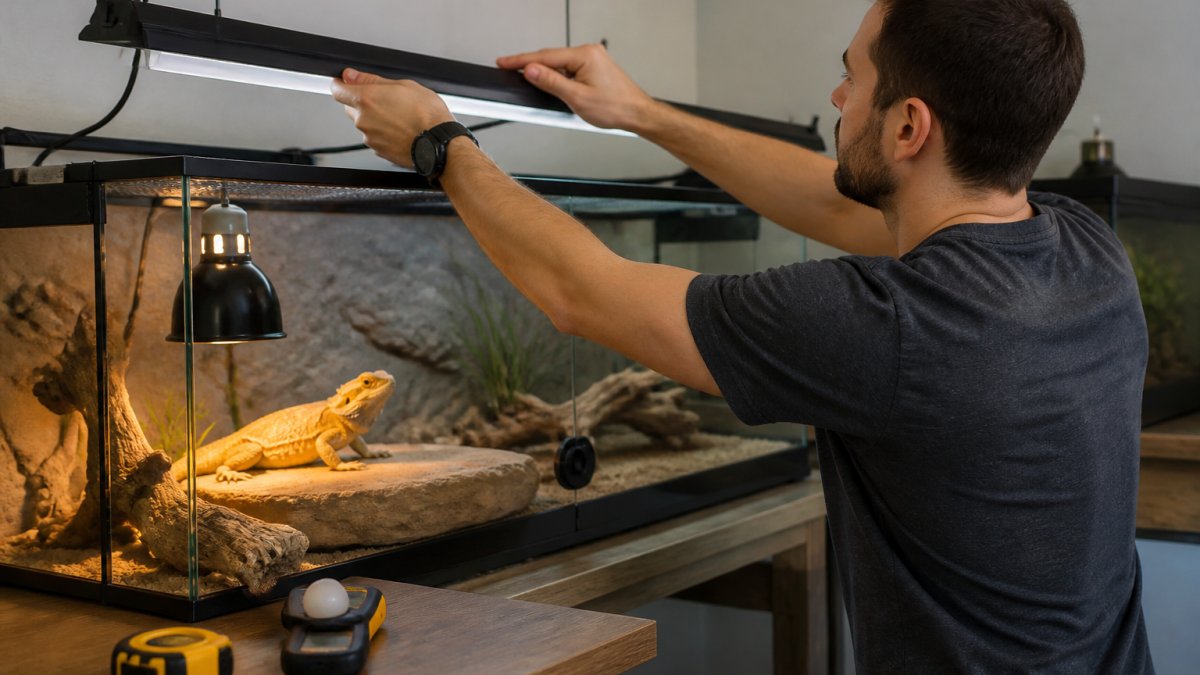
Always control heat with a thermostat and measure surface temperatures with an infrared thermometer, not a wall gauge.
Reptile Light Schedule: Photoperiod and Seasonal Cycles
A reptile light schedule should run 10 to 12 hours of light in winter and 12 to 14 hours in summer for most temperate and tropical species. Consistency matters more than the exact number: a stable day-night cycle regulates feeding, shedding, and breeding. Use a timer.
Night Lighting and Darkness
Reptiles need genuine darkness at night. Red or blue "night" bulbs still emit visible light, disrupting sleep and suppressing normal behavior. If your enclosure drops below safe temperatures overnight, use a ceramic heat emitter or deep heat projector, which produce heat without visible light.
Key Takeaway
Heat without light at night, light without heat during the day. Keeping those two channels separate is what lets you control temperature and photoperiod independently.
How Often to Replace Reptile UVB Bulbs (and How to Verify Output)
Replace reptile UVB bulbs every 6 to 12 months depending on type, even if the bulb still lights up. Fluorescent UVB tubes lose ultraviolet output long before they visibly dim, so a tube that looks fine can deliver almost nothing. A fluorescent tube's phosphor coating, which converts electrical energy into UVB, breaks down gradually, while a different phosphor keeps producing visible light.
Replacement Intervals by Lamp Type
- T5 HO fluorescent tubes: roughly 9 to 12 months of useful UVB output, with the last months delivering noticeably less than the first.
- T8 fluorescent tubes: shorter useful life than T5 HO, so many keepers replace closer to the 6-to-9-month mark.
- Compact and coil fluorescents: similar decay curve, and their narrow output cone makes degradation harder to notice.
Treat these as planning windows. The meter reading, not the calendar, is what tells you a bulb has actually fallen below target.
Vivarium Electronics T5 Lighting Fixture (Bulb Not Included) →
How to Verify Output with a UV Index Meter
Verification is the part most keepers skip. A UV Index meter at the basking surface tells you what the animal actually receives, the only number that matters.
A repeatable routine:
- Hold or mount the meter at the basking surface, at the exact height and spot the animal uses.
- Record the reading and the date in a simple log.
- Compare each new reading against the previous one, not just against the target range.
- When the reading falls below your species target, or drops sharply from the prior month, replace the bulb.
- Re-measure after replacement to confirm the new bulb restores the target.
Tracking the trend matters as much as the single number: a gradual decline means the bulb is aging predictably, while a sudden drop can signal a failing tube, a loose connection, or a shifted fixture.
Guidance on UVB meter use from the British and Irish Association of Zoos and Aquariums describes how keepers verify lamp output rather than trusting manufacturer claims.
A Simple Maintenance Schedule
- Weekly: glance at fixtures for dust on the tube or reflector, since a film of dust cuts output.
- Monthly: take UV Index readings at the basking spot and log them.
- Quarterly: wipe tubes and reflectors with a dry microfiber cloth and re-measure.
For most setups, a linear T5 HO tube in a reflector fixture is the easiest system to maintain. Our Vivarium Electronics T5 Lighting Fixture comes in 12, 24, 36, and 48 inch sizes with an integrated reflector and daisy-chain capability, so you can run multiple enclosures from one power source. Pair it with a LumenIZE Jungle Dawn LED Bar if you also want app-controlled dawn-to-dusk dimming for visible light.

Key Takeaway
A UVB bulb's visible glow says nothing about its UVB output. Log monthly meter readings, replace on the trend, and re-measure after every swap.
Safe Fixture Setup: Preventing Burns and Fire Hazards
Safe fixture setup comes down to three things: secure mounting, correct wattage ratings, and clearance from anything flammable. A clamp lamp that slips into the enclosure can burn an animal directly, and a socket overloaded beyond its rating is a genuine fire risk.

- Clamp or bracket is secured to a surface that cannot be knocked loose
- Socket wattage rating meets or exceeds the bulb wattage
- No plastic, fabric, or dried plant material within the beam path
Electrical safety guidance from the U.S. Consumer Product Safety Commission covers the general principles behind overloaded sockets and heat-source clearance, which apply directly to terrarium fixtures.
Pro Tip
Zip-tie your clamp lamp's cord to the stand or screen frame with a little slack. If the clamp ever fails, the cord holds the fixture from dropping straight onto your animal.
Conclusion
Building a correct lighting system takes more thought than buying a single bulb, and the variables, distance, output degradation, and night darkness, are where most setups fall short. Walnut Creek Supply carries the fixtures and bulbs to get each piece right: reflector fixtures, halogen basking bulbs in three wattages, and app-controlled LED bars for full-spectrum visible light. Browse our reptile lighting collection and build a setup your animal can thrive under.
Frequently Asked Questions
What type of lighting does my reptile need?
Most reptiles need three things from their lighting: UVB for vitamin D3 synthesis and calcium metabolism, a heat source for basking and thermoregulation, and visible light for a natural day-night cycle. UVB comes from fluorescent tubes or mercury vapor bulbs. Heat comes from halogen or incandescent basking bulbs. Visible light can come from LED bars or the UVB and heat bulbs themselves. Species-specific needs vary, so match your setup to your reptile's natural habitat and Ferguson zone.
Do reptiles need both UVB and a heat lamp?
Yes, in most cases. UVB and heat serve different biological functions. UVB enables vitamin D3 production, which lets reptiles absorb calcium. Heat drives digestion, immune function, and activity. Some mercury vapor bulbs produce both UVB and heat from a single fixture, but separate UVB and heat sources give you more control over each variable. A bearded dragon, for example, needs a basking spot around 100-110°F plus a UVB tube covering most of the enclosure.
How far should a UVB light be from a reptile?
Distance depends on bulb type and strength. A T5 HO UVB tube typically sits 12 to 18 inches above the basking spot, while weaker T8 tubes may need 6 to 10 inches. Mercury vapor bulbs usually require 12 to 24 inches. Always check the manufacturer's distance chart for your specific bulb. Use a UV Index meter at the basking spot to confirm your reptile receives the right UVI for its Ferguson zone. Mesh tops filter 30-50% of UVB, so adjust distance accordingly.
How many hours a day should reptile lights be on?
Most reptiles need 10 to 12 hours of light and 12 to 14 hours of darkness daily. This mimics a natural photoperiod and supports healthy circadian rhythms. Use a timer to keep the schedule consistent. In winter, some keepers shorten the photoperiod to 8-10 hours to simulate seasonal changes. Tropical species may need 12 hours year-round. No visible light or UVB at night, since reptiles need complete darkness to rest properly.
How do I know when to replace a reptile UVB bulb?
Replace fluorescent UVB tubes every 6 to 12 months, even if they still produce visible light. UVB output degrades long before the bulb burns out. Mercury vapor bulbs typically last 12 months. Use a UV Index meter to measure output at the basking spot monthly. When readings drop below the target UVI for your species, replace the bulb. Write the installation date on the bulb or fixture to track replacement intervals.
Can one bulb provide both heat and UVB?
Mercury vapor bulbs and some metal halide lamps produce both heat and UVB from a single fixture. They work well for large enclosures and basking species. However, they give you less control over each variable. If your basking temperature is correct but UVB is too strong, you can't adjust one without affecting the other. Separate UVB and heat sources let you fine-tune distance and wattage independently. For most keepers, a T5 HO UVB tube plus a halogen basking bulb is the most flexible setup.
Choosing reptile lighting well means matching UVB output, heat, and photoperiod to one specific species rather than buying whatever the shelf suggests. At Walnut Creek Supply, we stock the fixtures and bulbs that let you control each variable independently, from T5 HO reflector fixtures to dimmable full-spectrum LED bars and focused halogen basking lamps. Continue shopping with us and build an enclosure that gets the light right.


