


How to Identify High Quality Pet Food on the Label
Learn how to identify high quality pet food by reading the label, checking AAFCO statements, and reviewing the ingredient list. Start here.

Quick Summary
A high quality pet food is one whose label checks out: a complete AAFCO nutritional adequacy statement for your pet's life stage, a clear guaranteed analysis, and an ingredient list you can verify. Read the back panel before marketing words like premium or natural.
- Check the AAFCO nutritional adequacy statement first, including the life stage and how the food was substantiated.
- A formulated food and a feeding-tested food answer different questions, so compare like with like.
- Ingredients are listed by pre-cooking weight, so a named meat at the top still includes water that cooks off.
- Guaranteed analysis gives minimum protein and fat and maximum fiber and moisture, not exact amounts.
- Transition to a new food gradually over 7 to 10 days, and call your veterinarian if problems appear.
Table of Contents
- Why Label Reading Matters More Than Marketing Claims
- How to Read Dog Food Labels Step by Step
- Checking the AAFCO Nutritional Adequacy Statement
- Reading the Pet Food Ingredient List Without Overreading It
- Guaranteed Analysis and Matching Food to Your Pet's Life Stage
- How to Verify a Manufacturer's Quality and Transparency
- Choosing Your Next Bag and Transitioning Safely
- Frequently Asked Questions
Pet food labels can look like a wall of terms, but a few specific checks will tell you whether a bag is truly high quality pet food for your animal.
Marketing words like "premium," "natural," and "holistic" appear on bags across every price point. They do not tell you how a food was formulated or whether it meets a standard.
Why Label Reading Matters More Than Marketing Claims
The front of a pet food bag is designed to sell. The back panel is where the regulated information lives. A bag can show a farm on the front and a single chicken illustration, but the legal details that matter are printed on the side or back.
A useful habit is to flip the bag over before you look at anything else. Check these items in order:
- The product name and the species it is made for
- The nutritional adequacy statement
- The guaranteed analysis
Marketing claims can still matter, but treat them as the last thing you check, not the first.
How to Read Dog Food Labels Step by Step
Work through the label the same way every time, so you can compare two bags fairly.
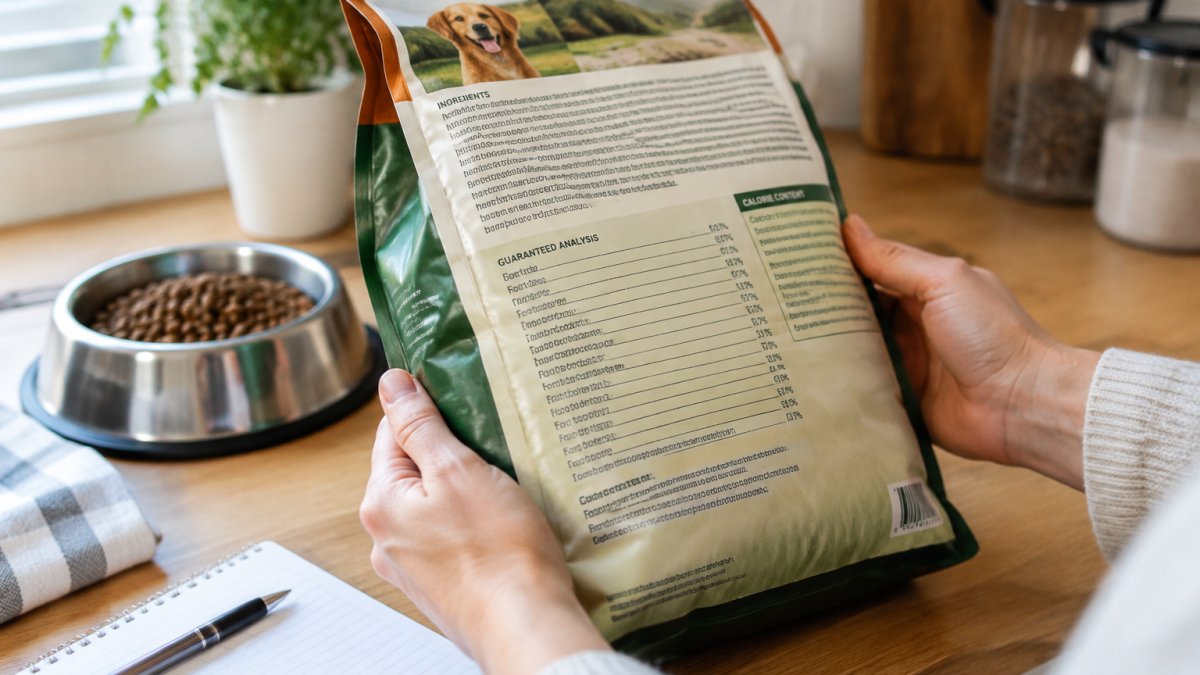
- Confirm the species and life stage. The label should state whether the food is for dogs, and whether it is for puppies, adults, all life stages, or growth.
- Find the nutritional adequacy statement. This sentence explains how the food was tested or formulated. More on this below.
- Read the guaranteed analysis. This lists minimum protein and fat and maximum fiber and moisture levels.
- Scan the ingredient list. Ingredients are listed by weight before cooking, from most to least.
- Check the feeding directions. Look at the calorie content and portion guidance for your dog's weight.
Doing this for two or three bags usually makes the differences obvious within a single shopping trip.
Checking the AAFCO Nutritional Adequacy Statement
The adequacy statement is the single most important sentence on a pet food label, and it is also the one most often skimmed. You can see a complete and balanced wet food carrying this statement as a reference for what a full statement looks like.

AAFCO publishes nutrient profiles for dogs and cats at each life stage. A manufacturer can meet those profiles in one of two ways, and the label language usually signals which:
- Formulated to meet the AAFCO [Dog or Cat] Food Nutrient Profiles for [life stage]. This means the recipe was calculated to hit the published nutrient minimums and maximums. It is a paper exercise: the formulator sets ingredient inclusion rates so the finished nutrient levels land inside the profile. It does not require feeding the food to animals.
- Animal feeding tests using AAFCO procedures substantiate that [product] provides complete and balanced nutrition for [life stage]. This means the food was fed to a group of animals under AAFCO's feeding-trial protocol, and the animals remained healthy by specified measures. It is evidence that a population of animals actually did well on the food, not just that the numbers added up on paper.
A common misconception is that a feeding trial is automatically "better" than formulation. In practice, the two answer different questions. A feeding trial shows the food supported health in the animals tested; it does not prove the food meets every nutrient minimum.
Watch out: some labels say only "complete and balanced" without naming a life stage or a method. That wording is not enough to evaluate.
Complete and balanced versus supplemental feeding
"Complete and balanced" means the food is intended to be the sole diet for the stated life stage. "Intermittent or supplemental feeding only" means it is not. The distinction matters because a supplemental food can look like a complete meal, and mixing it into a complete diet over time dilutes the nutrient profile. A topper, a treat, or a food labeled for supplemental feeding should stay a small share of total calories, not the base of the bowl.
How to compare two adequacy statements
Put the two bags side by side and ask three questions in order:
- Same species and life stage? An all-life-stages claim and an adult-maintenance claim are not interchangeable for a growing puppy.
- Same substantiation method? If one used a feeding trial and the other was formulated, you are comparing different kinds of evidence, not a better and a worse version of the same thing.
- Is the statement complete? A full statement names the species, the life stage, and the method. A partial statement is a prompt to contact the manufacturer, not a reason to assume the best.
If the method is unclear after reading the panel, check the manufacturer's website or call the number on the bag. A company that can answer the question quickly is giving you useful information about how it manages its formulations.
The two ways a manufacturer can substantiate an AAFCO adequacy claim differ in what they show:
| Method | What it means | What it does not prove |
|---|---|---|
| Formulated to AAFCO nutrient profiles | Recipe calculated to hit published nutrient minimums and maximums | That animals actually thrived on the food |
| AAFCO animal feeding tests | Food fed to animals under AAFCO protocol and they stayed healthy | That every nutrient minimum was met on paper |
Reading the Pet Food Ingredient List Without Overreading It
The ingredient list is useful, but it has limits. Ingredients appear in order of pre-cooking weight, which means a whole meat listed first still includes a lot of water that cooks off. Ingredient lists also do not show nutrient amounts or digestibility.
Some practical points:
- A named meat such as "chicken" or "deboned lamb" at the top is a good sign of a protein source, but look at the guaranteed analysis too.
- A "meal" such as "chicken meal" is concentrated protein, not a lesser ingredient.
- Long lists of exotic ingredients do not automatically mean better nutrition.
Use the ingredient list to spot allergens or ingredients your pet has reacted to before. Do not use it alone to judge overall quality.
Guaranteed Analysis and Matching Food to Your Pet's Life Stage
The guaranteed analysis gives minimum crude protein and crude fat and maximum crude fiber and moisture.
To compare fairly, many owners convert both foods to a dry matter basis. That calculation removes water so the nutrient percentages are comparable.
Life stage matters a great deal. A puppy formula supports growth, and an adult formula is designed for maintenance. Feeding an adult food to a growing puppy, or a puppy food to an overweight adult, can cause problems over time.
The Wellness Complete Health 26Lb Age Advantage Chicken Barley is listed as a dry dog food with an ingredient panel you can check against the steps above. For an adult small-breed option, you can compare the adult small breed lamb and brown rice formula and its life-stage claim.

How to Verify a Manufacturer's Quality and Transparency
Most label-reading guides stop at the bag. The stronger move is to treat the manufacturer as part of the evidence, because two foods with similar panels can come from companies with very different formulation and quality-control practices.
Work through these five areas in order. The goal is not to find a perfect company but to see how specifically and consistently it answers.
- Nutrition expertise. Ask who formulates the food and what credentials that person or team holds. A common pattern is a board-certified veterinary nutritionist or a nutrition PhD on staff or on retainer. If the answer is a marketing department or a generic "team of experts," you have learned something.
- Formulation and substantiation. Ask whether the food was formulated to the AAFCO nutrient profiles or substantiated by an AAFCO feeding trial, and for which life stage. The answer should match the label statement exactly. A mismatch is a red flag worth resolving before you buy.
- Ingredient sourcing. Ask where major ingredients are sourced and whether the company audits suppliers. Specific answers (named regions, supplier audit programs, certificates of analysis for incoming ingredients) are more useful than "high-quality ingredients." You are not looking for a particular country of origin; you are looking for a described process.
- Manufacturing and testing. Ask whether the company owns its plants or uses co-manufacturers, and what finished-product testing it runs. Look for mention of nutrient analysis of finished lots, pathogen testing, and retention samples. Co-manufacturing is common and not automatically a problem, but the brand should still be able to describe the testing regime.
- Quality control and complaints. Ask how the company handles a nutrient result that falls outside spec and how it tracks consumer complaints. Recall notices for pet food are published publicly, and you can search them yourself (the FDA).
Watch out: phrases like "vet recommended," "scientifically proven," or "research-backed" without a named source or study are marketing, not evidence. Ask what the claim is based on.
What transparency can and cannot tell you
A transparent manufacturer gives you more to evaluate, but transparency is not the same as suitability. A company can be open about its process and still make a food that does not fit your pet's life stage, body condition, or health needs.
A practical shortcut is to pick two or three foods you are considering and ask each manufacturer the same five questions by email. Compare how quickly and specifically they respond. The pattern of answers often separates companies more clearly than any single claim on the bag.
Choosing Your Next Bag and Transitioning Safely
Once you have compared labels, pick a food that meets the adequacy statement for your pet's life stage, has an ingredient list you are comfortable with, and fits your budget. A large-size adult limited-ingredient grain-free lamb dry dog food gives you a clearly labeled option to measure against these criteria. You can also see a limited-ingredient lamb and brown rice canned dog food to compare a complete label with a short ingredient list.

When you switch foods, change gradually over 7 to 10 days. Mix a small share of the new food into the old, and increase it slowly. Watch your dog's stool, appetite, and energy during the change. If you see vomiting, diarrhea, or refusal to eat, pause the transition and call your veterinarian.
Reading labels takes practice, but the steps above will become routine quickly. Check the adequacy statement first, then the guaranteed analysis and ingredients, and make your decision based on what your pet needs.
Frequently Asked Questions
How can you tell if dog food is high quality?
Start with the AAFCO nutritional adequacy statement, which shows whether the food is complete and balanced for a specific life stage. Then check that a named animal protein appears near the top of the ingredient list, that the guaranteed analysis lists protein and fat levels, and that the manufacturer discloses where it is made and how it tests its formulas. Compare the food's suitability to your dog's age, size and activity level rather than relying on front-of-bag claims alone. A food that meets these checks is a reasonable starting point, and your veterinarian can confirm whether it fits your individual dog.
Are the first ingredients on a pet food label the most important?
The first ingredients carry the most weight by volume, because the ingredient list is ordered by weight before cooking. A named meat such as deboned chicken at the top tells you the protein source is real, but fresh meat contains a lot of water, so it often weighs less after processing than a meal listed further down. Look at the full list for consistency, and remember that the list does not show digestibility, nutrient availability or whether the formula meets nutritional standards. Those answers come from the AAFCO statement and feeding trial information.
What does an AAFCO nutritional adequacy statement mean?
An AAFCO nutritional adequacy statement says the food meets the nutrient profiles established by the Association of American Feed Control Officials for a given life stage, such as growth, maintenance or all life stages. Some statements are based on formulation alone, while others rely on feeding trials that test the food in live animals. A statement tied to a feeding trial gives stronger evidence that the food performs as labeled. Check which method is named on the label, and confirm that the life stage matches your pet.
Which pet food brands should you stay away from?
Avoid brands that make health claims they cannot back up, that do not state a nutritional adequacy statement, or that hide where and how their food is produced. Be cautious of labels that rely on words like natural or premium without any supporting detail, and of foods that do not name the manufacturer on the package. A high price alone does not indicate quality, so compare the label criteria side by side. When a claim sounds unusually strong, look for the evidence behind it before you buy.


