


Premium vs Budget Pet Supplies: Where the Money Goes
Premium vs budget pet supplies comes down to ingredients, materials, and lifespan. Compare real costs, quality checks, and monthly budgets before you buy.

Last Updated: November 10, 2026
Quick Summary
The gap between premium and budget pet supplies comes down to ingredient quality, manufacturing standards, product lifespan, and how much of what you pay actually reaches your pet. Premium products name their ingredients, state their origin, and print a guaranteed analysis you can verify, while budget items often give you a flavor name and white space. Comparing cost per serving rather than sticker price shows a denser food with a smaller daily portion can land within pennies of a cheaper bag.
- Check six label criteria: named protein, ingredient order, guaranteed analysis, origin statement, preservatives, and single-ingredient simplicity.
- Convert protein percentages to a dry-matter basis before comparing canned or fresh food to dry kibble.
- Divide bag price by days of food to compare cost per serving instead of sticker price.
- High-wear items like leashes, crates, and scratchers usually win on lifetime cost with premium versions.
- Upgrade only your top two impact categories first, then reassess in 60 days.
Worth the upgrade or just marketing?We curate premium pet supplies with labels you can verify, for dogs, cats, and exotic pets.
Shop Premium Pet Supplies
Table of Contents
- Premium vs Budget Pet Supplies: What Actually Separates Them
- Premium vs Budget Dog Food: Ingredients, Nutrient Density, and Digestibility
- Premium vs Budget Cat Supplies: Litter, Food, and Gear That Lasts
- Pet Supply Quality and Safety: Recalls, Materials, and Label Claims
- The Average Monthly Cost of Owning a Dog, Category by Category
- Total Cost of Ownership: Where Budget Supplies Cost More Over Time
- Matching Quality to Your Pet: A Decision Framework
- Building Your First Premium Order at Walnut Creek Supply
- Frequently Asked Questions
Premium vs Budget Pet Supplies: What Actually Separates Them
The gap between premium and budget pet supplies comes down to four things: ingredient quality, manufacturing standards, product lifespan, and how much of what you pay actually reaches your pet. Pet parents often spend more on cheap gear over time than they would have spent buying once and buying well. This guide breaks down where the money goes, category by category, so you can decide which upgrades pay off and which ones are pure marketing. Below, we'll show you exactly how to read a label, compare cost per serving, and spot the products worth the premium.
The honest answer is that premium vs budget pet supplies is not a single decision. It's a series of small ones, and the right call differs for food, litter, bedding, and chews.
Six Quality Criteria You Can Check on Any Label
Premium pet supplies are products where the label tells you enough to verify the claim. That's the working definition we use. A premium product names its ingredients, states its origin, and gives you a guaranteed analysis you can actually read. A budget product often gives you a flavor name and a lot of white space.
Use these six checks on any bag, box, or package:
- Named protein source. "Whitefish meal" beats "meat meal" or "animal by-products."
- Ingredient order. Ingredients are listed by weight, so the first three matter most.
- Guaranteed analysis. Protein, fat, fiber, and moisture percentages should be printed clearly.
- Origin statement. "Made in the USA" with a named sourcing claim is stronger than a vague flag graphic.
- Preservative system. Mixed tocopherols and rosemary extract are common natural preservatives.
- Single-ingredient simplicity. A chew with one ingredient is easy to verify. A chew with twelve is not.
What most guides miss is that these criteria work on supplies too, not just food. A crate with a stated gauge of steel and a listed coating tells you more than one with a photo of a happy dog.
Premium vs Budget Dog Food: Ingredients, Nutrient Density, and Digestibility
Premium vs budget dog food usually differs most in nutrient density, meaning how much usable nutrition each scoop delivers.
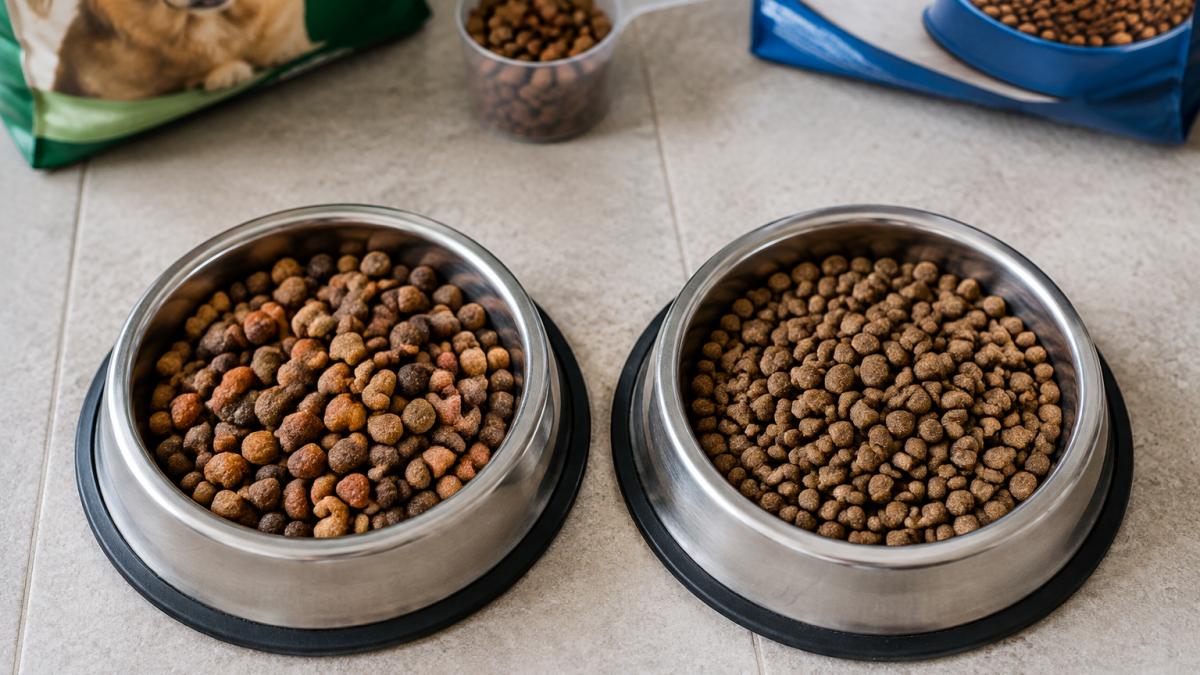
Start with the guaranteed analysis. Protein, fat, fiber, and moisture percentages are printed on every bag that follows Association of American Feed Control Officials labeling conventions.
Look at the Canidae Under The Sun Grain-Free Dry Dog Food. The first ingredients are whitefish meal, yellow peas, and garbanzo beans.
Digestibility is the other half of the equation. A food your dog absorbs efficiently produces smaller, firmer stools and often less gas.
For dogs with sensitive stomachs, some owners add a probiotic chew. The 3 in 1 Probiotic Chews for Dogs combine live probiotics, postbiotics, and prebiotic fiber in a soft chew format.
Why Serving Size and Cost Per Serving Beat Sticker Price
Cost per serving is a more useful comparison than bag price, and the feeding chart is where that comparison happens.
Here's how to run the math:
- Note the bag weight and the price.
- Find the recommended daily feeding amount for your dog's weight on the bag's chart.
- Divide total servings in the bag by your dog's daily portion to get days of food.
- Divide the bag price by those days.
A denser food with a smaller daily portion can land within pennies of a cheaper bag with a larger portion. Run the number before you decide the premium bag is out of reach.
Watch out: feeding charts are starting points, not prescriptions. Body condition, activity, and age move the number, so weigh your dog monthly and adjust the portion rather than trusting the bag's default for your dog's weight class.
Premium vs Budget Cat Supplies: Litter, Food, and Gear That Lasts
Premium vs budget cat supplies is where total cost of ownership gets interesting, because cats destroy cheap gear fast. A scratcher that sheds cardboard within a month costs more per week than a sturdy one that survives a year.
For food, the same label logic applies. A premium feline food with identifiable proteins gives you something to evaluate.
Gear is where we see the biggest split. A premium scratcher lounger with a contoured shape and included catnip tends to hold up to daily clawing far better than a flat budget board. Litter boxes follow the same rule: a high-sided box with a durable finish outlasts three flimsy ones.

Pet Supply Quality and Safety: Recalls, Materials, and Label Claims
Safety is the one category where budget cuts hurt most. The FDA's pet food recall information is the first place to check when a brand you buy makes the news, and it's worth a look before you commit to a new food.
Materials matter for gear too. Chews are a good example. The Dogginstix Bully Stick is a single-ingredient beef pizzle chew and is described as odor-free. One ingredient means one thing to verify.
Label claims deserve scrutiny across the board. "Natural," "premium," and "holistic" are marketing terms with limited regulatory definition. The Association of American Feed Control Officials publishes the nutritional standards behind pet food labels if you want the source material.
Watch out: never leave a pet unattended with any chew or toy, regardless of price point. Supervision matters more than the label.
The Average Monthly Cost of Owning a Dog, Category by Category
The average monthly cost of owning a dog varies widely by size, age, and where you shop. What we can give you is the category structure, which is where budgeting actually happens.
| Category | What Drives the Cost | Budget Approach | Premium Approach |
|---|---|---|---|
| Food | Bag size, nutrient density, protein source | Larger bag, lower density | Denser food, smaller serving |
| Treats | Frequency, ingredient count | Bulk biscuits | Single-ingredient chews |
| Supplements | Gut, joint, skin support | As needed | Daily probiotic routine |
| Gear | Lifespan, materials | Replace often | Buy once |
| Vet care | Age, breed, preventive care | Reactive | Preventive |
Treats are a quiet budget line. The Jeffers Chicken Jerky 24 oz bag is $19.99 and breaks easily into smaller training pieces. The Wonder Bark Everyday Happy Birthday Dog Treats are $9.99.
Total Cost of Ownership: Where Budget Supplies Cost More Over Time
Budget supplies cost more over time whenever the replacement cycle is short.
Run the math on a leash. A budget leash at a low sticker price that frays at the stitching and gets replaced twice a year has an annual cost of roughly twice its price.
Here's how we'd frame the decision by category:
- High-wear items like leashes, crates, and scratchers: premium usually wins on lifetime cost because the replacement cycle is short and the failure mode is visible.
- Consumables like treats and litter: compare cost per use, not per package, because the package size is a marketing decision and the use rate is yours.
- Food: compare cost per serving, and factor in digestibility, since a food your dog absorbs efficiently reduces waste at both ends of the process.
- One-off gear for a short-term need: budget is fine, because the replacement cycle never arrives.
A few category mechanics are worth knowing because they drive the replacement cycle more than price does.
The Consumer Federation of America has published guidance on how to evaluate total cost rather than sticker price across consumer categories, and the logic carries over to pet supplies cleanly.
Watch out: total cost of ownership is not an argument for buying the most expensive option in every category.
Matching Quality to Your Pet: A Decision Framework
Match quality to your pet's specific needs, not to a general rule about premium being better. A young, healthy dog on a tight budget may do fine on mid-range food. A senior dog with a sensitive gut is a different calculation.
Run this framework:
- List your pet's actual issues. Itching, loose stools, boredom, destructive chewing.
- Rank categories by impact. Food and gut health usually outrank gear.
- Upgrade the top two categories first. Leave the rest at budget.
- Reassess in 60 days. If nothing changed, redirect the spend.
Watch out: don't upgrade everything at once. If your pet reacts badly, you won't know which product caused it.
Building Your First Premium Order at Walnut Creek Supply
Start with food, add one treat upgrade, and stop there for the first order. That's the advice we give most often, and it keeps the experiment clean.
Walnut Creek Supply is family-owned and based in the USA, and we curate for cats, dogs, small animals, and reptiles rather than stocking everything. A sensible first order looks like this: a bag of Canidae Under The Sun for the main diet, a single-ingredient chew to replace rawhide, and a turkey meal topper if your dog is a picky eater.


Compare the per-serving cost on your current food against one premium bag. That single number will tell you more than any marketing claim.
The real challenge isn't finding premium pet supplies. It's knowing which ones are worth it for your animal. Walnut Creek Supply curates high-quality products with the labels to back them up, publishes guidance on nutrition and enclosure care, and keeps a range built for cats, dogs, small animals, and reptiles.
Frequently Asked Questions
Are premium pet supplies worth the extra cost?
It depends on the category. Food and chews usually justify the premium because ingredient quality and digestibility affect health daily. A single-ingredient bully stick is $3.98, and a grain-free dry food is $57.52 for 23.5 lb. For bowls, crates, and leashes, mid-range often works fine. Spend more where the product touches digestion, skin, coat, or safety, and save on accessories that are simple to inspect.
What is the difference between premium and budget pet supplies?
The gap shows up in three places: ingredient and material quality, formulation and construction, and lifespan. Premium pet food lists named proteins and whole ingredients, while budget food leans on by-products and vague label claims. Premium gear uses thicker materials and replaceable parts. Budget gear is often thinner and shorter-lived. Neither label is regulated, so read the guaranteed analysis and the materials list rather than trusting the word premium on the bag.
Are budget pet supplies safe for cats and dogs?
Many are, but the margin for error is thinner. Budget products cut costs somewhere, often in sourcing or quality control, so check for a named manufacturer, a lot number, and a clear ingredient list. Avoid any toy or chew that breaks into small pieces, and supervise chewing sessions. Food safety matters most: stick with brands that publish full ingredient panels and have no active recall. Price alone does not signal safety in either direction.
How much does it cost to own a dog each month?
A realistic monthly budget covers food, treats, chews, supplements, and supplies. As a working example from our own catalog: a 23.5 lb bag of grain-free dry food is $57.52, a 24 oz bag of chicken jerky is $19.99, a 90-count probiotic chew tub is $29.99, and single bully sticks are $3.98 each.
Where can pet owners save money without hurting their pet?
Save on categories where quality is easy to verify: food bowls, bedding, leashes, and basic crates. Spend on food, chews, and anything your pet ingests or chews for hours. Buy treats in larger bags, since a 24 oz jerky bag at $19.99 costs less per ounce than small packs. Use single-ingredient chews like bully sticks instead of rawhide, and track cost per serving rather than sticker price so you compare fairly.
Prices of Walnut Creek Supply pet products
Grain-free dry food, 23.5 lb $57.52
Probiotic chew tub, 90 count $29.99
Chicken jerky, 24 oz $19.99
Single bully stick $3.98


