


Safe Cat Toys for Indoor Cats: 6 Picks That Hold Up
Safe cat toys for indoor cats, tested against real hazards. Compare six picks by safety, price, and play style, plus what to leave out when you're away.

Table of Contents
- What Makes a Cat Toy Actually Safe
- Safe Cat Toys for Unsupervised Play: What Can Stay Out
-
Six Safe Cat Toys for Indoor Cats, Compared
- 1. Caroline's Cats Spin-N-Pounce: Best for Solo Hunting Sessions
- 2. Gbruno Rolling Ball in Pouch: Best for Chase-and-Pounce Play
- 3. Gbruno Cat Track Tower: Best for Apartments and Small Rooms
- 4. Gbruno Newage Windmill: Best for Chewers and Groomers
- 5. Pet Greens Live Catnip: Best for Resetting a Bored Cat
- 6. Where the Cheap Classic Toys Still Fit
- Interactive Cat Toys: The Owner-Led Side of the Toy Box
- Cat Toy Safety: Hazards, Materials, and What to Avoid
- Toys for Bored Indoor Cats: Rotation and Enrichment Schedule
- Matching Toys to Age, Size, and Health
- Frequently Asked Questions
Last Updated: October 21, 2026
What Makes a Cat Toy Actually Safe
A safe cat toy is one your cat cannot swallow, strangle on, or cut itself with during normal play. At Walnut Creek Supply, the safe cat toys category includes feather wands, jingle balls, and string toys.
Before any toy comes home, consider a five-point check.
The Five-Point Inspection Before Any Toy Comes Home
- No loose parts under 1.5 inches. Anything small enough to swallow whole is a choking hazard. Bells, plastic eyes, and pom-poms fail this test routinely.
- No strings longer than 6 inches. Thread, yarn, and ribbon are ingestion risks. Cats swallow them, and linear foreign bodies are among the most dangerous blockages a vet treats.
- No exposed wire or sharp edges. Run a finger around every seam. If you feel a point, your cat's mouth will find it.
- No glued-on decorations. Tug each attached piece. If it moves, it will come off.
- No toxic odor. A strong chemical smell signals cheap materials. Skip it.
The ASPCA's pet toy safety guidance recommends supervising play with any toy that has moving parts, and we agree with that baseline.
Watch Out
Leaving a feather wand out after play can be a mistake. Cats chew feathers off and swallow them, and ingested feathers can cause intestinal blockage. Put wands away every single time.
Safe Cat Toys for Unsupervised Play: What Can Stay Out
Safe cat toys for unsupervised play share one trait: no parts your cat can detach.
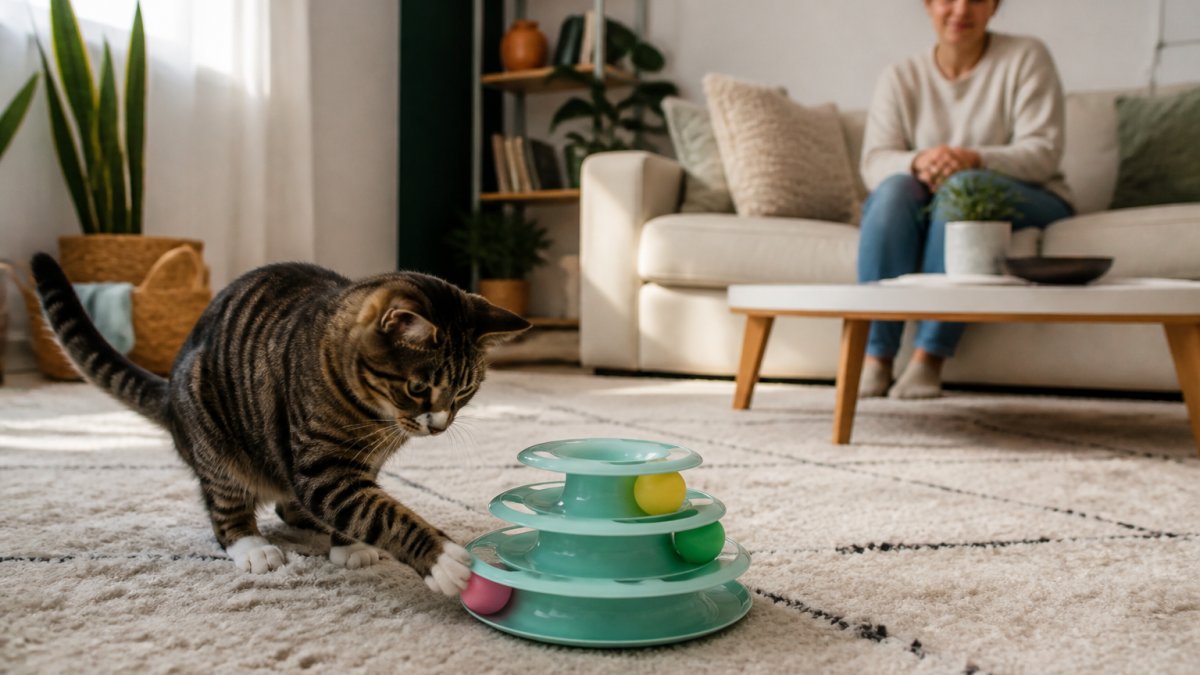
The AVMA's pet safety resources make the same point from a veterinary angle: the risk isn't the toy's purpose, it's its construction.
Leave-Out vs. Put-Away, by Toy Type
| Toy Type | Leave Out Unsupervised? | Why |
|---|---|---|
| Solid track towers | Yes | Sealed balls, no detachable parts |
| Motion-activated balls | Yes, if battery door screws shut | Check the compartment latch |
| Windmill and suction toys | Yes, on smooth surfaces | TPR body, no loose pieces |
| Catnip plants | Yes, in a pot | Plant material, not plastic |
| Wand and feather toys | No | Strings and feathers detach |
| Crinkle balls and pom-poms | No | Small enough to swallow |
| Puzzle feeders | Yes, if sized correctly | Watch for cracked plastic |
If you can't name every part of the toy, don't leave it out.
Six Safe Cat Toys for Indoor Cats, Compared
We picked six toys from our own shelves that pass the five-point check. Prices are current as of this update.
| Toy | Price | Best For | Supervised? |
|---|---|---|---|
| Caroline's Cats Spin-N-Pounce | $21.95 | Solo hunting sessions | Leave out |
| Gbruno Rolling Ball in Pouch | $38.99 | Chase-and-pounce play | Leave out |
| Gbruno Cat Track Tower | $31.99-$32.99 | Apartments and small rooms | Leave out |
| Gbruno Newage Windmill | $23.99 | Chewers and groomers | Leave out |
| Pet Greens Live Catnip | $10.99 | Resetting a bored cat | Leave out |
| Classic cheap toys | Varies | Rotating with other toys | Supervised |
1. Caroline's Cats Spin-N-Pounce: Best for Solo Hunting Sessions
The Spin-N-Pounce is a great option for safe cat toys for indoor cats because it keeps a cat engaged.

Its construction includes a silent motor. It runs on a two-minute auto-standby, then a two-hour touch-activated window.
The catch: it only works on bare floor. Carpet kills the rotation, so plan around that.
Price: $21.95. Check the Spin-N-Pounce here.
Pro Tip
Cat behaviorists Linda Hall and Rita Reimers of Cat Behavior Alliance endorse the Spin-N-Pounce for enrichment.
2. Gbruno Rolling Ball in Pouch: Best for Chase-and-Pounce Play
The Gbruno Rolling Ball is motion-activated, starting when your cat touches it and stopping when play stops, which is what makes it work for independent play. The rechargeable battery means no hunting for replacements.
Its smooth rolling mechanism is gentle on paws. One caveat: the manufacturer carries a California Proposition 65 warning.
Price: $38.99. See the Rolling Ball in Pouch.

3. Gbruno Cat Track Tower: Best for Apartments and Small Rooms
Track towers are the quiet workhorse of the toy box. The Gbruno version stacks three or four detachable layers of ball track, with an optional battery-powered butterfly or bird on top.
The tear-resistant PP plastic holds up to enthusiastic play, and the non-slip base keeps it upright. Detachable layers allow for cleaning.
Price: $31.99 to $32.99 depending on the layer count. View the Cat Track Tower.
4. Gbruno Newage Windmill: Best for Chewers and Groomers
The spiky middle section gently massages your cat’s face, grooms fur, and cleans teeth while the transparent bins spin an LED or catnip ball. The suction cup base sticks firmly to smooth surfaces like windows and floors, lasting up to 24 hours.
TPR is bite-resistant and odorless. If your cat destroys fabric toys in a week, this is built for that habit.
Price: $23.99. Shop the Newage Windmill.
5. Pet Greens Live Catnip: Best for Resetting a Bored Cat
A live catnip plant is the most potent form of catnip, and the tender leaves are gentler to your cat’s mouth. It's safe, non-addictive, and repottable for a continuous supply.
Note: Catnip parties can get messy! Supervision - and a cleanable surface - are highly recommended, as some cats can become real party animals!
Price: $10.99. Get Pet Greens Live Catnip.
6. Where the Cheap Classic Toys Still Fit
Ping-pong balls, paper bags, and cardboard boxes still work, cheap, satisfying the hunting instinct, and cat-approved. The difference is supervision: ping-pong balls get batted under furniture, and paper bags can trap a panicked cat. Use them, then put them away.
Caroline's Cats Spin-N-Pounce Rechargeable Automatic Interactive Indoor Dancing →
Interactive Cat Toys: The Owner-Led Side of the Toy Box
Interactive cat toys are the ones you control: wands, feathers, laser pointers, and anything on a string. The Cornell Feline Health Center's cat behavior guidance notes that owner-led play mimics hunting and reduces boredom-related behavior problems.
Interactive toys can be stored in a drawer, not on the floor. Ten focused minutes with a wand can be more engaging than an hour of a toy your cat ignores.
Cat Toy Safety: Hazards, Materials, and What to Avoid
Cat toy safety comes down to three hazards: ingestion, strangulation, and chemical exposure. Ingestion is most common, strings, tinsel, feathers, and small bells end up in cats' stomachs, and linear objects are worst because they can bunch the intestine (a linear foreign body), often requiring surgery.
Most safety advice stops at "supervise your cat." Below is an inspection and discard routine.
The Inspection Checklist: What to Look For on Every Toy
Run this check before a new toy goes into rotation and again during a monthly audit.
- Tug every attached part. Eyes, bells, pom-poms, feathers, ribbons, and glued-on decorations should not move when you pull firmly. If a piece shifts, it will come off in a cat's mouth.
- Measure the smallest detachable piece. Anything under roughly 1.5 inches across is a swallow risk. Bells, plastic eyes, and craft pom-poms fail this routinely.
- Check every string, cord, and elastic. Anything longer than about 6 inches is a linear foreign body risk. Frayed or knotted string is worse than clean string because it catches on the tongue and intestinal lining.
- Run a finger around every seam and edge. Feel for points, rough mold lines, and exposed wire. If you feel a burr, your cat's mouth will find it.
- Inspect battery compartments. The door should be screwed shut, not snapped. Look for corrosion, a swollen battery, or a loose contact. A damaged battery is a burn and ingestion hazard, not just a dead toy.
- Smell the toy. A strong chemical or solvent odor signals cheap plasticizers or adhesives. Skip it.
- Check for cracks in hard plastic. A hairline crack in a track tower or puzzle feeder will spread, and the broken piece becomes a sharp edge.
When to Discard a Toy
Throw a toy out, do not repair it, when any of the following is true:

- A seam has opened or stuffing is visible.
- A bell, eye, or decoration has come loose, even if you found the piece.
- String, ribbon, or elastic is frayed, knotted, or has been chewed through.
Owners often keep a "favorite" toy long past the point where it is safe because the cat still plays with it. Consider replacing it with a same-category toy and rotating the old one out.
Materials and Chemical Transparency
Look for ABS, PP, and TPR plastics, which are durable and common in pet toys. The California Office of Environmental Health Hazard Assessment publishes what those warnings mean.
Material choices worth preferring: solid, single-piece molded plastics (ABS, PP) over glued assemblies; TPR over soft vinyl for chewers; and toys with no painted or dyed surfaces where the cat's mouth contacts the toy most.
A monthly toy audit can be a useful safety habit. Check every seam, tug every attached part, and throw out anything cracked or frayed. A few minutes a month can help prevent emergencies.
Evidence Note
Veterinary and animal-welfare guidance consistently emphasizes supervision for toys with strings, feathers, and small detachable parts, and treats linear foreign bodies as a surgical risk rather than a minor one. The criteria above apply that guidance; they are not a substitute for your veterinarian's advice on a specific cat.
Toys for Bored Indoor Cats: Rotation and Enrichment Schedule
Toys for bored indoor cats work best on rotation. Cats habituate fast, a toy that's exciting on Monday is furniture by Friday.
Here's a recommended schedule:
| Day | Activity | Toy |
|---|---|---|
| Daily | 10-minute owner-led hunt | Wand or feather |
| Daily | Free play | Track tower or windmill |
| Every 3 days | Swap out one toy | Any leave-out toy |
| Weekly | Catnip session | Live catnip |
| Monthly | Safety audit | All toys |
Matching Toys to Age, Size, and Health
Most toy guides treat "indoor cat" as one category. It is not. A four-month-old kitten, a 16-pound adult, and a 14-year-old cat with arthritis need different toys, sizes, and supervision levels.
Kittens
Kittens explore with their mouths, so the ingestion risk is highest in the first year.
- Size: Choose toys large enough that they cannot be swallowed whole, roughly golf-ball size or bigger for solo toys. Avoid small bells and craft pom-poms entirely.
- Supervision: Supervise all play until the cat is past the mouthing stage. Wand toys are ideal because you control the distance.
- What to skip: String, yarn, ribbon, and tinsel. Kittens swallow linear objects at a higher rate than adults.
Adult Cats
Adult cats handle the full range of toy types, including track towers, motion-activated balls, and puzzle feeders.
- Size: Match toy size to the cat's frame. A large cat can tip a light track tower, so choose a weighted base or wider footprint.
- Weight: Heavy chewers do better with solid molded plastics and TPR than fabric toys that shred.
- Activity level: A sedentary adult may ignore a motion toy but engage with a food puzzle; a high-drive adult may need both plus daily wand sessions.
Senior Cats
Senior cats often have reduced vision, arthritis, or dental disease, and toys that were fine at age five can startle or hurt them.
- Placement: Keep toys at floor level and within easy reach. Avoid toys that require jumping or climbing.
- Motion: Sudden motion-activated toys can startle a cat with vision loss. Prefer predictable, slow-moving toys or owner-led play at the cat's pace.
- Texture: Soft fabric and low-effort batting toys are easier on sore joints and mouths than hard plastic chew toys.
Cats with Health Conditions
- Dental issues: Skip hard plastic chew toys and rough textures. Soft fabric toys and catnip are gentler.
- Mobility limitations: Choose toys that can be batted from a lying position, a track tower beside a favorite bed, or a wand toy moved slowly within reach.
- Vision loss: Avoid sudden motion and toys that roll unpredictably. Scent-based toys like catnip help a cat locate play without sight.
Size Thresholds That Matter
- Swallow risk: Any detachable piece under roughly 1.5 inches across.
- Linear risk: Any string, cord, or elastic longer than about 6 inches.
- Stability: A toy should not tip when a cat of the cat's weight bats it from the side. If it does, weight the base or choose a wider design.
If your cat has a health condition, ask your vet before introducing motion-activated toys. Some cats with vision loss startle easily at sudden movement, and some senior cats with arthritis do better with predictable, slow play.
Frequently Asked Questions
Which cat toys are safe for unsupervised play?
Toys with no loose strings, no detachable small parts, and no batteries your cat can reach are the safest bet when you're not in the room. Weighted track towers, solid balls too large to swallow, and sturdy suction-cup toys on smooth floors generally hold up. Anything with feathers, ribbons, or wand handles should be put away. Before you leave, check seams, remove loose fibers, and confirm any battery compartment is screwed shut. Rotate what stays out so a cat left alone still has something new to investigate.
Are string toys safe for cats to play with alone?
No. Strings, ribbons, yarn, and wand cords are a known ingestion risk, and a cat playing alone can swallow them faster than you can intervene. Linear objects can bunch in the intestines and require surgery. Use wand toys only during supervised interactive play, then store them in a closed drawer or bin. If your cat is a dedicated string chewer, swap in a wand with a solid attached attachment you control, or switch to a battery-operated toy that moves without a cord.
How often should I replace my cat's toys?
Check every toy weekly and replace anything with a torn seam, exposed stuffing, cracked plastic, or a chewed battery door. Crinkle balls and pom-pom balls tend to flatten or shed within a few weeks of heavy play. Electronic toys usually last longer, but batteries and moving parts wear out. A practical rule: inspect on laundry day, replace quarterly, and pull a toy the moment it fails the inspection. Rotation stretches the life of the whole collection because each toy takes less daily abuse.
How can I keep an indoor cat entertained when I'm away?
Build a rotation of three or four solo-safe toys and swap them every few days so the selection feels new. Add a puzzle feeder or food-dispensing toy at mealtime to turn eating into a task. Leave a window perch or a suction-cup toy on smooth glass for visual stimulation. Battery-operated toys with auto shut-off, like the Spin-N-Pounce, run a short session and then go quiet, which keeps the toy interesting instead of background noise. Fifteen minutes of active play before you leave also settles most cats.
Indoor cats need play that matches their instincts, and the wrong toy creates risk instead of enrichment. Walnut Creek Supply stocks a curated set of safe cat toys for indoor cats, from the rechargeable Spin-N-Pounce to live catnip, each one chosen because it passes the checks we'd run on our own cats. Browse the collection and build a toy box that keeps your cat active, engaged, and safe.


