


How to Care for Pet Reptiles: A Complete Beginner's Guide
Choosing pet reptiles means getting the habitat, heating, feeding, and cleaning routine right from day one. Build a safe, healthy home today.

Last Updated: November 8, 2026
Quick Summary
To care for pet reptiles, recreate their natural environment by matching the species to your space and schedule, then getting enclosure size, a temperature gradient, lighting, humidity, and diet right. Buy the enclosure, heat lamp with thermostat, UVB lighting, and thermometers before the animal arrives, and spot-clean daily.
- Choose the species before buying the habitat, not the other way around.
- A 40-gallon tank suits many beginner lizards, but adult bearded dragons need 120 gallons or larger.
- Fit a heat lamp over one end and connect it to a thermostat to prevent overheating.
- Place hides on both the warm and cool ends so the animal can thermoregulate under cover.
- Spot-clean droppings daily and disinfect surfaces weekly with a product left for its stated contact time.
Setting up your first reptile enclosure?We carry curated reptile supplies and practical guides to help you build a safe, stable habitat.
Shop Reptile Supplies
Table of Contents
- How to Care for Pet Reptiles for Beginners: Start With the Right Species
- Matching a Species to Your Experience and Schedule
- Reptile Habitat Setup: Enclosure Size, Substrate, and Hiding Places
- Heating, Lighting, and UVB: Building the Right Temperature Gradient
- Humidity, Hydration, and a Clean Water Dish
- Reptile Feeding and Care: Balanced Diet, Supplements, and Feeding Schedule
- Cleaning, Health Monitoring, and When to See a Reptile Veterinarian
- Stock Your Reptile Setup With Supplies That Last
- Frequently Asked Questions
How to Care for Pet Reptiles for Beginners: Start With the Right Species
Learning how to care for pet reptiles starts with one decision that shapes everything else: the species.
Reptile care is the practice of recreating a species' natural environment in captivity: correct enclosure size, a temperature gradient, appropriate lighting, humidity, diet, and cleaning routine.
Here is the version many guides skip: the animal is often the cheaper part of the setup.
Matching a Species to Your Experience and Schedule
Match the species to your life before you match it to your taste. A nocturnal gecko that eats insects a few times a week suits a busy schedule; a large diurnal lizard that needs daily salad prep and a very large enclosure does not. The care matrix below is a useful comparison tool.
Ask three questions first:
- How much space can you dedicate? A 40-gallon tank is a realistic minimum for many beginner lizards, and larger species outgrow that quickly.
- How much daily time do you have? Daily feeding, misting, and spot cleaning add up.
- Can you commit for the animal's lifespan? Many popular species live well over a decade.
A common mistake is buying the animal first and the habitat second. Reverse that order.
Beginner Species Care Matrix: Compare Before You Choose
Use this matrix to compare the three most forgiving beginner lizards on the variables that actually drive your setup and routine. Treat the ranges as starting points to verify against a species-specific care sheet, not as fixed settings.
| Care Variable | Leopard Gecko | Bearded Dragon | Crested Gecko |
|---|---|---|---|
| Activity pattern | Nocturnal | Diurnal | Nocturnal |
| Enclosure orientation | Floor space | Floor space | Taller, vertical space |
| Typical adult enclosure | Around 40 gallons | 120 gallons or larger | Around 18 x 18 x 24 inches |
| Basking / warm zone | Warm hide and belly heat | Strong overhead basking spot | Moderate warm area, no hot basking rock |
| UVB need | Low; many keepers use a low-output bulb | High; daily UVB is standard | Low; often kept with plant-friendly lighting |
| Humidity | Low to moderate, with a humid hide | Low to moderate | Moderate to high |
| Diet | Live insects | Insects plus daily greens | Prepared diet plus insects |
| Handling tolerance | High | High, but support the body | Moderate; stress easily |
| Main beginner pitfall | Impaction from loose substrate | Undersized enclosure and weak UVB | Enclosure drying out |
The point of the matrix is to stop you from copying one species' numbers onto another. A 40-gallon tank that works for a leopard gecko is undersized for an adult bearded dragon, and a high-humidity planted setup that suits a crested gecko will cause shedding and respiratory trouble for a leopard gecko.
Pet Lizards for Beginners: The Most Forgiving Options
The most forgiving beginner lizards are leopard geckos and bearded dragons, with crested geckos close behind. All three tolerate handling, eat readily, and have well-documented care requirements.
Leopard geckos are nocturnal, need a modest enclosure, and eat live insects. Bearded dragons are diurnal, need strong UVB lighting and a larger tank, and eat insects and vegetables.
Choose based on the environment you can maintain, not the one that looks best in photos.
Reptile Habitat Setup: Enclosure Size, Substrate, and Hiding Places
Reptile habitat setup comes down to three things: enough floor space, a safe substrate, and at least two hiding places. A glass terrarium or front-opening enclosure works well because it holds heat and humidity and lets you reach in without looming over the animal.
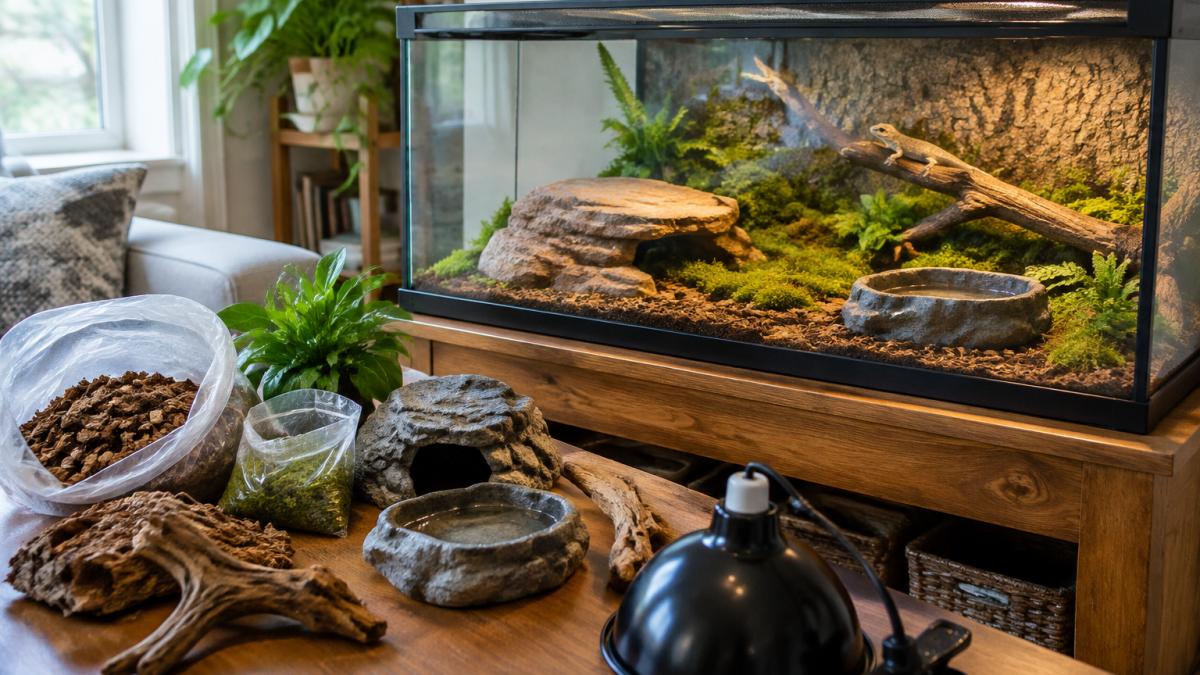
Place hides on both the warm and cool ends so the animal can thermoregulate without leaving cover. Add a rough basking rock and a branch for climbing.
Tank Size, Terrarium, and Substrate Choices
Tank size should be the largest you can reasonably fit, not the smallest the species survives in.
For substrate, pick based on species and feeding style:
- Paper towel or tile: easy to clean, ideal for quarantine and new arrivals
- Bioactive soil mix: supports live plants and cleanup crews, best for planted setups
- Sand or loose substrate: only where the species is adapted to it, and never for animals that lunge at food
If you want a ready-made bioactive option, our bioactive terrarium substrate is a nutrient-rich mix built for planted setups. Live moss, like our sustainably harvested live staghorn moss, helps hold moisture and gives the enclosure a natural look.
Watch out: loose substrate can contribute to impaction in animals that strike at prey, so many keepers use paper towel or tile for new arrivals and enthusiastic feeders.
How to Measure and Verify Enclosure Conditions
A setup is only as good as your ability to confirm it, and most beginners trust the equipment setting instead of the reading.
- Placement: put one thermometer probe at the basking spot and one at the cool end, both at the height the animal actually uses. A gauge stuck to the glass reads the glass, not the air or surface the reptile sits on.
- Surface vs. air: basking temperature is a surface reading, so use a probe or an infrared thermometer pointed at the rock or branch. Air temperature at the cool end tells you whether the animal has somewhere to escape the heat.
- Humidity: use a digital hygrometer at enclosure level, and check it at the same time each day.
A thermostat, two thermometers, and a hygrometer are useful tools for turning guesswork into a routine you can repeat. Record the readings for the first week so you can spot a drift before it becomes a health problem.
Heating, Lighting, and UVB: Building the Right Temperature Gradient
How to build one:
- Measure the enclosure and decide your basking and cool-end targets for the species.
- Fit a heat lamp over one end, never the middle.
- Connect the heat source to a thermostat so it cannot overheat.
- Place thermometers at both ends and check them daily for the first week.
- Adjust the lamp height or wattage until both zones hold steady.
Lighting matters just as much. Diurnal species generally need UVB lighting on a daily cycle to support calcium use and bone health.
Watch out: skipping the thermostat can lead to overheating and burns. A heat source without a thermostat is a considerable risk.
For a deeper walkthrough of bulb types and fixture placement, see our guide on how to choose reptile lighting.
Humidity, Hydration, and a Clean Water Dish
Humidity and clean water are the two easiest things to neglect and the two that cause the most preventable health problems. Each species has a target humidity range, and shedding trouble, dehydration, and respiratory issues often trace back to getting it wrong.
Measure humidity with a digital gauge at enclosure level, not a dial stuck to the glass. Our humidity-retaining terrarium top is a direct fix for enclosures that dry out too fast.
For water, use a shallow dish the animal can climb out of easily, and change it daily. Some keepers add a misting system for species that need consistently high moisture, such as our adjustable misting nozzle for terrariums and rainforest enclosures.
Reptile Feeding and Care: Balanced Diet, Supplements, and Feeding Schedule
Reptile feeding and care means matching diet to species, dusting insects with calcium, and feeding on a schedule the animal's metabolism can handle.
A practical feeding routine:
- Feed insects that are no wider than the space between the animal's eyes
- Dust insect meals with a calcium supplement, and use a vitamin D3 supplement as directed for species that need it
- Offer fresh vegetables to omnivores and herbivores daily, removing what is not eaten
Live feeders should be healthy and well fed themselves. Our live organic mealworms are raised on a high-calcium diet, and our live organic Dubia roaches are gut-loaded when shipped.


Watch out: offering prey that is too large causes choking and impaction risk. When in doubt, choose more small feeders over fewer large ones.
Cleaning, Health Monitoring, and When to See a Reptile Veterinarian
Cleaning and health monitoring are what separate a reptile that survives from one that thrives. Spot-clean droppings daily, disinfect surfaces weekly, and watch for changes in appetite, weight, shedding, and behavior.
For weekly disinfection, remove the animal and substrate, spray surfaces, let the product stand for its stated contact time, then wipe dry and ventilate before the animal returns. Our terrarium disinfectant and deodorizer is a ready-to-use option with a five-minute contact time, and it is EPA registered.

Signs that warrant a reptile veterinarian visit:
- Refusing food for more than a few days in a normally eager feeder
- Labored breathing, wheezing, or mucus around the mouth and nose
- Retained shed around toes, tail, or eyes
Find a veterinarian who treats reptiles before you need one. Emergency care is much harder to arrange at the moment something goes wrong.
Stock Your Reptile Setup With Supplies That Last
Buy the setup in the right order and you will spend less and replace less. Here is the priority list we give new keepers:
| Priority | Item | Why It Matters |
|---|---|---|
| 1 | Enclosure and lid | Sets the size and security baseline |
| 2 | Heat lamp and thermostat | Builds a stable temperature gradient |
| 3 | UVB lighting and fixture | Supports calcium use and bone health |
| 4 | Thermometers and humidity gauge | Lets you verify conditions, not guess |
| 5 | Substrate and hides | Provides cover and species-appropriate footing |
| 6 | Water dish and cleaning supplies | Keeps hydration and hygiene consistent |
Buy the first four before the animal arrives. The rest can follow in the first week.
Getting a reptile's environment right is the whole job, and it is far easier when the equipment is right the first time. Walnut Creek Supply is a family-owned, USA-based shop built for exactly this: curated reptile supplies, from heat and UVB fixtures to live feeders and cleaning products, plus guidance that helps you avoid the mistakes new keepers make.
Frequently Asked Questions
Are reptiles easy to take care of?
Some are, some are not. Beginner-friendly pet reptiles such as leopard geckos and corn snakes are forgiving because they tolerate a range of temperatures and eat readily. Harder species need precise humidity, UVB, or live-food variety. The real work is upfront: getting the enclosure, temperature gradient, and lighting right. After that, most pet reptiles need daily water checks, weekly cleaning, and a consistent feeding schedule.
What does a pet reptile need in its enclosure?
Every enclosure needs a heat source with a thermostat, a basking area, a cooler zone, hiding places on both sides, a clean water dish, and a substrate suited to the species. Most day-active reptiles also need UVB lighting. Add a thermometer and hygrometer so you can measure temperature and humidity instead of guessing. Live moss and natural decor help hold moisture and give the animal cover.
How often should you feed a pet reptile?
It depends on age and species. Young, growing reptiles usually eat daily or every other day, while adults often eat two to three times a week. Insectivores do well on live insects such as Dubia roaches or mealworms, dusted with calcium and vitamin D3 as directed. Always match feeder size to the animal's mouth, and remove uneaten live insects so they do not stress or bite your pet.
How do you keep a pet reptile warm and healthy?
Use a heat source connected to a thermostat, and create a temperature gradient so your reptile can move between a warm basking area and a cooler zone. Measure both ends with a thermometer rather than trusting the dial on the bulb. Pair heat with UVB lighting for day-active species, and keep humidity in the species-specific range with a hygrometer. Stable conditions prevent most common health problems.
How often should a pet reptile see a veterinarian?
An annual checkup with a reptile veterinarian is a good baseline for a healthy pet, plus a visit any time you see signs of illness such as lethargy, loss of appetite, difficulty shedding, or abnormal droppings. Because reptiles hide illness well, keep a simple log of weight, feeding, and shedding so you can spot changes early. Find an exotics vet before you need one.


