


How to Choose Safe Pet Toys for Dogs, Cats and Small Pets
Learn how to choose safe pet toys by matching size, material and chew strength to your pet. Inspect, replace and supervise with confidence.

Last Updated: November 6, 2026
Quick Summary
To choose safe pet toys, match the toy's size to your pet's mouth and age, then match the material to their chewing strength and play style. Pick durable, non-toxic materials with no small parts, and inspect, replace and supervise toys regularly.
- A toy that fits entirely inside a dog's mouth can be swallowed whole, so size for the mouth.
- Any toy with a piece smaller than your pet's throat is a choking hazard.
- Molded one-piece toys with no glued eyes, bells or squeakers are safer than assembled toys.
- Puppies need softer rubber and fabric toys, and should avoid hard nylon bones.
- Retire a toy with a rip, loose part, sharp edge or frayed rope rather than repairing it.
Table of Contents
- Step 1: Match Toy Size to Your Pet's Size and Age
- Step 2: Match the Toy to Chewing Strength and Play Style
- Step 3: Pick Durable, Non-Toxic Materials
- How to Choose Safe Pet Toys for Puppies
- Safe Dog Toys for Aggressive Chewers
- Best Dog Toys to Keep Them Busy
- Are Dog Toys With Batteries Safe?
- Step 4: Inspect, Replace and Supervise
- Frequently Asked Questions
Step 1: Match Toy Size to Your Pet's Size and Age
When choosing safe pet toys, size for your animal's mouth matters more than how sturdy the toy looks on the shelf. A common mistake is choosing a toy that is too small for the pet playing with it.
Size rules by animal:
- Dogs: the toy should be too big to swallow but small enough to carry comfortably.
- Cats: look for toys they can bat and grab, not ones they can get their whole head over.
- Small pets: hamsters, ferrets, and gerbils need toys scaled to their bodies, with no gaps a head can wedge into.
Age matters too. If you have cats, our guide to safe cat toys for indoor cats breaks down size and safety picks for each type.
The small-parts rule that prevents choking
Any toy with a piece smaller than your pet's throat is a choking hazard. Check every toy for loose eyes, bells, squeakers, and tags before it goes on the floor. If a part can come off in your hand, it can come off in your pet's mouth. When in doubt, remove it or skip the toy entirely.
Step 2: Match the Toy to Chewing Strength and Play Style
Chewing strength decides which materials survive and which become hazards. A toy built for a light chewer falls apart under a heavy chewer, and the pieces become a choking risk.
Play styles and what suits them:
- Heavy chewers: firm rubber chew toys with no small parts.
- Fetch players: solid, floatable toys with no loose pieces.
- Tuggers: rope and rubber toys with reinforced seams.
For dogs who destroy soft toys fast, our list of durable dog toys for chewers gives you tougher options to compare. The right match is the difference between a toy that lasts months and one that is shredded by dinner.
Step 3: Pick Durable, Non-Toxic Materials
Durable, non-toxic materials are the foundation of any safe toy, but 'non-toxic' on a package is a marketing word, not a regulated guarantee. The useful signal is not the front-of-pack claim but the material disclosure, the construction, and whether the toy sheds, cracks, or flakes under real chewing. Read the toy like a spec sheet, not a slogan.
Material quick guide:
- Natural rubber: tough, flexible, gentle on teeth; look for solid molded pieces with no glued-on parts.
- Thermoplastic rubber (TPR): firm and good for light to medium chewers; softer TPR grades can be punctured by determined chewers.
- Rope: great for tugging, but watch for fraying and for threads a pet can pull loose and swallow.
How to read the label and the material claims
A toy that cannot tell you what it is made of cannot promise it is safe. Work through these checks before the toy goes on the floor:
- Material disclosure: the packaging or product page should name the material plainly (for example, 'natural rubber' or 'thermoplastic rubber'), not just 'rubber-like' or 'premium material.' If no material is listed, skip it.
- Coatings and painted surfaces: painted faces, metallic finishes, and printed decals are the first things to flake off under chewing. Prefer toys colored through the material rather than painted on the surface, and avoid chipped or peeling coatings entirely.
- Dyes and finishes: strongly scented or brightly dyed soft plastics are a common source of concern; a mild material smell that fades is normal, a sharp chemical smell that lingers is a reason to pass.
Watch out: a 'non-toxic' sticker is not a certification. Treat a 'non-toxic' claim as a starting point and verify the material, construction, and care details yourself.
Match the material to the chewing style
Material choice only works when it matches how your pet actually plays. A firm TPR toy built for a light chewer can be punctured by a heavy chewer, and the fragments become a choking risk. For a concrete example of a durable rubber toy, the Purple Rubber Dental Pacifier Dog Toy uses textured ridges and a treat hole, made from thermoplastic rubber that is gentle on teeth.

Species differences in material risk
Dogs and cats do not fail toys the same way. Dogs crush and puncture; cats bite, claw, and ingest string, ribbon, and yarn, which can bunch in the intestines and require surgery. For cats, favor solid toys with no loose string, and put wand toys away after play rather than leaving them down.
Here is how the main toy materials compare for safety and chewing style.
Purple Rubber Dental Pacifier Dog Toy – Ridges, Treat Hole & Durable Design →
| Material | Best for | Key difference |
|---|---|---|
| Natural rubber | Heavy chewers | Tough, flexible, gentle on teeth; look for solid molded pieces |
| Thermoplastic rubber (TPR) | Light to medium chewers | Firm; softer grades can be punctured by determined chewers |
| Rope | Tuggers | Great for tugging; watch for fraying and loose threads |
| Soft plush | Gentle play | Risky for chewers because seams and stuffing fail first |
| Hard nylon and antler-style chews | Pets whose chewing style suits them | Long-lasting but hard enough to crack teeth in aggressive chewers |
How to Choose Safe Pet Toys for Puppies
Puppies need softer toys because their teeth and gums are still developing. Choose rubber and fabric toys made for teething, sized so they cannot be swallowed. Avoid hard nylon bones and anything with small parts. Puppies chew constantly, so inspect toys daily and rotate them to keep interest high.
Safe Dog Toys for Aggressive Chewers
Aggressive chewers need the toughest materials you can find, with zero small parts. Solid natural rubber and firm rubber bones are common choices for heavy chewers. Skip rope and plush, which shred fast. For heavy chewers who need something that lasts, our roundup of durable chew toys for aggressive chewers is worth a look before you buy.
Best Dog Toys to Keep Them Busy
A busy dog is a calmer dog, and food-dispensing toys do the work. They turn a treat into a puzzle, which keeps a dog engaged far longer than a plain chew. The Jeffers T-Rex Natural Rubber Treat Dispensing Dental Dog Chew Toy is built for medium chewers, with a treat hole and a textured surface that helps clean teeth. Stuff it, hand it over, and let your dog work for the reward.

Are Dog Toys With Batteries Safe?
Battery toys can be used with supervision. The risk is the battery compartment. If a pet can open it, they can chew or swallow the batteries, which is a serious hazard. Follow these rules:
- Check that the compartment screws shut tight.
- Remove the toy once play is done.
- Never leave a battery toy with a pet unattended.
If a battery is ever swallowed, call your vet right away (What Happens If a Dog Swallows a). Do not wait for symptoms.
Step 4: Inspect, Replace and Supervise
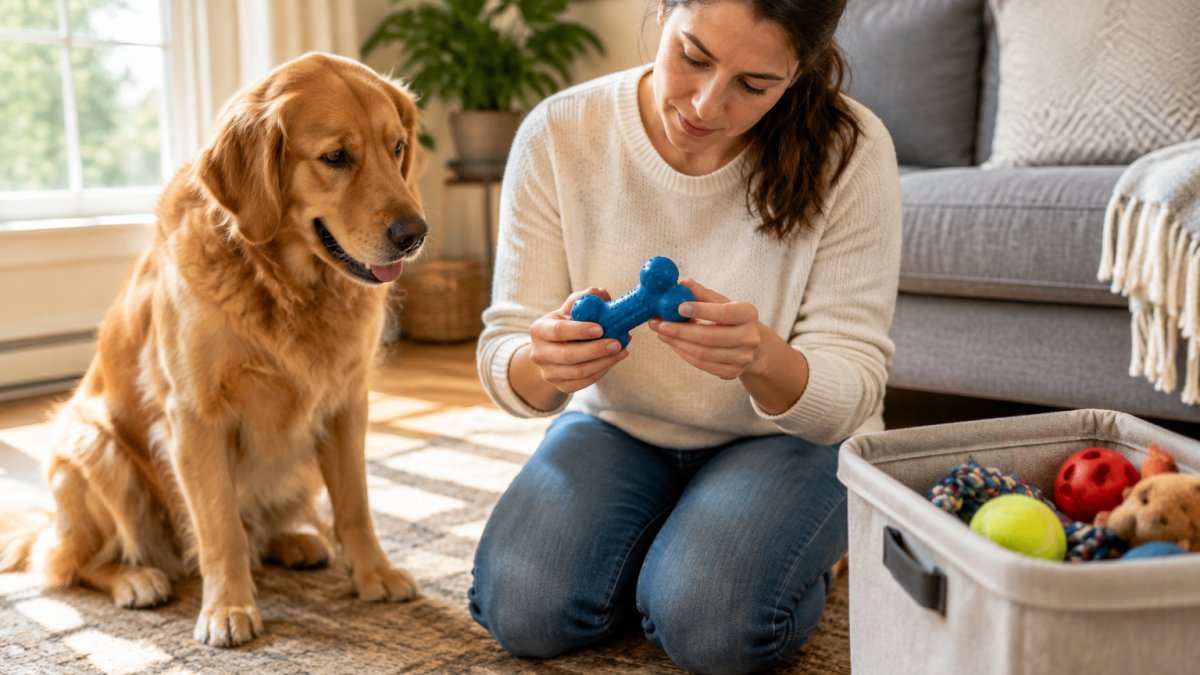
Inspection and supervision prevent most toy injuries, but 'inspect regularly' is not a routine. Make it a repeatable check you run before and after every play session, and a deeper check once a week. The routine matters more than the toy, because no toy is indestructible.
The before-and-after play checklist
Run this quick pass every time a toy comes out and goes away:
- Squeeze and flex it: look for cracks, splits, and soft spots that did not exist before.
- Check every seam and joint: run a thumb along seams, glued eyes, and squeaker housings.
- Test small parts: tug on eyes, bells, squeakers, tags, and rope knots. If a part moves in your hand, it can come off in your pet's mouth.
- Feel the edges: run a finger along chewed edges for sharp or jagged points.
When a toy needs to go
Retire a toy when you spot any of these:
- A rip, hole, or split seam
- A loose or missing part
- Sharp or jagged edges
- A squeaker that has come free
Replace rather than repair. A patched toy is a weak toy, and the next chew can break it open. A common pattern is to rotate toys so each one gets inspected less often but more carefully, and to keep a discard bin next to the toy storage so damaged toys leave the floor immediately.
Supervision rules that actually prevent injury
Supervision means active attention, not just being in the room. Keep high-risk toys, rope, plush, battery toys, and anything with a squeaker, for interactive play only, and put them away when play ends. Leave only solid, one-piece toys down for solo chewing. Multi-pet households need extra care: a toy sized for a large dog is a choking hazard for a small one, so separate toys by pet.
If a toy part is swallowed or a pet is injured
Watch out: a torn seam can let stuffing or a squeaker loose, and a swallowed squeaker can cause an intestinal blockage. Signs that warrant a call to your veterinarian right away include repeated vomiting, gagging, drooling, refusing food, abdominal pain or bloating, straining to defecate, and lethargy after play. Battery ingestion is an emergency, call your vet or an emergency animal hospital immediately and do not wait for symptoms.
Frequently Asked Questions
How do I check if a pet toy is safe?
Run a quick five-point check before the toy goes in the bin. Squeeze it to feel for hard or brittle spots, tug the seams and squeaker, and look for small parts a pet could bite off. Check that the toy is larger than your pet's mouth so it cannot be swallowed, and confirm the label lists non-toxic materials. Skip anything with loose glued-on eyes, exposed battery compartments or paint that flakes when scratched. Repeat this inspection every week, since safe pet toys only stay safe while they are intact.
What makes a dog toy unsafe?
Most unsafe toys share a few traits: parts small enough to swallow, materials that crack into sharp shards, loose seams that release stuffing, and hard surfaces that can chip a tooth. Squeakers and glued-on decorations are common culprits. So are toys sized wrong for the dog, since a toy built for a toy breed can lodge in a larger dog's throat. Battery toys add another risk if the compartment opens. Any toy with a rip, a missing piece or a separated component should come out of rotation immediately.
How often should you replace pet toys?
Replace a toy as soon as it shows damage, not on a fixed calendar. A heavy chewer may destroy a rubber toy in weeks, while a gentle cat may keep a soft toy for months. Check toys weekly and retire any with tears, cracks, exposed filling, missing pieces or loose seams. Washable toys should be cleaned regularly, and food-dispensing toys need rinsing after every use. Keeping a small rotation and inspecting it often is more reliable than guessing at a replacement schedule.
Are battery-operated toys safe for pets?
They can be, with supervision. Dog toys with batteries add motion and sound that keep some pets engaged, but the battery compartment must be screwed shut and impossible to pry open. Never leave a battery toy with a pet unattended, and remove it the moment the casing cracks or the compartment loosens. Check the toy for sharp edges around the battery door, and store spare batteries out of reach. If a pet chews into a battery, call your veterinarian or a pet poison hotline right away.
Choosing safe pet toys comes down to four habits: match the size, match the chew strength, pick non-toxic materials, and inspect before every play. At Walnut Creek Supply, we curate high-quality supplies and share guidance so you can make informed choices for your pet's safety. Our family-owned shop focuses on premium products and educational content to help you avoid common pitfalls. Get started with Walnut Creek Supply and give your pet safer, more enriching play.


