


Durvet Ivermectin Injection 1% for Cattles and Swines
Durvet Ivermectin Injection 1% for Cattles and Swines

Low stock
Regular price
$33.99 USD
Sale price
$33.99 USD
Regular price
Unit price
per
Shipping calculated at checkout.
- Fully secure checkout
- Trusted by thousands
- Rated and reviewed

Want Fast delivery? order by noon to get rolling!
Question about this product?
We're happy to help.
Product Description:
We've got your back! With our live arrival, safe & sound guarantee
Supplier for this item: HardyPaw
Supplier for this item: HardyPaw
Shipping and Return Policies:
Shipping and Return Policies:


Durvet Ivermectin Injection 1% for Cattles and Swines
Injectable Ivermectin for Broad Livestock Parasite Control
Product Description
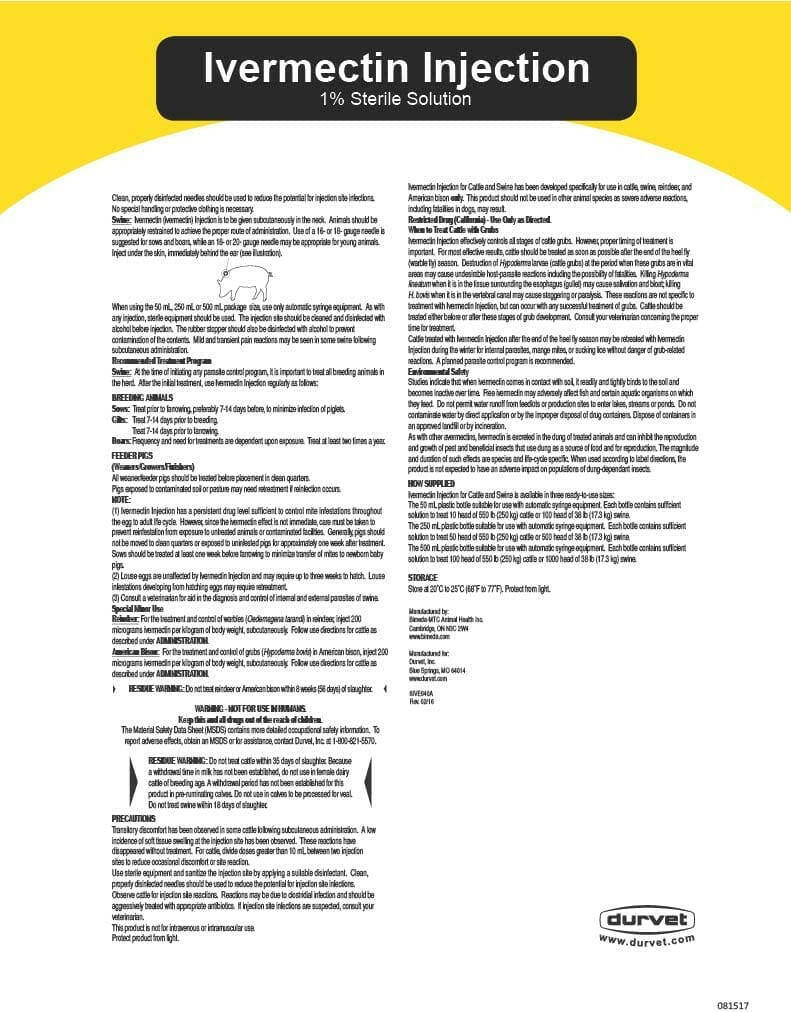
Durvet Ivermectin Injection 1% is a sterile, ready-to-use parasiticide for cattle and swine that treats and controls internal and external parasites. The injectable formula targets key roundworms, lungworms, lice, mange mites, and cattle grubs to support herd health and productivity. Administer Durvet Ivermectin Injection 1% subcutaneously only, following labeled dose rates by species and body weight.
Benefits
- Dual Parasite Control: Treats internal worms and external parasites in cattle and swine.
- Low-Volume Dosing: Delivers labeled dose rates with small injection volumes.
- Cattle Grub Coverage: Controls all stages of cattle grubs with proper timing.
- Clear Dosing Guidance: Weight-based dosing charts support accurate administration.
- Multiple Pack Sizes: Available in multi-dose bottles for routine livestock programs.
Ingredients
Active Ingredient: Ivermectin 1% (10 mg/mL).
Inactive Ingredients: Glycerol formal (40%) and propylene glycol 100% q.s.
How to Use
Dosage & Administration Instructions
- Route Only: Subcutaneous injection only; never intravenous or intramuscular.
- Site Guidance: Inject cattle near the shoulder; swine in the neck behind the ear.
- Dose Accuracy: Base dose on current body weight; do not underdose.
- Clean Technique: Use sterile equipment and disinfect the injection site.
- Dose Splitting: For cattle doses over 10 mL, split between two sites.
Recommended Dosage Chart
|
Species |
Category/Type |
Weight (lb) |
Dose (mL) |
Route |
Notes |
|
Cattle |
- |
220 |
2 |
Subcutaneous |
1 mL per 110 lb (50 kg); Max 10 mL per injection site |
|
Cattle |
- |
330 |
3 |
Subcutaneous |
1 mL per 110 lb (50 kg); Max 10 mL per injection site |
|
Cattle |
- |
440 |
4 |
Subcutaneous |
1 mL per 110 lb (50 kg); Max 10 mL per injection site |
|
Cattle |
- |
550 |
5 |
Subcutaneous |
1 mL per 110 lb (50 kg); Max 10 mL per injection site |
|
Cattle |
- |
660 |
6 |
Subcutaneous |
1 mL per 110 lb (50 kg); Max 10 mL per injection site |
|
Cattle |
- |
770 |
7 |
Subcutaneous |
1 mL per 110 lb (50 kg); Max 10 mL per injection site |
|
Cattle |
- |
880 |
8 |
Subcutaneous |
1 mL per 110 lb (50 kg); Max 10 mL per injection site |
|
Cattle |
- |
990 |
9 |
Subcutaneous |
1 mL per 110 lb (50 kg); Max 10 mL per injection site |
|
Cattle |
- |
1,100 |
10 |
Subcutaneous |
1 mL per 110 lb (50 kg); Max 10 mL per injection site |
|
Swine |
Growing pigs |
19 |
0.25 |
Subcutaneous (neck) |
1 mL per 75 lb (33 kg) |
|
Swine |
Growing pigs |
38 |
0.5 |
Subcutaneous (neck) |
1 mL per 75 lb (33 kg) |
|
Swine |
Growing pigs |
75 |
1 |
Subcutaneous (neck) |
1 mL per 75 lb (33 kg) |
|
Swine |
Growing pigs |
150 |
2 |
Subcutaneous (neck) |
1 mL per 75 lb (33 kg) |
|
Swine |
Breeding animals |
225 |
3 |
Subcutaneous (neck) |
1 mL per 75 lb (33 kg) |
|
Swine |
Breeding animals |
300 |
4 |
Subcutaneous (neck) |
1 mL per 75 lb (33 kg) |
|
Swine |
Breeding animals |
375 |
5 |
Subcutaneous (neck) |
1 mL per 75 lb (33 kg) |
|
Swine |
Breeding animals |
450 |
6 |
Subcutaneous (neck) |
1 mL per 75 lb (33 kg) |
Additional Information
Precautions
- Human Warning: Not for use in humans; keep out of children’s reach.
- Species Limits: Use only in cattle, swine, reindeer, and American bison.
- Dairy Restriction: Do not use in female dairy cattle of breeding age.
- Injection Reactions: Monitor for swelling or infection; treat suspected clostridial infection aggressively.
- Handling and Storage: Protect from light; store 59°F-86°F; use within 60 days of first puncture.
Shipping & Returns
We offer ground, express, priority, and international delivery; see our shipping policy for details.
For return instructions or product concerns, please refer to our detailed refund policy.
Frequently Asked Questions
Q1: What is Durvet Ivermectin Injection 1% used for in cattle and swine?
Ans: Durvet Ivermectin Injection 1% is labeled to treat and control internal and external parasites. In cattle, the label includes gastrointestinal roundworms, lungworms, grubs, sucking lice, and mange mites. In swine, it includes roundworms, lungworms, lice, and mange mites.
Q2: What is the correct dose rate for cattle?
Ans: For cattle, the labeled dose is 1 mL per 110 lb (50 kg) given subcutaneously under loose skin near the shoulder. Each injection site should not exceed 10 mL, and larger doses should be divided between two sites.
Q3: What is the correct dose rate for swine?
Ans: For swine, the labeled dose is 1 mL per 75 lb (33 kg) given subcutaneously in the neck, immediately behind the ear. The label includes dosing examples for growing pigs and breeding animals based on body weight.
Q4: Can Durvet Ivermectin Injection 1% be given intramuscularly or intravenously?
Ans: No. Label precautions state the product is not for intravenous or intramuscular use. Durvet Ivermectin Injection 1% should be administered subcutaneously only, using sterile equipment and appropriate restraint to ensure the correct route and reduce injection-site complications.
Q5: What are the meat withdrawal times after treatment?
Ans: Residue warnings state cattle must not be treated within 35 days of slaughter, and swine must not be treated within 18 days of slaughter. The label also states not to use in calves to be processed for veal.
Q6: Why is the product not for female dairy cattle of breeding age?
Ans: Residue warnings state a milk withdrawal time has not been established for the product, so the label restricts use in female dairy cattle of breeding age. This limitation supports residue compliance and helps producers follow food-safety requirements.
Q7: What side effects or reactions can occur after injection?
Ans: Label precautions note transitory discomfort may occur in some cattle, and soft tissue swelling at the injection site has been observed, typically resolving without treatment. In swine, mild and transient pain reactions may occur following subcutaneous administration.
Q8: When should cattle be treated for grubs to avoid reactions?
Ans: The label states timing is essential for cattle grubs. Treat cattle as soon as possible after the heel fly season ends and avoid treatment when larvae are in vital areas. Treating those stages can trigger undesirable host-parasite reactions.
Q9: What storage and multi-dose bottle rules should be followed?
Ans: Store Durvet Ivermectin Injection 1% at 59°F-86°F and protect from light. Use within 60 days of first puncture and limit punctures to a maximum of 25 times. For larger bottle sizes, automatic syringe equipment is recommended.
-

Live Fish
& more
all types ++ healthy and fast
-

Live
Plants
-

Cultures
& Meds
Bacteria, meds, colony cultures
-

Aquatic
Feed
Live Feed Too!
-

Reef
& more
all types ++ healthy and fast
-

Aquarium
Filtration
Media, Pumps, Parts
-

Aquarium
Features & DecoMedia, Pumps, Parts


-

Bird Cage & Enclosure
Cozy Clouds & Supportive Orthopedic Options
-

Bird Food & Feeds
Live Feed Too!
-

Bird accessories
Chews
& Perches
-

Wild Birds and Outdoor Aviary
-

Everything for Birds


-

Cat
Posts
& Pads
Scratch Away!
-

Cat
Shelter
Beds and Hideouts
-

Cat
Toys
Stimluate, Enrichment
-

Cat
Food
Delicious, Whole
-

Cat
Clothing
& CostumesCozy and Cute


-

Critter Enclosures
-

Critter
Bedding -
Critter
Feed
-

Critter
Toys &
Accessories


-

Dog Beds
Cozy Clouds & Supportive Orthopedic Options
-

Dog Clothing & Outerwear
-

Dog Leash, Harness, Tag
Great Toys And Gift Sets Await!
-

Dog Food
Wholesome & Healthy Foods & Treats
-

Dog Treats
Wholesome & Healthy Foods & Treats
-

Dog Toys
Great Toys And Gift Sets Await!


-

Terrariums
Moss and bedding,vines and branches, logs, bark sections, cork, waterfall supplies, dividers, UV lights, Heat lamps, Basking Lights, heated rocks, Foggers, Misters, Aerators and more!
-

Toys and accessories
All your Herp has been hoping for! ++ hammocks hides feeders and more
-

Garden
Snails
learn More about your creatures -

Real Feed For your Reptiles & Amphbians
Foods For Reptiles & Amphibians, Live Feed Too!
-

Frogs
Care & Habitat, Live Feed, Live Feed Farm, and Other Specialty Items
-

Turtles
Care & Habitat, Whole Natural Foods, Basking, Docks, Care, Filtration, Supplements, Feeds, Medicine, and more!
-

Snakes
Habitat, Care, Live Feed Farming, and Other Accessories
-

Lizards
From Anole to Monitors, we've got the goods for their care
-

Care Guides
learn More about your creatures -

Organic Terrarium Supplies
Moss and bedding,vines and branches, logs, bark sections, cork, waterfall supplies, dividers, UV lights, Heat lamps, Basking Lights, heated rocks, Foggers, Misters, Aerators and more!
-

Hermit Crab
Supplies
learn More about your creatures


Jump to:
Other Pet Types
-

Pet Snails
all the supplies for everyones favorite starter pet, the Garden Snail! The...
Pet Snails
124 products -

Reptiles & Amphibians
Welcome to We Love Herps – Your Habitat Hub for Reptiles &...
Reptiles & Amphibians
713 products -

Reef Supplies
Reef keeping is one of the most rewarding — and demanding —...
Reef Supplies
78 products


Walnut Creek Pet - WCP Cats!
-

48 Hour Starter Plan for New Kitten Owners: Checklist and Vet Timeline
Prepare for adoption: supplies checklist, vet schedule, and a starter...9 min readen -

Cat Nutrition Guide: Building a Species-Appropriate Diet From the Ground Up
The Obligate Carnivore Foundation The phrase "obligate carnivore" means that...2 min readCare Guide -

Cat Dental Health: Why It Matters, What to Watch For, and How to Help at Home
How Common and How Serious Periodontal disease affects an estimated...2 min readCare Guide -

Indoor Cat Enrichment: A Simple Weekly Plan That Keeps Cats Happy and Out of Trouble
Boredom is the root cause of most indoor cat behavior...2 min readCare Guide -

Freeze Dried Cat Food: What It Is, Why It Matters, and How to Feed It
Cats are obligate carnivores. Their bodies are designed to derive...2 min readCare Guide -

Why Your Cat Needs a Water Fountain (And How to Choose the Right One)
Most cat owners do not realize their cat is chronically...3 min readCare Guide -

Kitten Nutrition Plan: 3 Age Based Feeding Stages for New Owners
Vet backed age based kitten nutrition with clear meal schedules...13 min readen -

Why Cardboard Boxes Are So Appealing to Cats
If you have ever brought home a package only to...3 min readcat -

Why Cats Need Vertical Space at Home
Cats do not experience a home only at floor level....3 min readcat -

Why Window Watching Is Healthy Enrichment for Indoor Cats
Cats may spend hours perched by a window, quietly watching...3 min readcat -

Cat Clothing & Costumes: Cute, Yes—But Here’s How to Keep It Safe and Stress-Free
Cute should never come at the cost of comfortSome cats...1 min readCat -

Cat Harness & Leash Basics: A Safe, Stress-Low Way to Explore Outdoors
Yes—some cats love walks (when it’s done right)Harness training can...1 min readcat enrichment -

What’s Changed in Cat Vet Care (2021–2026): Vaccines, Parasite Prevention & a More Personalized Approach
Cat Care Has Changed — In a Good Way (2021...3 min readcat health -

Cat Wellness Trends 2026: Freeze-Dried Raw, Gut Health & Clean Ingredients-Whats Worth It?
The Big Shift: Wellness Is Getting More Practical In 2026,...3 min readcat wellness -

The Natural Cat Nutrition Playbook: Fresh-First Feeding for Every Life Stage
The “Why” Behind Natural Cat Nutrition Cats aren’t small dogs—they’re...3 min readcat nutrition -

Stop the “Bored Cat” Cycle: A Simple Toy Rotation Plan That Boosts Enrichment
Most cats don’t need more toys—they need a better systemIf...1 min readcat enrichment -

Cat Food Basics: A Natural-First Plan for Picky Eaters (Without Overcomplicating It)
Cat nutrition doesn’t have to be a guessing gameIf you’ve...1 min readcat food -

Cat Caves & Bedding: The Cozy Setup That Reduces Stress (And Helps Cats Sleep Better)
Comfort is a health tool for catsCats don’t just like...1 min readcat bedding


Articles from our team - WCP Blogs!
-

Dog Owners: 5 Checks to Spot Misleading Dog Food Labels in the Aisle
Use five quick aisle checks to read dog food labels: nutritional adequacy, named protein, guaranteed analysis, calories, and red flag...12 min readdog food labels -

Prevent Dog and Cat Fights: 3-3-3 Rule and 5–10 Minute Sessions
Follow a shelter backed, phased plan—separation, scent swapping, short barrier meetings and the 3-3-3 rule—to build calm dog and cat...11 min readClean Label -

Start Your First 72 Hours Right: New Dog Checklist for Adopters
Checklist for adopters to start a new dog right: prioritize decompression, book a vet visit within 48 to 72 hours,...14 min readen -

95–97% vs 60–75%: Vet-Backed Freeze-Dried or Dehydrated Dog Food for Dog Owners
Vet-backed, practical comparison of freeze-dried (95–97% nutrient retention) vs dehydrated (60–75%). Learn cost, prep time, safety, and when to use...9 min readdehydrated dog food vs freeze dried -

Dog Owners: Vet Supervised 8 to 12 Week Dog Allergy Diet Trial
Vet-first steps to confirm a dog food allergy: run a strict 8 to 12 week elimination diet, avoid treats and...12 min readdog allergy diet -

Dog Owners: 15 Minute DIY Paw Balm and Vet Safe Wax vs Butter Use
Learn when to use wax vs butter, make a 15 minute DIY paw balm, and shop vet safe, lick safe...11 min readdog paw balm -

Pumpkin for Dogs: 4 Vet Recommended Doses by Dog Size
Veterinarian advice on feeding plain canned pumpkin safely. Find doses by dog size, simple prep rules, and when to call...7 min readen -

Veterinary Take on Raw Dog Food: Why 95% of DIY Plans Fail for Dog Owners
Evidence first veterinary take on raw dog food: why 95% of DIY recipes fail, the pathogen and nutrient risks, and...11 min readen -

A to Z Safety Checklist for Plants Toxic to Dogs
A quick A to Z safety checklist for plants toxic to dogs, six urgent steps to take in the first...12 min readen -

37 Nutrient Parameters: What U.S. Dog Owners Must Check on AAFCO Labels
Learn how AAFCO and FDA rules show up on U.S. dog food labels, how to read the nutritional adequacy statement,...6 min readaafco dog food standards -

Dog Anxiety: Natural Approaches That Actually Calm Stressed Dogs
Understanding Dog Anxiety Anxiety in dogs manifests differently depending on the trigger and the individual dog. Generalized anxiety shows up...2 min readAnxiety -

Puppy Care Essentials: Nutrition, Socialization, and the First-Year Checklist
Nutrition: The Foundation Is Laid Early Puppies grow rapidly — many breeds double or triple their birth weight in the...2 min readCare Guide -

Senior Dog Care: Nutrition, Joint Support, and the Vet Visits That Actually Matter
When Is a Dog "Senior"? The general threshold is 7 years for most breeds, but this varies significantly by size....2 min readCare Guide -

How to Use Freeze Dried Treats for Dog Training: High-Value Rewards That Actually Work
Not all training treats are created equal, and the difference between a mediocre reward and a high-value one is the...3 min readCare Guide -

AirTag Dog Collar: How GPS and Tracking Technology Keeps Dogs Safe
Every dog owner knows the cold drop in the stomach when a dog slips a leash, bolts through a cracked...2 min readCare Guide -

Lick Mats for Dogs: How This Simple Tool Reduces Anxiety and Slows Feeding
The lick mat is one of the most underrated enrichment tools in a dog owner's kit. Inexpensive, easy to use,...2 min readCare Guide -

Why Paw Care Matters: A Guide to Dog Paw Cleaners, Balms, and Between-Walk Maintenance
Your dog's paws are the interface between the outside world and your home. Every walk deposits pollen, pesticides, road salt,...2 min readCare Guide -

How to Keep Your Dog Cool in Summer: Dog Cooling Mats and Hot-Weather Essentials
Heat stress in dogs escalates faster than most owners expect. Dogs cannot sweat through their skin the way humans do...3 min readCare Guide -

Why Dogs Need “Consent Checks” During Handling
Most dog owners handle their dogs all day without thinking twice: petting, hugging, wiping paws, clipping nails, checking ears, putting...3 min read -

Why Dogs Need a “Yes Space” at Home
If you’ve ever found yourself saying “no” all day—no jumping, no chewing, no barking at the window, no stealing socks—you’re...3 min read -

Why Dogs Need a “Decompression Walk” After Busy Days
Some dogs bounce back quickly after a hectic day. Others come home from a busy environment and act “wired,” restless,...3 min read -

Why Some Dogs Love Carrying Toys Around the House
Some dogs do not just play with toys. They proudly parade them from room to room, carry them during greetings,...3 min readdog-blog-posts -

Why Some Dogs Love Shredding Toys and Cardboard
If your dog seems determined to tear apart toys, boxes, or paper, it can be frustrating at first. But shredding...3 min readdog-blog-posts -

Why Sniffing Walks Matter for Dogs
For many dog owners, a walk is all about movement. The goal is often to cover distance, burn energy, and...3 min readdog-blog-posts


